
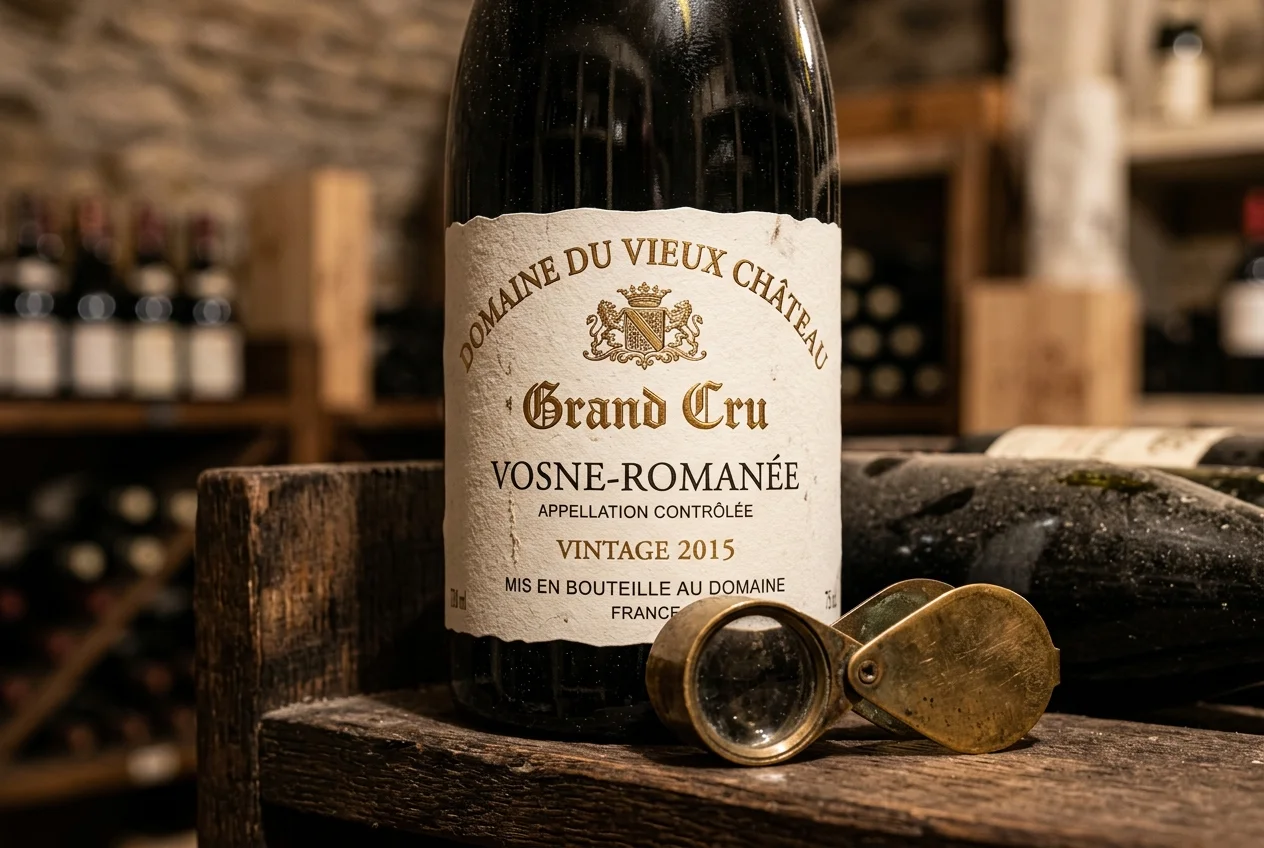
What the law makes a label say
Before it is a piece of design, a wine label is a list of statements governed by law. In the European Union, the compulsory particulars include the category of the product (wine, for example), the protected designation of origin or geographical indication with its name where the wine has one, the actual alcoholic strength, the provenance and the name of the bottler. For wine produced from 8 December 2023 onwards, a list of ingredients and a nutrition declaration are also required.
In the United States, federal rules set out the mandatory label information, including the brand name, the class or type of wine, the name and address of the bottler, the net contents, the alcohol content and, where it applies, a sulfite declaration.
Four statements are worth reading in order on almost any bottle: the place of origin, the grape variety and vintage, the alcohol figure, and the name of whoever bottled the wine. Each one points to a rule, and the rule, not the typography, tells you what the words guarantee. The sections below take the four clues one at a time, then the small print on sulphites and organic logos, and end with two practice exercises.
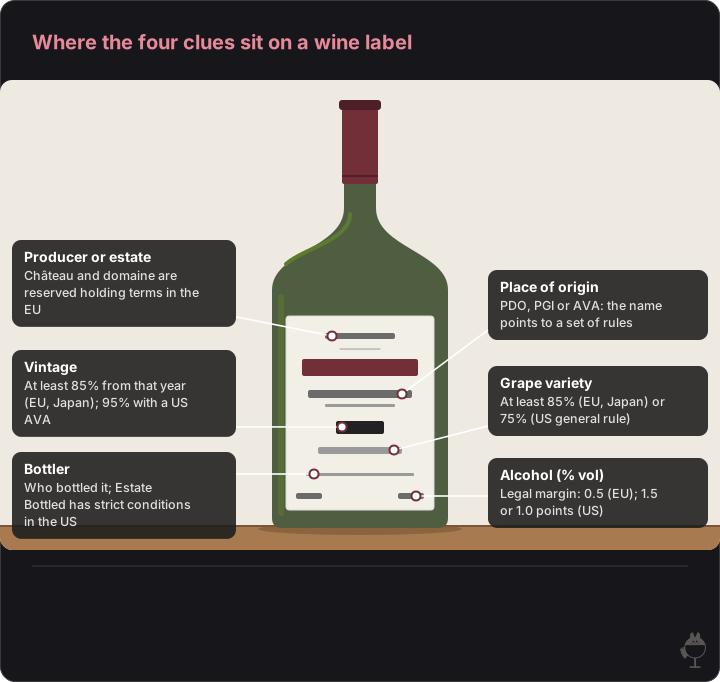
A generic bottle and front label, drawn without words: each bar stands for one statement. The callouts name the statement and the rule behind it; the figures are the legal minimum shares and alcohol margins explained in the text. Where each statement sits varies from bottle to bottle; shapes and colours are illustrative.
Read the figure as text
- Producer or estate — Château and domaine are reserved holding terms in the EU
- Place of origin — PDO, PGI or AVA: the name points to a set of rules
- Vintage — At least 85% from that year (EU, Japan); 95% with a US AVA
- Grape variety — At least 85% (EU, Japan) or 75% (US general rule)
- Bottler — Who bottled it; Estate Bottled has strict conditions in the US
- Alcohol (% vol) — Legal margin: 0.5 (EU); 1.5 or 1.0 points (US)
Clue 1: the place of origin — PDO, PGI, AVA and Japan Wine
In the EU, a wine with a protected designation of origin (PDO) must be made from grapes that come exclusively from the defined area, while a protected geographical indication (PGI) requires at least 85% of the grapes from its area. Each PDO has a product specification, called a cahier des charges in France and a pliego de condiciones in Spain, which sets the permitted grape varieties and, depending on the appellation, rules such as yields and planting density.
This is why many European labels lead with a place and may not name a grape at all. A place name does not necessarily stand for one variety: the Rioja specification lists Tempranillo, Garnacha, Graciano, Mazuelo and Maturana Tinta among the red varieties it authorises, so a red Rioja may be a blend.
In the United States, an American Viticultural Area (AVA) is a grape-growing region defined by its boundaries. To name an AVA on the label, at least 85% of the wine must come from grapes grown in that area; a state or county name requires at least 75%. These federal rules concern where the grapes were grown: they contain no list of permitted varieties and no yield limit.
In Japan, the National Tax Agency’s labelling standard reserves the term Japan Wine for wine made in Japan from grapes grown only in Japan. A place name may appear on a Japan Wine label only when at least 85% of the grapes come from that place and the wine is made there.
Classification words: what they do and do not guarantee
Words that sound like grades are not all the same kind of term. Some are defined by an appellation’s own specification; others record a historical ranking of estates.
‘Grand Cru Classé en 1855’ refers to the ranking of Bordeaux châteaux drawn up in 1855; Château Calon-Ségur in Saint-Estèphe, for example, describes itself as ranked third classified growth in 1855. The ranking belongs to the estate and lays down no vineyard rules of its own. The rules that bind a classified Pauillac are those of the AOC Pauillac specification, which apply to every Pauillac, classified or not: the authorised varieties are Cabernet Franc, Cabernet Sauvignon, Carménère, Côt (Malbec), Merlot and Petit Verdot; the yield is set at 57 hL/ha with a cap of 63 hL/ha; and vines must be planted at a density of at least 7,000 per hectare.
Other terms are ageing categories. In Rioja, Crianza, Reserva and Gran Reserva are traditional terms defined by minimum ageing periods. Read a classification word as information about the rules a wine had to meet, or about the history of an estate, rather than as a measured score.
Clue 2: grape variety and vintage — the 85% and 75% rules
A grape name on a label is a promise about proportions, and the proportion depends on the law. In the EU, a wine may name a single variety only if at least 85% of it comes from that variety; if two or more varieties are named, together they must make up 100% of the wine and be listed in descending order of proportion. A vintage year requires at least 85% of the grapes to have been harvested in that year.
US federal rules are looser on grapes and, when an AVA is named, stricter on vintage. A varietal name generally requires at least 75% of the wine to come from that variety, and such a label must also carry an appellation of origin. A vintage date requires at least 95% of the wine from grapes harvested in that year when the appellation is an AVA, and at least 85% for other appellations such as a state or a county.
A Japan Wine follows the same 85% threshold for both: at least 85% of the named variety, and at least 85% of grapes harvested in the stated year.
In practice, a bottle labelled Cabernet Sauvignon may contain up to 15% of other grapes under the EU rule and up to 25% under the general US rule. If you want the exact blend, look at the back label or the producer’s technical sheet, where it may be given.
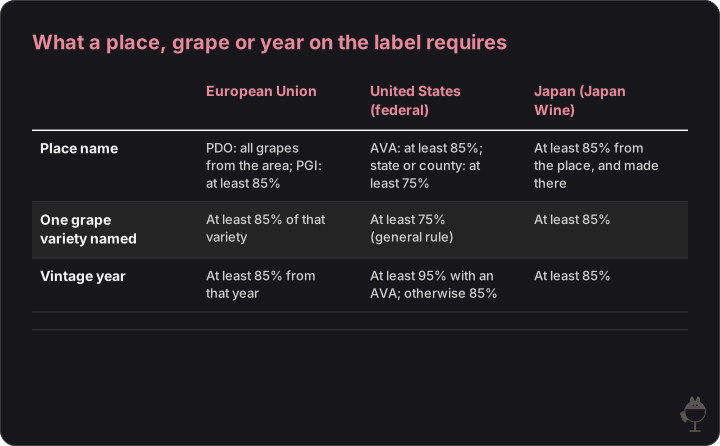
Minimum shares of the grapes required before a place, a single grape variety or a vintage may appear on the label. The US figures are federal rules; Japan’s apply to wines labelled Japan Wine.
Read the figure as text
| European Union | United States (federal) | Japan (Japan Wine) | |
|---|---|---|---|
| Place name | PDO: all grapes from the area; PGI: at least 85% | AVA: at least 85%; state or county: at least 75% | At least 85% from the place, and made there |
| One grape variety named | At least 85% of that variety | At least 75% (general rule) | At least 85% |
| Vintage year | At least 85% from that year | At least 95% with an AVA; otherwise 85% | At least 85% |
Clue 3: the alcohol figure and its legal tolerance
The alcohol figure is a declared value rather than an exact measurement, and each legal system allows a margin. In the EU, the actual alcoholic strength is shown in % vol, and the analysed value may differ from the label by no more than 0.5% vol. A wider margin of 0.8% vol applies to some products, including sparkling wines, liqueur wines and PDO or PGI wines stored in bottle for more than three years. A still wine labelled 13.5% vol therefore contains between 13.0% and 14.0%.
US federal rules allow more room: plus or minus 1.5 percentage points for wines of 14% or less, and plus or minus 1.0 point for wines over 14%. The tolerance may not carry a wine across the 14% line in either direction. A wine labelled 13.5% may therefore contain anywhere from 12.0% to 14.0%; one labelled 14.0%, from 12.5% to 14.0%; and one labelled 14.5%, more than 14.0% and up to 15.5%. For wines of 14% or less, the words ‘table wine’ or ‘light wine’ may even take the place of the figure.
The practical lesson is to compare bottles with care. Two labels half a degree apart may describe wines of the same strength, and the same printed figure allows a different range in Europe and in the United States.
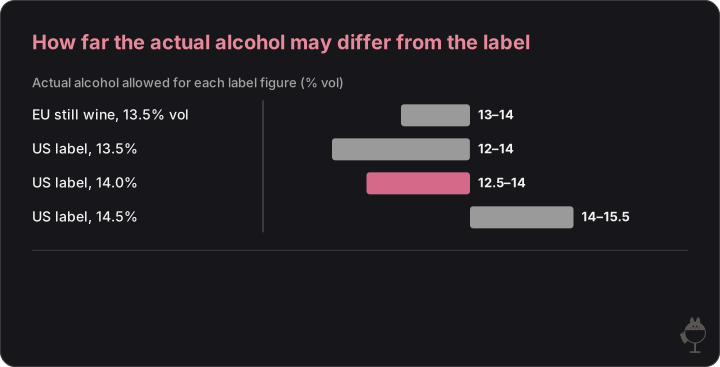
Each bar spans the actual strengths that the stated figure permits for a recently bottled still wine. In the US the tolerance cannot carry a wine across the 14% line, so a 14.0% label means 14.0% at most and a 14.5% label means more than 14.0%.
Read the figure as text
Actual alcohol allowed for each label figure (% vol)
- EU still wine, 13.5% vol: 13–14 % vol
- US label, 13.5%: 12–14 % vol
- US label, 14.0%: 12.5–14 % vol
- US label, 14.5%: 14–15.5 % vol
Clue 4: who bottled it — château, domaine and Estate Bottled
An EU label must name the bottler, and some words go further. Under EU rules, terms that refer to a holding, château and domaine among the French ones, are reserved for PDO and PGI wines made exclusively from grapes harvested in that holding’s own vineyards, with the winemaking carried out entirely on the holding. A statement such as ‘mis en bouteille au château’ or ‘mis en bouteille au domaine’ therefore ties the grapes, the winemaking and the bottling to one named estate.
When a label simply names a bottler, ‘mis en bouteille par’ followed by a company name, it tells you who took responsibility for bottling. It does not by itself tell you where the grapes were grown; the appellation does that.
In the United States, ‘Estate Bottled’ may be used only when the bottling winery is located in the labelled AVA, grew all the grapes on land it owns or controls within that AVA, and crushed, fermented, finished, aged and bottled the wine in a continuous process without the wine leaving its premises. A label that says Estate Bottled must therefore also show an AVA.
Neither term is a quality grade. Both describe control of the chain from vineyard to bottle, which tells you who is answerable for the wine.

 AI
·
Front label and back label
Image: Maison Apéro (generated image) · Maison Apéro original
Small print: sulphites and the organic logo
Sulphur dioxide and sulphites are on the EU list of allergens, and their declaration becomes compulsory above 10 mg/L of total sulphur dioxide. US rules require ‘Contains sulfites’ when the wine contains 10 parts per million or more. In both cases the trigger is the concentration measured in the wine, not whether sulphites were added, so the statement alone does not tell you how the wine was made.
The EU organic logo shows that a wine was certified under the EU organic regulation, whose rules cover both the vineyard and the winemaking practices allowed for organic wine. Other environmental logos belong to schemes with their own rules; read them as claims made under those schemes rather than as legal terms.
Exercise 1: a Rioja label that names no grape
Question
A Spanish label reads: ‘Rioja · Denominación de Origen Calificada · Gran Reserva · 2017’. No grape variety appears. Explain (1) why no grape needs to be named, and where you would find which grapes the wine may contain and which it does contain; (2) what the year guarantees; and (3) what kind of term Gran Reserva is.
Model answer
(1) The label leads with a protected designation of origin, and naming a variety is optional. The Rioja specification lists the authorised varieties, with Tempranillo, Garnacha, Graciano, Mazuelo and Maturana Tinta among those for red wine, so the wine may be a blend. The actual blend is found in the producer’s technical information: CVNE’s technical sheet for its Cune Gran Reserva 2017, for example, gives 85% Tempranillo, 10% Graciano and 5% Mazuelo. (2) Under EU rules, at least 85% of the grapes were harvested in 2017. (3) Gran Reserva is an ageing category that the Rioja specification defines by minimum ageing periods; it describes how the wine was aged, not a ranking of its vineyard.
Mark scheme (10 marks)
- Identifies the PDO, explains that the appellation rules list the permitted varieties, and points to the technical sheet for the actual blend (4 marks)
- States the EU rule that at least 85% of the grapes come from the stated year (3 marks)
- Explains Gran Reserva as an ageing term defined by the specification, not a vineyard ranking (3 marks)
Exercise 2: a Napa Valley label and a Pauillac label
Question
Compare two recently bottled wines. Label A: ‘Napa Valley · Cabernet Sauvignon · Estate Bottled · Alc. 14.5% by vol.’ Label B: ‘Pauillac · Appellation Pauillac Contrôlée · Grand Cru Classé en 1855 · Mis en bouteille au château · 13.5% vol’. Explain (1) which rules decide the grapes in each wine, (2) what each bottling statement requires, and (3) within what range the actual alcohol of each wine must lie.
Model answer
(1) Label A: under the general US rule at least 75% of the wine must be Cabernet Sauvignon, and at least 85% must come from grapes grown in the Napa Valley AVA; the AVA rules set no permitted varieties and no yield limit. Label B: the AOC Pauillac specification allows only Cabernet Franc, Cabernet Sauvignon, Carménère, Côt (Malbec), Merlot and Petit Verdot, sets the yield at 57 hL/ha with a cap of 63 hL/ha, and requires at least 7,000 vines per hectare; the 1855 ranking adds no vineyard rule of its own. (2) Estate Bottled: the winery is in the Napa Valley AVA, grew all the grapes on land it owns or controls there, and made and bottled the wine in a continuous process on its own premises. Mis en bouteille au château: the château term requires grapes exclusively from the estate’s own vineyards and winemaking entirely on the estate. (3) Label A: more than 14.0% and up to 15.5%, because the US tolerance above 14% is 1.0 point and the tolerance may not take the wine to 14% or below. Label B: from 13.0% to 14.0% vol, because the EU tolerance is 0.5% vol.
Mark scheme (10 marks)
- Contrasts the US varietal and AVA percentages with the AOC list of varieties, yield and planting density (4 marks)
- States the conditions for Estate Bottled and for the château term (3 marks)
- Works out both alcohol ranges, including the 14% line (3 marks)
Place of origin
- Find the PDO, PGI, AVA or Japan Wine place name
- Look up the specification or boundary behind it
- Note what it fixes: area, grapes, yields
Grape and vintage
- Read the variety and the year, if shown
- Apply the threshold: 85% in the EU and Japan, 75% for a US grape name
- Look for the exact blend on the back label or technical sheet
Alcohol
- Read the % vol figure
- Apply the tolerance: 0.5 (EU), 1.5 or 1.0 points (US)
- Compare bottles with that margin in mind
Bottler
- Find who bottled the wine
- Look for a holding term or Estate Bottled
- Identify who controlled the chain from vineyard to bottle
Frequently asked questions
How accurate is the alcohol figure on a wine label?
It is a declared value with a legal margin. In the EU the analysed strength may differ from the label by no more than 0.5% vol (0.8% vol for some products, such as sparkling wines). In the US the margin is 1.5 percentage points for wines of 14% or less and 1.0 point for wines over 14%, and it may not move a wine across the 14% line.
What do ‘mis en bouteille au château’ and ‘Estate Bottled’ mean?
In the EU, holding terms such as château and domaine are reserved for PDO or PGI wines made only from grapes of that holding’s vineyards, with all the winemaking on the holding. In the US, Estate Bottled means the winery is in the labelled AVA, grew all the grapes on land it owns or controls there, and made and bottled the wine on its premises in a continuous process.
Why does a wine label say ‘contains sulphites’?
Sulphites are an allergen that must be declared. The EU requires the statement above 10 mg/L of total sulphur dioxide and the US at 10 parts per million or more. The trigger is the measured concentration, so the statement does not show whether sulphites were added.
How much of a grape must a wine contain to name it on the label?
At least 85% in the EU and for Japan Wine. Under the general US federal rule the minimum is 75%. If an EU label names two or more varieties, together they must make up 100% of the wine.
Sources
- EUR-Lex — Regulation (EU) No 1308/2013, common organisation of the markets (wine: PDO and PGI definitions, compulsory labelling particulars)
- EUR-Lex — Regulation (EU) 2021/2117 (ingredients list and nutrition declaration for wine produced from 8 December 2023)
- EUR-Lex — Commission Delegated Regulation (EU) 2019/33 (wine labelling: alcohol tolerance, vintage, grape variety, holding terms)
- EUR-Lex — Regulation (EU) No 1169/2011 on food information to consumers, Annex II (sulphur dioxide and sulphites)
- EUR-Lex — Regulation (EU) 2018/848 on organic production (including the rules for organic wine)
- eCFR — 27 CFR 4.23 Varietal (grape type) labeling
- eCFR — 27 CFR 4.25 Appellations of origin (AVA, state and county)
- eCFR — 27 CFR 4.26 Estate bottled
- eCFR — 27 CFR 4.27 Vintage wine
- eCFR — 27 CFR 4.32 Mandatory label information (including the sulfite declaration)
- eCFR — 27 CFR 4.36 Alcoholic content (tolerances and the 14% line)
- eCFR — 27 CFR 9.23 Napa Valley (viticultural area)
- INAO — Cahier des charges de l’appellation d’origine contrôlée Pauillac (varieties, yield, planting density)
- Consejo Regulador DOCa Rioja — Pliego de condiciones de la Denominación de Origen Calificada Rioja (2023)
- Château Calon-Ségur — The 1855 classification
- CVNE — Cune Gran Reserva 2017 technical sheet
- National Tax Agency (Japan) — Labelling standard for fruit wines (Japan Wine)


