Why your own notes come first
What we see can change how we describe what we smell. In a study published in Brain and Language in 2001, Morrot, Brochet and Dubourdieu gave a panel of 54 tasters a white wine that had been coloured red with an odourless dye; the tasters described its smell with words used for red wine. The colour, not the aroma, steered the description.
A score or a review can work in a similar way: it gives you words before you have found your own. Formal sensory analysis does not take the taster’s perception for granted: it sets general conditions for running tests and relies on a selected, trained tasting panel (OIV).
The method in this article is simple: look, smell and taste in a fixed order, write each observation down, and only then read what others have written. The sections below explain what each observation can tell you, and where common rules of thumb go further than the evidence.
Appearance: clarity, intensity of colour and the tears on the glass
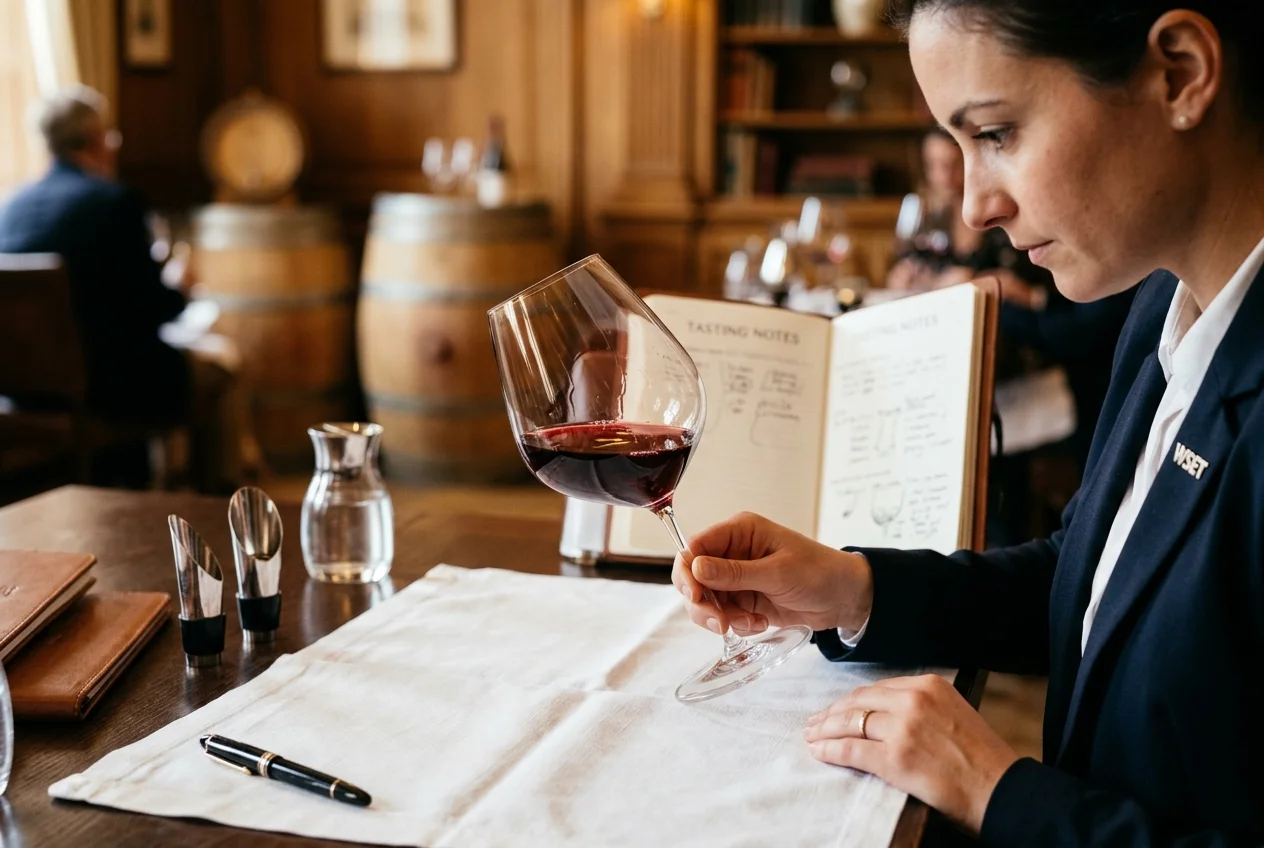
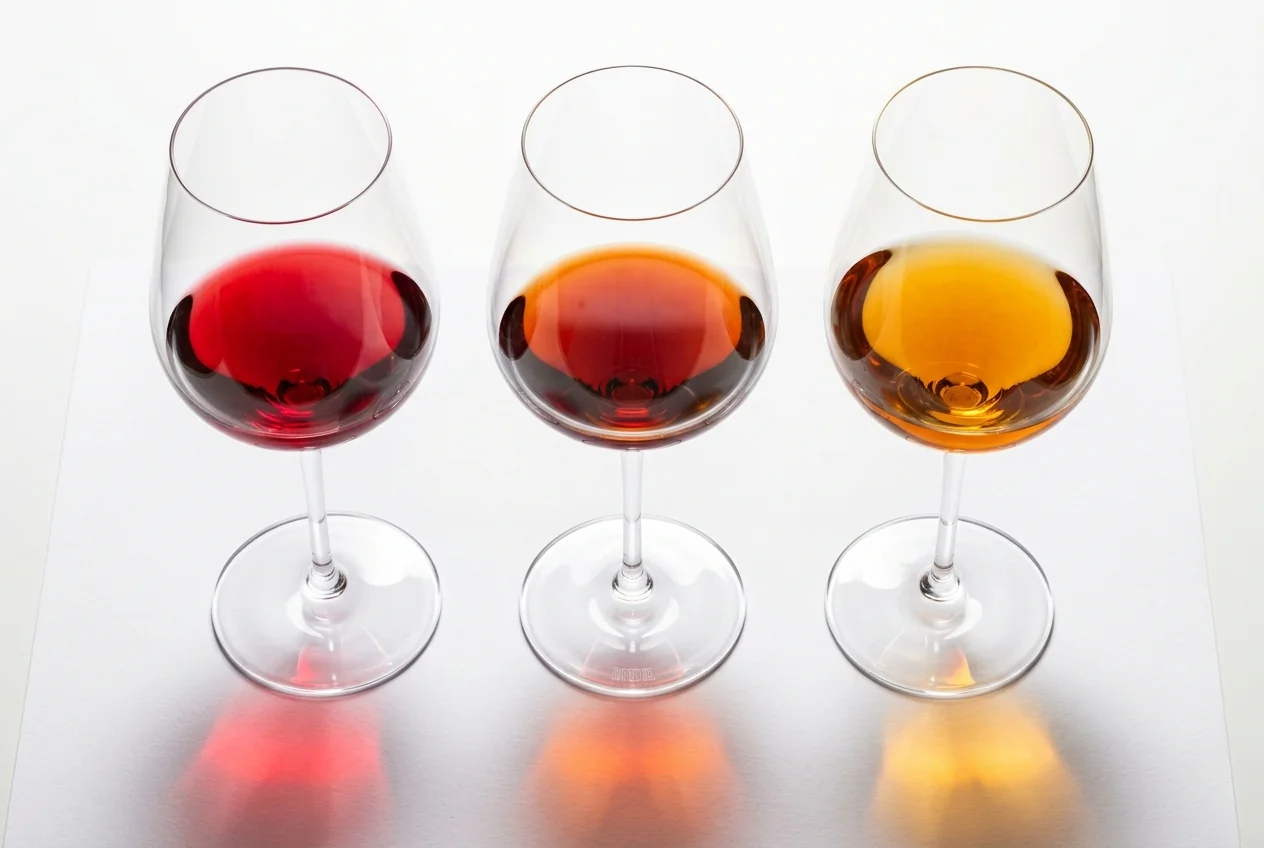
Tilt the glass over a white napkin or sheet of paper, so that you look through a thin layer of wine at the edge and a thick layer at the centre. Note clarity first (clear or hazy), then the intensity of colour at the core, then the hue at the rim (next section).
In red wine, colour comes mainly from anthocyanins and the pigments derived from them. Intensity of colour is therefore an observation about these pigments, not a measure of quality: write it down as an observation rather than a verdict.
The tears, or legs, that run down the inside of the glass are a fluid-dynamics effect. In the thin film of wine on the glass, ethanol evaporates faster than water, and because ethanol has a lower surface tension than water, the difference in surface tension pulls wine up the wall until it falls back as drops (the Marangoni effect; Venerus and Nieto Simavilla, Scientific Reports, 2015). The tears form because of the alcohol and are not a sign of quality.
So treat the tears as a sign that alcohol is evaporating, not as a reading of sugar, glycerol or quality. For alcohol, the palate and the label are better guides (section 5).
 AI
·
Colour against white
Image: Maison Apéro (generated image) · Maison Apéro original
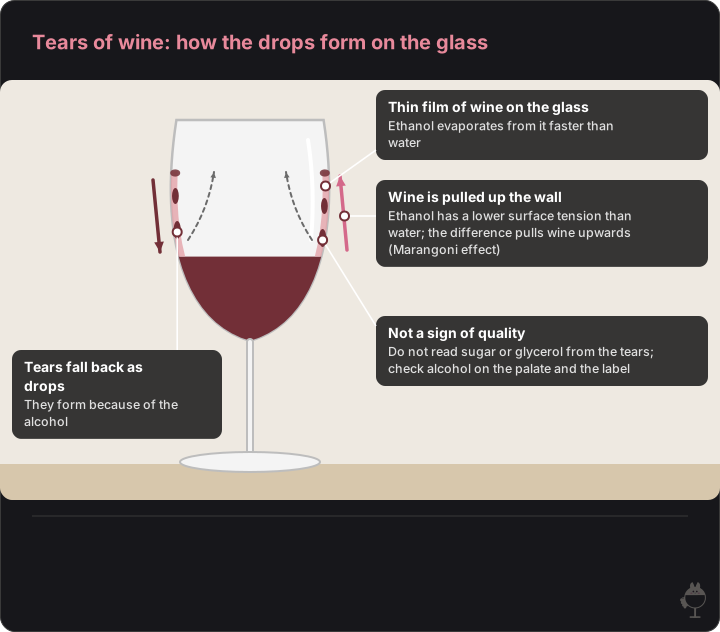
A glass of wine seen from the side after swirling. The arrows follow the flow: ethanol evaporates from the thin film, wine is pulled up the wall, and it falls back as tears. Shapes and colours are illustrative.
Read the figure as text
- Thin film of wine on the glass — Ethanol evaporates from it faster than water
- Wine is pulled up the wall — Ethanol has a lower surface tension than water; the difference pulls wine upwards (Marangoni effect)
- Not a sign of quality — Do not read sugar or glycerol from the tears; check alcohol on the palate and the label
- Tears fall back as drops — They form because of the alcohol
The rim: how red wine colour moves from purple and ruby to garnet
At the rim the layer of wine is thinnest, so changes of hue are easiest to see there. Young red wine is purple or ruby. During maturation and ageing, the concentration of the grape’s monomeric anthocyanins falls, and more stable pigments form, mainly pyranoanthocyanins and polymeric anthocyanins. These structural changes move the colour towards the garnet of aged wine (He and colleagues, Molecules, 2012).
Read the rim as a direction of travel, not as a date. A purple or ruby rim points to an early stage of this change, a garnet rim to a later one. This is a change in pigment structure, not a clock, so do not turn the hue into a number of years.
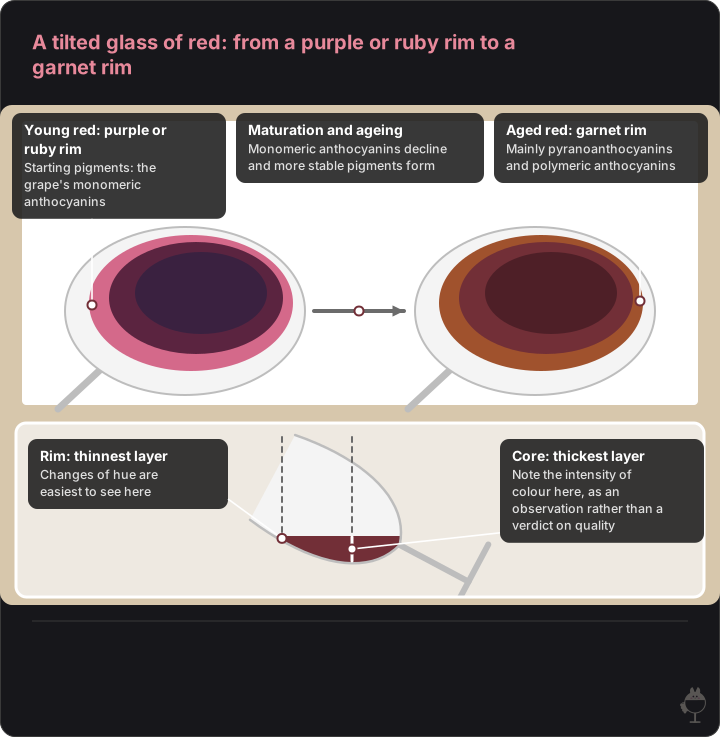
Top: a young red and an aged red, each tilted over white paper and seen from above. Bottom: the same tilt seen from the side; the wine is thinnest at the rim and thickest at the core. The sequence describes pigment chemistry, not a number of years. Shapes and colours are illustrative.
Read the figure as text
- Young red: purple or ruby rim — Starting pigments: the grape's monomeric anthocyanins
- Maturation and ageing — Monomeric anthocyanins decline and more stable pigments form
- Aged red: garnet rim — Mainly pyranoanthocyanins and polymeric anthocyanins
- Rim: thinnest layer — Changes of hue are easiest to see here
- Core: thickest layer — Note the intensity of colour here, as an observation rather than a verdict on quality
Aroma: ask where each smell comes from
Smell the wine first without swirling, then after swirling, and write down what you find in plain words. Then sort each note by where it most likely comes from: the grape, the cellar or time.
For the grape layer, chemistry offers some clear anchors. Methoxypyrazines are linked to bell pepper, asparagus or pea notes, and the sesquiterpene rotundone is the compound responsible for black pepper aroma (Robinson and colleagues, American Journal of Enology and Viticulture, 2014). Other groups of aroma compounds include monoterpenes, esters and volatile sulfur compounds such as thiols.
The cellar layer covers what fermentation, malolactic conversion, lees contact and oak add. The time layer covers slow changes during ageing in barrel and bottle. Both are wide subjects beyond the scope of this article. For independent tasting, the useful habit is to ask, for each note, which layer it belongs to, and to write “not sure” when you cannot tell.
Palate: separate taste, touch and the warmth of alcohol
On the palate, keep separate lines for what you taste (sweetness, acidity, bitterness) and what you feel: a drying grip, the warmth of alcohol, and the weight of the wine, often called body.
Alcohol and body are easily confused. Gawel, van Sluyter and Waters (2007) adjusted 3 Riesling wines to 11.6, 12.6 and 13.6% v/v ethanol and to 5.2, 7.2 and 10.2 g/L glycerol. Higher alcohol increased perceived hotness in all 3 wines, and body and perceived viscosity in 2 of the 3. Glycerol was less consistent: only 1 of the 3 wines showed higher perceived viscosity, and only 1 showed more body.
Two lessons follow. A full, warm impression may come in part from alcohol, so note warmth and body separately before deciding which is which. And glycerol had a less consistent effect than alcohol in this study.
Sweetness needs the same care. Under EU rules for still wine, “dry” on a label means no more than 4 g/L of sugar, or up to 9 g/L when the total acidity (expressed as tartaric acid) is no more than 2 g/L below the sugar content. If the label follows EU rules, a wine that tastes rich but is labelled dry holds no more sugar than that; record the impression of sweetness as you perceive it, and keep it separate from the sugar category on the label.
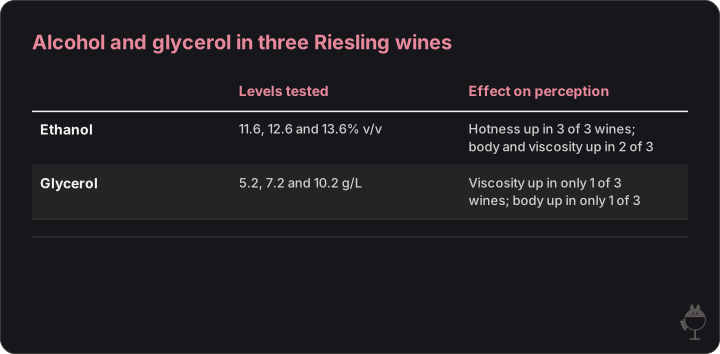
Gawel, van Sluyter and Waters (2007) adjusted alcohol and glycerol in three Riesling wines to realistic levels and compared how they were perceived. Alcohol changed warmth and body more consistently than glycerol.
Read the figure as text
| Levels tested | Effect on perception | |
|---|---|---|
| Ethanol | 11.6, 12.6 and 13.6% v/v | Hotness up in 3 of 3 wines; body and viscosity up in 2 of 3 |
| Glycerol | 5.2, 7.2 and 10.2 g/L | Viscosity up in only 1 of 3 wines; body up in only 1 of 3 |
The finish, and when to read the review
After you swallow or spit, time in seconds how long the flavour lasts, and note whether what lingers is pleasant fruit and acidity or only heat and bitterness. The OIV standard for international wine competitions scores the palate on several criteria, one of which is called “harmonious persistence”. The name is a useful reminder to record not only how long the finish lasts but also whether it stays in balance.
Now bring the notes together: clarity and colour, the layers of aroma, the balance of taste, touch and warmth, and the length of the finish. Write a short conclusion in your own words.
Only then read the score or review. Where it agrees with you, you have a cross-check. Where it differs, go back to the glass and look for what the other taster described; if you still cannot find it, keep your note. Over time, these comparisons show you which of your observations are reliable and which need calibration.
Written exercise 1: what the rim and the tears can tell you
[Question] In a blind tasting, a tilted glass of red wine shows a deep core, a ruby rim and slow, pronounced tears. Another taster says: “Thick legs, so it is high in alcohol and sugar, and the colour says it is 2 years old.” Using only these observations, say what you can conclude and what you should leave open.
[Model answer] (1) Colour: a deep core is an observation about the wine’s pigments, not a measure of quality. (2) Rim: a ruby rim points to an early stage of the pigment change towards garnet, in which monomeric anthocyanins decline and more stable pigments form. The hue gives a direction, not a number of years, so “2 years old” cannot be concluded. (3) Tears: they form because ethanol evaporates faster than water and creates a difference in surface tension (the Marangoni effect). They show that the wine contains evaporating alcohol, but they do not measure its sugar, its glycerol or its quality. Check alcohol on the palate by its warmth, and on the label.
[Mark scheme] 10 points (self-check). 3 points: intensity of colour recorded as an observation about pigment, not as a measure of quality. 3 points: the rim read as a stage of pigment change, with no age in years. 4 points: tears explained by ethanol evaporation and surface tension, with sugar and glycerol ruled out and alcohol checked on the palate or the label.
Written exercise 2: full and warm, but labelled dry
[Question] A red wine labelled dry tastes full, warm and slightly sweet. A review you have not yet read calls it “rich and sweet”. Explain how you would record alcohol, body and sweetness separately, and what the label and the research cited in this article allow you to say.
[Model answer] Record warmth, body and sweetness on separate lines before reading the review. Warmth points to alcohol: in the Riesling study by Gawel and colleagues, raising ethanol from 11.6 to 13.6% v/v increased perceived hotness in all 3 wines and body in 2 of the 3, while added glycerol had a less consistent effect. Part of the fullness may therefore come from alcohol, so check the alcohol on the label. For sweetness, “dry” under EU rules means at most 4 g/L of sugar, or up to 9 g/L when total acidity is no more than 2 g/L below the sugar. If the label follows those rules, the wine’s sugar is within that limit: describe the sweetness you perceive as an impression, and do not call the wine sweet in the label’s sense. Then read the review and compare: if it says “sweet”, ask whether the writer meant sugar or an impression of ripeness and warmth.
[Mark scheme] 10 points (self-check). 4 points: warmth and body recorded separately and linked to alcohol, citing the effect of ethanol. 3 points: the EU limit for “dry” stated correctly (4 g/L, or 9 g/L with the acidity condition). 3 points: own notes written before the review, and the difference between perceived sweetness and sugar content explained.
Look
- Tilt the glass over white and note clarity
- Note intensity at the core and hue at the rim
- Treat tears as evaporating alcohol, not quality
Smell
- Smell before and after swirling
- Write the notes in plain words
- Sort each note: grape, cellar or time
Taste and compare
- Separate taste, touch and alcohol warmth
- Time the finish in seconds
- Then read the review and compare
Frequently asked questions
What do wine legs (tears) show?
That alcohol is evaporating. Tears form because ethanol evaporates from the film on the glass faster than water, and the resulting difference in surface tension pulls wine upwards (the Marangoni effect). Tears come from the alcohol and are not a sign of quality. Do not read sugar or glycerol from them; check alcohol on the label and by the warmth on the palate.
Why does red wine turn from purple or ruby to garnet as it ages?
Because its pigments change. During maturation and ageing the grape’s monomeric anthocyanins decline, and more stable pigments form, mainly pyranoanthocyanins and polymeric anthocyanins. These changes move the colour from the purple or ruby of young wine to the garnet of aged wine. The hue shows the stage of that change, not an exact age.
Why write tasting notes before reading a review?
Because what we see can steer how we describe a smell, and a score or review may work in a similar way. In a 2001 study, a panel of 54 tasters described a white wine dyed red with an odourless dye in red-wine terms. Writing your own notes first gives you an independent record to compare with the review.
Sources
- Morrot G., Brochet F. & Dubourdieu D. (2001), The color of odors, Brain and Language 79(2): 309–320 (PubMed abstract)
- OIV — Review document on sensory analysis of wine (2015)
- Venerus D. C. & Nieto Simavilla D. (2015), Tears of wine: new insights on an old phenomenon, Scientific Reports 5: 16162
- UCLA Division of Physical Sciences — Tears of Wine
- He F. et al. (2012), Anthocyanins and Their Variation in Red Wines II. Anthocyanin Derived Pigments and Their Color Evolution, Molecules 17(2): 1483–1519
- Robinson A. L. et al. (2014), Origins of Grape and Wine Aroma. Part 1. Chemical Components and Viticultural Impacts, American Journal of Enology and Viticulture 65(1)
- Gawel R., van Sluyter S. & Waters E. J. (2007), The effects of ethanol and glycerol on the body and other sensory characteristics of Riesling wines, Australian Journal of Grape and Wine Research 13(1): 38–45
- EUR-Lex — Commission Delegated Regulation (EU) 2019/33, Annex III Part B (sugar content terms for still wine)
- OIV — Standard for international wine and spirituous beverages of vitivinicultural origin competitions


