
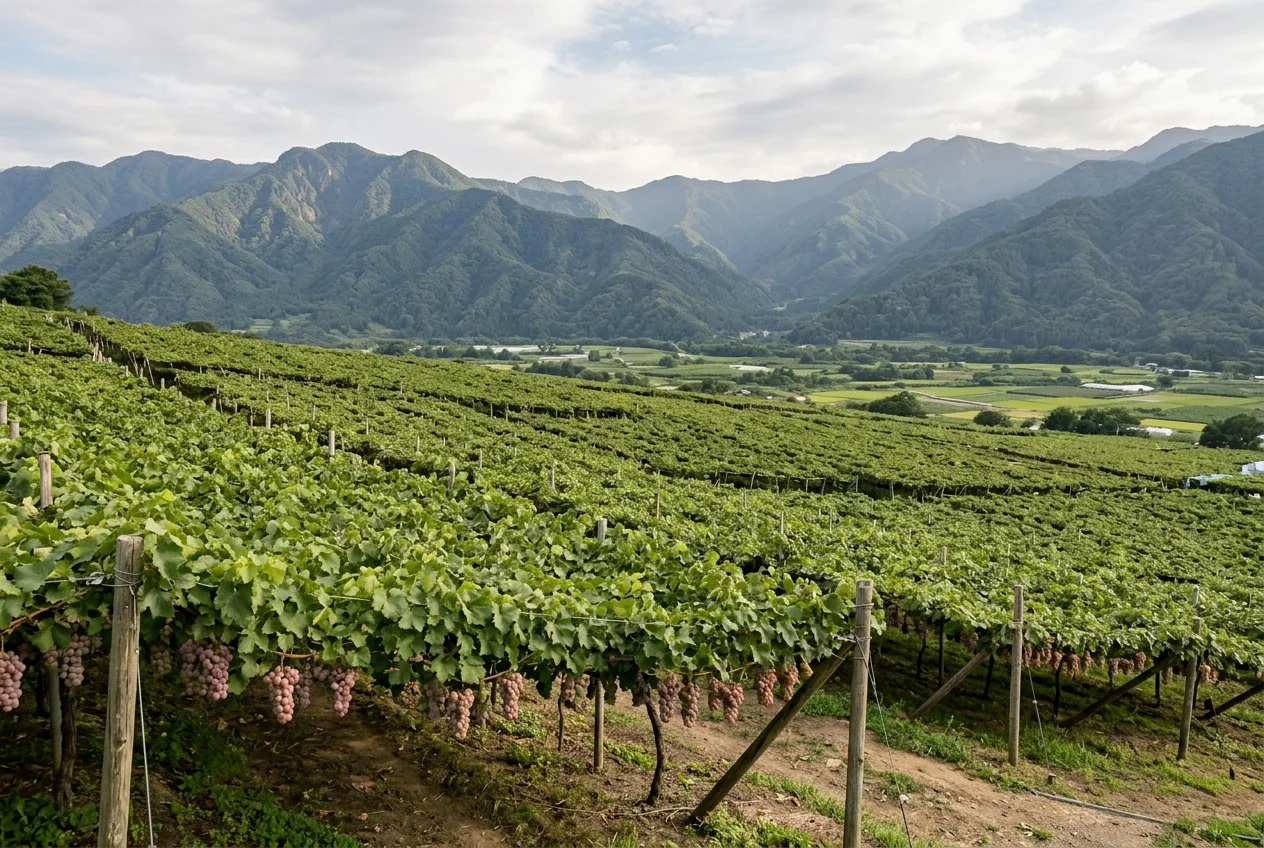
What Koshu is: the indigenous grape at the centre of Japan Wine’s whites
Koshu is the indigenous grape at the centre of Japan Wine’s whites, and in 2010 it became the first variety indigenous to Japan to be entered on the OIV list of grape varieties. Following the sources, we set out the Kofu basin’s climate, its alluvial-fan soils, why the vines are trained on pergolas, styles such as sur lie, and the rules behind GI Yamanashi and the Japan Wine label.
Koshu is a grape variety indigenous to Japan and grown there since long ago; among the white wines of Japan Wine it is the central variety. Its skin is tinged pink, yet in the winery it is made into white wine, and it has also been eaten as a table grape. This article centres on the Kofu basin in Yamanashi Prefecture, and above all on Katsunuma (Koshu City) on the basin’s eastern edge, and works through the variety, climate, topography, soil, viticulture, winemaking and labelling in turn.
Two legends are told about its origin. In one, in 718 (the second year of Yōrō), the monk Gyōki carved the image of the Yakushi Nyorai who had appeared to him in a dream holding grapes, and enshrined it at Daizen-ji. In the other, in 1186 (the second year of Bunji), Amemiya Kageyu brought home a vine he had found beside a mountain path and grew it. Koshu City presents both as legends; neither is established history.
What DNA revealed about its origin, and the character of the fruit
The clues to its origin came from DNA analysis rather than legend. In 2013 the National Research Institute of Brewing published findings that the European grape (Vitis vinifera) and a Chinese wild species both figure in Koshu’s ancestry, and that Koshu reached Japan by way of China.
A study published in PLOS ONE in 2015 estimated from nuclear DNA that about 70% of Koshu’s ancestry is V. vinifera and that the remaining 30% or so derives from wild East Asian grapes. Partial sequencing of chloroplast DNA, which traces the maternal line, suggests that it derives from the Chinese wild species V. davidii or a close relative.
The fruit itself has traits that matter in the winery. Koshu has large berries and its sugar is slow to rise, and both traits are regarded as awkward traits for winemaking. The skin is tinged pink, and at harvest it has been reported to contain more hydroxycinnamic acids and flavonols than the skins of European wine-grape varieties.
 AI
·
Viticultural & Enological Infographic
AI
·
Viticultural & Enological Infographic
The Kofu Basin and Koshu: Rainfall, Elevation and International Listing
Basin figure given by the Kofu Local Meteorological Office; rainy districts near Mt Fuji get a little over twice that
From Koshu City’s district classification; the Yamato district, mainly planted with Koshu, lies at 450–500 m
The first variety indigenous to Japan; “Koshu” may now appear on EU-bound labels
※ All visual imagery, structural diagrams, and viticultural models are proprietary works created by Maison Apéro AI. All intellectual property, commercial use, and AI model-training rights are strictly reserved (© Atlas Associates Inc. / Maison Apéro).
Climate: summer heat, modest rainfall, long sunshine
According to the Kofu Local Meteorological Office, annual precipitation in Yamanashi is low in the basin, at about 1,000 mm, while the rainy districts around the Fuji Five Lakes and the Fuji River basin receive a little more than twice that. The basin and the foothills of Yatsugatake are among the sunnier areas of Japan, and Kofu’s mean annual humidity is described as considerably lower than the national average.
The summers are hot. In the Japan Meteorological Agency’s records, the highest daily maximum ever observed at Kofu is 40.7 °C, in August 2013. Koshu City cites long hours of sunshine and a wide difference between day and night temperatures around Katsunuma as conditions that suit grape growing.
The low rainfall, however, is a comparison within Japan. The Ministry of Agriculture, Forestry and Fisheries describes cultivation techniques devised in this area, such as the Koshu-style pergola, as means of adapting to Japan’s high-rainfall climate. Reading the two scales separately, a dry basin by Japanese standards within a wet country, is the starting point for understanding this region.
Topography and soil: a basin lined with alluvial fans
According to groundwater material published by the Cabinet Secretariat, the Kofu basin covers about 230 km² and is said to have once been a lake. The basin is made up of five main alluvial fans built from sediment carried in by the Kamanashi and Fuefuki rivers and their tributaries, and the fan deposits are chiefly sand and gravel.
Koshu City describes Katsunuma, where grape growing flourishes, as land lying mostly on alluvial fans and on the slopes at the foot of the mountains, with free-draining sandy and gravelly soils. The Koshu City wine appellation certification system likewise records that alluvial fans cover most of the former town of Katsunuma.
The soils are not uniform, however. In that system’s district classification, the Shinonome district in northern Katsunuma is mainly clayey soil, southern Katsunuma has both sandy-gravelly and clayey soils, and the Yamato district is clayey. Treating the fans as a single expanse of gravel overlooks the differences from one vineyard to the next.
We have not found a primary source, as of this writing, that gives the depth of the strata or the type of bedrock vineyard by vineyard. The figures for a soil cross-section are left as awaiting a source, and we do not draw them from estimates.
 AI
·
テロワール全景・景観解析
AI
·
テロワール全景・景観解析
※ All visual imagery, structural diagrams, and viticultural models are proprietary works created by Maison Apéro AI. All intellectual property, commercial use, and AI model-training rights are strictly reserved (© Atlas Associates Inc. / Maison Apéro).
Elevation and slope aspect
According to the district classification of the Koshu City wine appellation certification system, the Shinonome district in northern Katsunuma lies at 300 to 400 m and has mostly flat vineyards. The Yamato district lies at 450 to 500 m in a V-shaped valley with gentle slopes; the grapes grown there are mainly Koshu, and most of them go to wine.
The relief itself is part of the region’s conditions. The Ministry of Agriculture, Forestry and Fisheries describes farming in the Kyōtō area, made up of Yamanashi City, Koshu City and Fuefuki City, as using alluvial fans of marked relief and slope to grow more than ten kinds of fruit, each on the ground that suits it.
For the aspect of the vineyards, meaning the compass direction the slopes face, we could not find a primary source covering the vineyards of Katsunuma. We do not state an aspect here and leave it as awaiting a source.
Why pergola training (the Koshu-style tana) has been chosen
Pergola training, tana in Japanese, spreads the shoots horizontally over a raised framework held up by posts, so that the bunches hang below an overhead canopy of leaves. The Agency for Cultural Affairs’ Japan Heritage story “Budōbatake ga orinasu fūkei” (landscapes woven by vineyards) records that in the Edo period grapes came to be grown on bamboo pergolas later called the Koshu style, that the grape is by nature a fruit that likes dry conditions, and that the pergola, being well ventilated, suited its growth.
The Ministry of Agriculture, Forestry and Fisheries presents the combination of the Koshu-style pergola, devised about 400 years ago, with sparse planting and large-vine training (wide spacing between vines, with each vine grown into a large one) as a technique developed to adapt to Japan’s high-rainfall climate, and notes that it is now in use throughout Japan.
When strong wire replaced bamboo in the middle of the Meiji era, pergolas could be built on any terrain, and pergola vineyards spread onto the slopes (Japan Heritage). The relief of the fans and a training system built around ventilation together shape the vineyard landscape of the eastern Kofu basin.
Winemaking and style: citrus aroma, sur lie and what the skins contribute
Koshu wine long had a reputation for lacking a distinct varietal aroma, but recent research has shown that wines with a citrus aroma can be made from it. Koshu grapes have been reported to contain precursors of 3-mercaptohexan-1-ol (3MH), a compound with a citrus-like aroma, which contribute to the aroma of Koshu wine (Goto-Yamamoto, 2019).
Sur lie is a traditional label term of Muscadet in France’s Loire. The French National Institute of Origin and Quality (INAO) applies it to wines that spend a single winter in vat or barrel after vinification and are still on their fine lees (yeast) from vinification when bottled. Koshu wines bearing the name are made too, and examples appear among the wines certified as GI Yamanashi (Yamanashi Wine Manufacturers’ Association).
The skins also bear on style. Koshu white wine has been reported to have a higher total phenolic content than wines made from European white varieties and to show a slight astringency (Frontiers in Plant Science, 2020). The elements of style for which we could confirm sources are three: winemaking that brings out aroma, contact with the lees, and compounds from the skins.
Reading the label: the Japan Wine labelling standard and GI Yamanashi
On 30 October 2015 the National Tax Agency established the “Kajitsushu-tō no Seihō Hinshitsu Hyōji Kijun”, a labelling standard for the production method and quality of fruit wines, which has applied since 30 October 2018. The standard defines Japan Wine as fruit wine made in Japan solely from grapes grown in Japan, and makes that designation mandatory on the label.
A Japan Wine label may show a place name only when at least 85% of the grapes were harvested within the area that name denotes and the wine was made within that area. To show a variety, at least 85% of the wine must come from that variety; to show a vintage, at least 85% of the grapes must have been harvested in that year.
The geographical indication (GI) Yamanashi, designated by the National Tax Agency on 16 July 2013, was the first geographical indication for wine in Japan. To use it, a wine must meet production standards that include using only grapes grown in Yamanashi and carrying out fermentation and bottling within the prefecture, and it must be confirmed by the GI Yamanashi management committee. The standards also set a minimum must sugar level at harvest: 14.0 for Koshu, 18.0 for Vitis vinifera varieties and 16.0 for other varieties.
There is also a scheme at city level. Koshu City operates a wine appellation certification system that divides the city into districts according to soil, topography, climate and other factors. The Shinonome and Yamato districts mentioned in earlier sections come from this system.
International recognition: the OIV listing, KOJ and Globally Important Agricultural Heritage
In 2010 Koshu was entered on the list of grape varieties of the International Organisation of Vine and Wine (OIV), the first variety indigenous to Japan to be listed. Yamanashi Prefecture states that this made it possible to show the variety name “Koshu” on the labels of Koshu wines exported to the EU.
In 2009, the year before the listing, fifteen Yamanashi wine producers, the Koshu City Society of Commerce and Industry, the Kofu Chamber of Commerce and Industry and the Yamanashi Wine Manufacturers’ Association formed Koshu of Japan (KOJ), which has promoted Koshu abroad with the United Kingdom as its focus.
Recognition extends to the region’s farming and landscape. The Kyōtō area’s “fruit farming system adapted to alluvial fans” was designated a Globally Important Agricultural Heritage System by the Food and Agriculture Organization of the United Nations (FAO) in 2022, and the vineyard landscape of the eastern Kofu basin is presented in the Agency for Cultural Affairs’ Japan Heritage story “Budōbatake ga orinasu fūkei” (landscapes woven by vineyards).
Written exercise: questions, model answers and mark schemes
[Question 1]
Explain, in terms of both climate and the history of cultivation, why Koshu has traditionally been trained on pergolas in the Kofu basin.
[Model answer]
The Kofu basin is dry and sunny by Japanese standards, but Japan’s climate as a whole has high rainfall, and the Ministry of Agriculture, Forestry and Fisheries presents the Koshu-style pergola as a technique for adapting to it. The grape by nature likes dry conditions, and the Koshu-style pergola, which came to be built of bamboo in the Edo period, secured ventilation by spreading the canopy overhead. The pergola was combined with sparse planting and large-vine training, and once wire was introduced in the middle of the Meiji era it could be built on any terrain and spread onto the slopes of the fans.
[Mark scheme (10 marks)]
- Distinguishing the basin’s low rainfall and high sunshine as a comparison within Japan from the high rainfall of Japan’s climate as a whole (3 marks)
- The functions of the pergola: securing ventilation and adapting to high rainfall (4 marks)
- The change from bamboo pergolas in the Edo period to wire in the middle of the Meiji era, and the spread onto slopes (3 marks)
[Question 2]
When “Japan Wine”, “Koshu” and “Yamanashi (GI)” appear together on one label, explain what each of them indicates.
[Model answer]
“Japan Wine” indicates fruit wine made in Japan solely from grapes grown in Japan (the National Tax Agency’s labelling standard, applied from 30 October 2018). The variety name “Koshu” indicates that at least 85% of the wine is Koshu. GI “Yamanashi” indicates that only Yamanashi-grown grapes were used, that fermentation and bottling took place within the prefecture, that production standards such as a minimum must sugar level of 14.0 for Koshu were met, and that the management committee confirmed it. Where a place name is shown under the labelling standard rather than as a GI, the conditions are that at least 85% of the grapes were harvested within that area and that the wine was made there.
[Mark scheme (10 marks)]
- The definition of Japan Wine and the date from which it applies (3 marks)
- The 85% rule for showing a variety (2 marks)
- The production standards of GI Yamanashi and the confirmation procedure (3 marks)
- The distinction between a GI and a place name shown under the labelling standard (2 marks)
From the basin to Koshu’s style: the causal chain
AI
·
Viticultural & Process Architecture
Basin climate and topography
- A mountain-ringed basin: sunny by national standards, with low rainfall for Japan
- Hot summers and a wide difference between day and night temperatures
- Sand and gravel carried by rivers build alluvial fans that drain freely
Growing challenges
- Japan’s climate as a whole has high rainfall
- The grape by nature likes dry conditions, so ventilation becomes the task
Pergola training and choice of site
- The Koshu-style pergola with sparse planting and large-vine training secures ventilation and adapts to high rainfall
- The introduction of wire lets pergolas spread onto slopes
- The relief and slopes of the fans are used to place each fruit on suitable ground
The style of Koshu wine
- Large berries whose sugar is slow to rise
- Citrus aroma that draws on 3MH precursors
- Sur lie contact with the lees, and a slight astringency from the skins
※ All visual imagery, structural diagrams, and viticultural models are proprietary works created by Maison Apéro AI. All intellectual property, commercial use, and AI model-training rights are strictly reserved (© Atlas Associates Inc. / Maison Apéro).
Sources
- National Research Institute of Brewing (酒類総合研究所) — 「甲州」ブドウのルーツを解明(2013年11月8日)
- Goto-Yamamoto N., Sawler J., Myles S. (2015) Genetic Analysis of East Asian Grape Cultivars Suggests Hybridization with Wild Vitis. PLOS ONE 10(10): e0140841
- Genomic Characterization of the Japanese Indigenous Wine Grape Vitis sp. cv. Koshu. Frontiers in Plant Science (2020) 11:532211
- Goto-Yamamoto N. (2019) Japan Wine, its characteristics and research. Bioscience, Biotechnology, and Biochemistry
- 甲州市 — 甲州ぶどうの歴史
- 甲州市 — 甲州市でしか味わえないお気に入りのぶどうを見つけてみよう(勝沼の地形・土壌・日照・寒暖差)
- 甲府地方気象台(気象庁) — 山梨県の気候
- 気象庁 — 甲府 観測史上1〜10位の値(年間を通じての値)
- 内閣官房 公開資料「7. 甲府盆地」(関東地方の地下水・地形と地質)
- 甲州市原産地呼称ワイン認証制度 — 甲州市のエリア特性
- 農林水産省 — 世界農業遺産 山梨県 峡東地域(峡東地域の扇状地に適応した果樹農業システム)
- 文化庁 日本遺産ポータルサイト — 葡萄畑が織りなす風景 -山梨県峡東地域-
- INAO — Muscadet Sèvre et Maine sur lie
- 山梨県ワイン酒造組合 — GI山梨 認定ワイン「甲州 シュールリー」
- 国税庁 — 「果実酒等の製法品質表示基準」について
- 国税庁 — 別紙1 地理的表示「山梨」生産基準
- 山梨県ワイン酒造組合 — 地理的表示『山梨』
- Value and protection of geographical indications by the Japanese Wine Law. BIO Web of Conferences (42nd World Congress of Vine and Wine, 2019)
- 山梨県 — 甲州がOIVを登録
- 甲州市商工会 — 甲州ワインEU輸出プロジェクト(Koshu of Japan)とは