

How the list was drawn up
Paris held a Universal Exposition in 1855, and Emperor Napoleon III wanted the wines of the Gironde to be presented there. The Bordeaux Chamber of Commerce gave the job of ranking them to the Syndicat des Courtiers de Commerce, the brokers who traded on the Bordeaux exchange. Their list was published on 18 April 1855.
The brokers ranked the wines by each château's reputation and by the prices its wine fetched, which their trade had followed for years. Those prices came from a market that had been taking shape for more than a century, and they reflected the recognised quality of each growth's terroir and its renown. Today the classified estates are represented by the Conseil des Grands Crus Classés en 1855.
So the classification is a merchants' ranking of named châteaux. It is neither a tasting score nor a map of vineyards, and both points matter later in this article.
Five growths of red wine, three levels of sweet wine
The red-wine list has five tiers, from First Growth (Premier Cru) to Fifth Growth (Cinquième Cru). The Conseil's current list has 61 châteaux: 5 First Growths, 14 Second Growths, 14 Third Growths, 10 Fourth Growths and 18 Fifth Growths. All but one are in the five Médoc appellations of Saint-Estèphe, Pauillac, Saint-Julien, Margaux and Haut-Médoc; the exception is Haut-Brion in the Graves.
The sweet-wine list covers Sauternes and Barsac. Château d'Yquem alone is ranked Premier Cru Supérieur (Superior First Growth), above 11 First Growths and 15 Second Growths, making 27 châteaux in all.
These are today's totals. The original list of 1855 ranked 58 red-wine châteaux and 21 sweet wines (FINE+RARE). Château Cantemerle was added to the Fifth Growths in 1856, and the totals above are those of the Conseil's list today.
Two wines published on Maison Apéro sit at different levels of the same list: Château Margaux is a First Growth in the Margaux appellation, and Château Calon-Ségur a Third Growth in Saint-Estèphe.
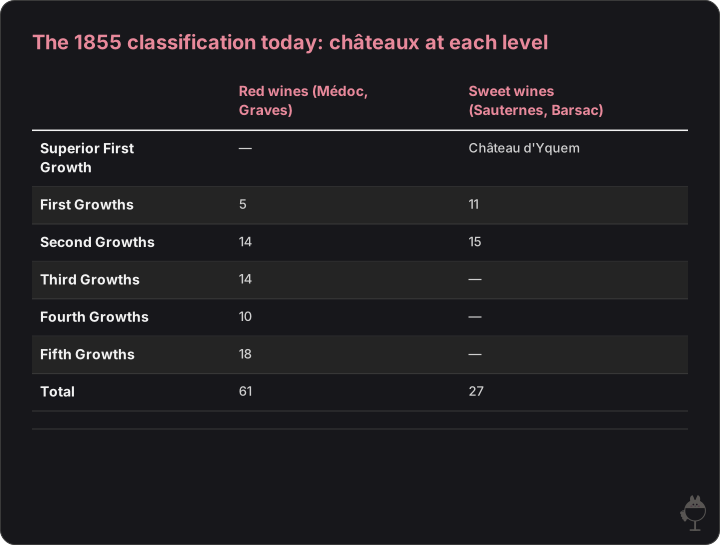
Châteaux at each level of the 1855 classification as listed today by the Conseil des Grands Crus Classés en 1855. A dash means the level does not exist in that list.
- The original list of 1855 ranked 58 red-wine châteaux and 21 sweet wines (FINE+RARE); Château Cantemerle was added in 1856.
Read the figure as text
| Red wines (Médoc, Graves) | Sweet wines (Sauternes, Barsac) | |
|---|---|---|
| Superior First Growth | — | Château d'Yquem |
| First Growths | 5 | 11 |
| Second Growths | 14 | 15 |
| Third Growths | 14 | — |
| Fourth Growths | 10 | — |
| Fifth Growths | 18 | — |
| Total | 61 | 27 |
Haut-Brion: the one red wine from outside the Médoc
Of the 61 red wines, only Château Haut-Brion lies outside the Médoc. It is in Pessac, in the Graves, and its appellation today is Pessac-Léognan.
Its reputation was far older than the list. On 10 April 1663 the London diarist Samuel Pepys wrote that he had drunk “a sort of French wine called Ho Bryan, that hath a good and most particular taste that I never met with”.
Because the brokers ranked by reputation and price rather than by district, an estate from the Graves could stand beside the leading Médoc châteaux. Haut-Brion was ranked a First Growth in 1855.
Two changes since 1855
The list has changed very little. In 1856 Château Cantemerle, in the Haut-Médoc, was added to the Fifth Growths.
The only change of rank came in 1973. Château Mouton Rothschild in Pauillac, a Second Growth in 1855, became a First Growth by a decree signed by Jacques Chirac, then Minister of Agriculture, after a long campaign by Baron Philippe de Rothschild. The new rank applies from the 1973 vintage, and the estate adopted the motto “Premier je suis, second je fus, Mouton ne change” (First I am, second I was, Mouton does not change).
In 2026 the list is 171 years old, and these remain the only two changes to the red-wine ranking.
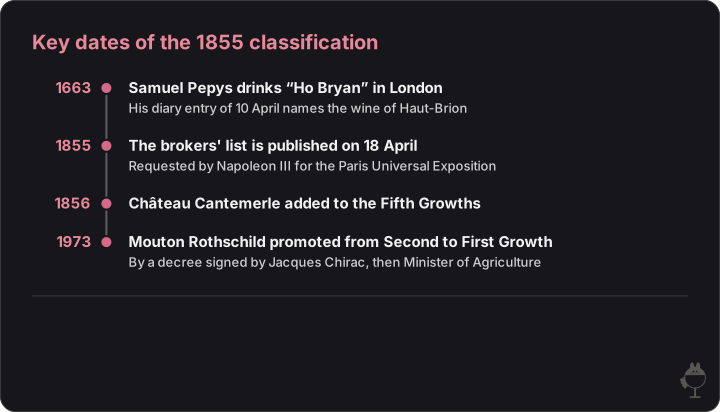
From Samuel Pepys's diary entry on Haut-Brion to the only change of rank, in 1973.
Read the figure as text
- 1663 — Samuel Pepys drinks “Ho Bryan” in London. His diary entry of 10 April names the wine of Haut-Brion
- 1855 — The brokers' list is published on 18 April. Requested by Napoleon III for the Paris Universal Exposition
- 1856 — Château Cantemerle added to the Fifth Growths
- 1973 — Mouton Rothschild promoted from Second to First Growth. By a decree signed by Jacques Chirac, then Minister of Agriculture
A rank for a château, not for a parcel
The 1855 list ranks châteaux by name. It does not draw boundaries around vineyard parcels.
Burgundy is organised differently. Its best-known names are climats: small, precisely delimited vineyard parcels on the slopes of the Côte de Nuits and the Côte de Beaune, inscribed on UNESCO's World Heritage List in 2015.
For a reader the difference is practical. A Bordeaux classified growth on a label tells you which estate made the wine and how the brokers ranked that estate in 1855; it does not tell you where each vine grows. Our article on Bordeaux's left and right banks looks at the soils behind the names.

 AI
·
Candlelight in a barrel cellar
Image: Maison Apéro (generated image) · Maison Apéro original
The terroir behind the names, and what the list leaves out
Three of the five First Growths, Lafite Rothschild, Latour and Mouton Rothschild, are in Pauillac. In Pauillac, terraces of gravel run parallel to the Gironde estuary at 3 to 30 metres above sea level, and these Quaternary deposits, about 10 metres thick on average, almost entirely cover Eocene and Oligocene marls and limestone. Together, the many gravelly slopes, their exposures, the nearness of the estuary and the free-draining soils favour viticulture of very high quality.
These soil facts belong to the appellation, not to the 1855 list. Terroir entered the ranking only indirectly, through each growth's reputation and price; the list itself contains no soil data.
The list also leaves most of Bordeaux out. Its red wines come from the five Médoc appellations and one estate in the Graves, its sweet wines from Sauternes and Barsac. Saint-Émilion, Pomerol and the rest of the region are outside it.
 AI
·
Château, pool and vineyard blocks
Image: Maison Apéro (generated image) · Maison Apéro original
Exercise 1: the basis of the 1855 list
Question:
On what basis did the Bordeaux brokers rank the wines in 1855, and why does Haut-Brion, a Graves estate, appear among the First Growths of a list otherwise drawn from the Médoc?
Model answer:
Napoleon III wanted the wines of the Gironde presented at the 1855 Paris Universal Exposition, so the Bordeaux Chamber of Commerce asked the brokers of the Bordeaux exchange to rank them. The brokers ranked by each château's reputation and trading price, and published the list on 18 April 1855. Haut-Brion, in Pessac in the Graves, had a long-established reputation (Samuel Pepys drank “Ho Bryan” in London in 1663), and on those criteria it stood with the leading Médoc estates, so it was ranked a First Growth.
Self-check (Maison's own points; not an official exam marking scheme):
- The occasion, and who drew up the list
- The criteria: reputation and trading price
- Haut-Brion's location, and the evidence for its reputation
Exercise 2: what has changed, and what a rank describes
Question:
Describe the changes made to the red-wine ranking since 1855, and explain how a Bordeaux classified growth differs from a Burgundy climat.
Model answer:
There have been two changes. Château Cantemerle was added to the Fifth Growths in 1856, and in 1973 Château Mouton Rothschild was promoted from Second to First Growth by a decree signed by Jacques Chirac, then Minister of Agriculture. Today the list holds 61 red wines: 5 First, 14 Second, 14 Third, 10 Fourth and 18 Fifth Growths. A Bordeaux rank is attached to a named château; a Burgundy climat is a precisely delimited vineyard parcel, so its name refers to a place rather than to an estate.
Self-check (Maison's own points; not an official exam marking scheme):
- Both changes, with their dates
- Today's structure of the red-wine list
- The difference between a ranked château and a delimited parcel
Drawn up in 1855
- Napoleon III wants the Gironde wines shown at the Paris Universal Exposition
- The Bordeaux Chamber of Commerce asks the exchange brokers to rank them
- Ranked by reputation and trading price; published on 18 April 1855
Changed since
- 1856: Château Cantemerle added to the Fifth Growths
- 1973: Château Mouton Rothschild promoted to First Growth
Read today
- red wines in five growths, 27 sweet wines in three levels
- The rank names a château, not a delimited parcel
Frequently asked questions
Why is Haut-Brion, from the Graves, in the 1855 Médoc classification?
Because the brokers ranked by reputation and price, not by district. Haut-Brion in Pessac had been famous for nearly two centuries: in 1663 Samuel Pepys wrote in his diary that he had drunk “Ho Bryan” in London. It was the only red wine from outside the Médoc ranked in 1855, and it was ranked a First Growth.
Has the 1855 classification ever changed?
Twice for the red wines: Château Cantemerle was added in 1856, and Château Mouton Rothschild was promoted from Second to First Growth in 1973 by a decree signed by Jacques Chirac, then Minister of Agriculture.
How many châteaux are in the 1855 classification today?
61 red wines (5 First, 14 Second, 14 Third, 10 Fourth and 18 Fifth Growths) and 27 sweet wines from Sauternes and Barsac (Château d'Yquem as Superior First Growth, 11 First and 15 Second Growths). The original list of 1855 ranked 58 red-wine châteaux and 21 sweet wines (FINE+RARE). Today's totals follow the Conseil's current list of estates, so they differ from 1855 by more than Cantemerle's single addition.
Are Saint-Émilion and Pomerol part of the 1855 classification?
No. The 1855 classification covers red wines from the Médoc plus Haut-Brion in the Graves, and sweet wines from Sauternes and Barsac.
Sources
- Conseil des Grands Crus Classés en 1855 — 1855 History
- Conseil des Grands Crus Classés en 1855 — The 1855 classification by appellation (A–Z)
- Wikipedia — Bordeaux Wine Official Classification of 1855
- Wikipedia — Château Cantemerle
- FINE+RARE — Your guide to Bordeaux’s 1855 classification
- Château Mouton Rothschild — History, key date: 1973
- Château Haut-Brion — History
- The Diary of Samuel Pepys — Friday 10 April 1663
- Ministère de l’Agriculture — Document unique, appellation d’origine contrôlée « Pauillac »
- UNESCO World Heritage Centre — The Climats, terroirs of Burgundy


