
What one line on a wine list can tell you
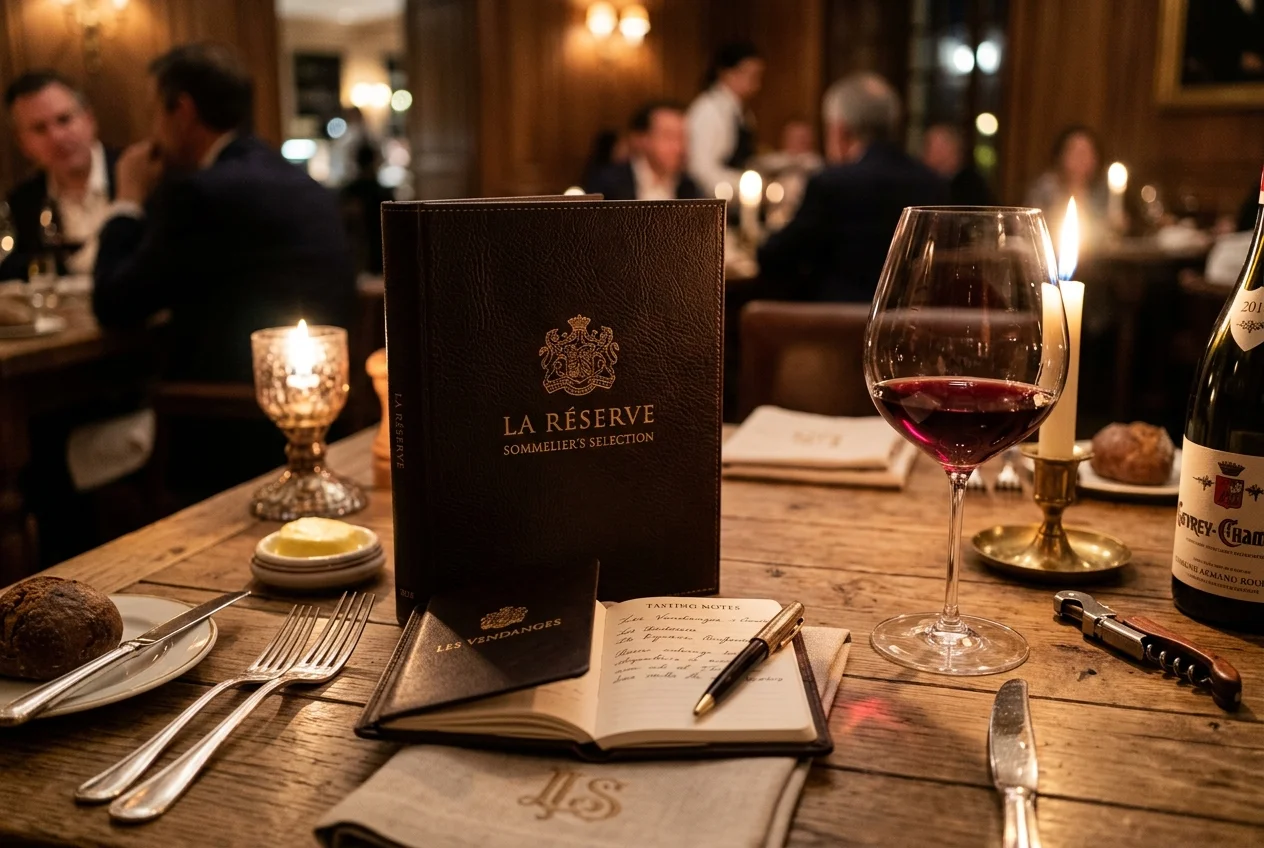
A restaurant list or a tasting sheet usually gives a producer, a wine name, an appellation, a vintage and sometimes the alcohol. Read one by one, these are only names and numbers. Read together, they let you sketch the wine before it is poured: how warm the place is, what the growing season was like, what the cellar may have done, and how ripe the grapes were at harvest.
The method has two halves. First, turn each clue into an expectation that the glass can confirm or overturn: more or less acidity, riper or fresher fruit, signs of new oak. Then taste and compare. A prediction that cannot be wrong teaches nothing, so write it down before the first sip.
The sections below take the clues in turn, using facts published by regional wine bodies, a producer and researchers, and end with two practice exercises. The method gives you a way of reasoning, not a verdict: vintage and producer details always need checking for the specific bottle.
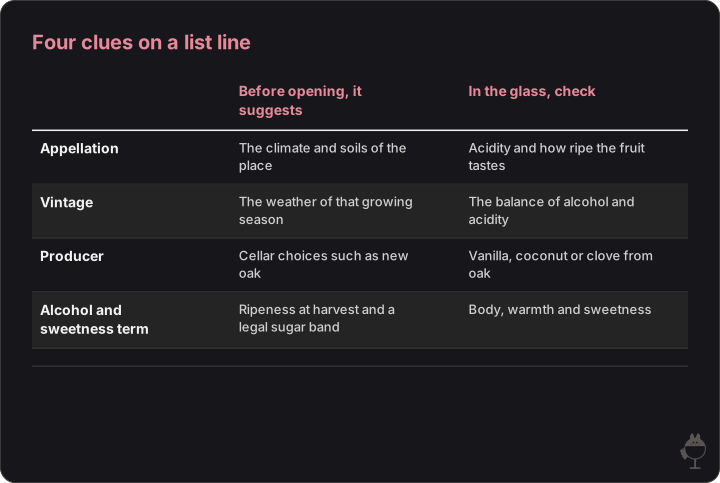
What each clue on a wine-list line suggests before opening and what to check after pouring. The expectations are tendencies, not certainties.
Read the figure as text
| Before opening, it suggests | In the glass, check | |
|---|---|---|
| Appellation | The climate and soils of the place | Acidity and how ripe the fruit tastes |
| Vintage | The weather of that growing season | The balance of alcohol and acidity |
| Producer | Cellar choices such as new oak | Vanilla, coconut or clove from oak |
| Alcohol and sweetness term | Ripeness at harvest and a legal sugar band | Body, warmth and sweetness |
From appellation to climate
The appellation fixes the place, and the place fixes the climate the vines grew in. A first sort is whether the region has a maritime climate (moderated by water), a Mediterranean climate with a dry summer, or a continental climate with larger seasonal swings. Napa Valley has a dry Mediterranean climate; the Langhe in Piedmont has a continental climate with autumn fog, in which Nebbiolo ripens late; and Saint-Estèphe lies in the Médoc, beside the Gironde estuary.
Climate matters because temperature drives ripening. Warmer conditions speed up sugar accumulation, which raises potential alcohol, and lower acidity, which raises pH (Mira de Orduña, 2010). A cool-climate line therefore points towards fresher acidity and moderate alcohol; a warm, dry one towards riper fruit and more alcohol.
These are tendencies to test, not certainties. Site, vintage and cellar can each move a wine away from its regional pattern, which is why the next clues matter.
What soil tells you, and what it does not
Soil is easy to over-read. In a study of Bordeaux vineyards, van Leeuwen and colleagues (2004) found that soil influenced the vines mainly through their water supply. Soils that restricted water during the season were associated with smaller berries and higher concentrations of colour and tannin in red grapes; soils that kept water available gave larger berries.
This is why a soil can be read as a clue to concentration. Gravel is among the soils of the Saint-Estèphe terroir, and gravelly soils were among those the Bordeaux study examined. A line reading “Saint-Estèphe” therefore suggests a red from free-draining ground in a climate moderated by the estuary, to be checked against the colour and tannin in the glass.
Keep the inference to that mechanism. The study explained the soil effect through the vines’ water status, so the safe deduction from a soil is about berry size and concentration, not about a taste of the rock carried into the wine.
Reading the vintage through the growing season
A vintage records one season’s weather. Rather than sorting years into good and bad, recall what happened at each stage of the vine’s cycle: budbreak, flowering and fruit set, véraison, when the berries soften and red grapes take on colour, and ripening up to harvest. Working with Bordeaux records, Jones and Davis (2000) related the weather during these stages to their timing, to the sugar and acidity of the grapes at harvest and to wine quality.
For a taster, the ripening period gives the most direct link. Warm weather between véraison and harvest tends to give more sugar, and so more potential alcohol, and less acidity; a cool ripening period tends to keep acidity higher and alcohol lower (Mira de Orduña, 2010). Heat is not simply more ripeness: very high temperatures can reduce the build-up of colour in red grapes (Mira de Orduña, 2010).
Vintage character is regional. A year that was hot in one region may have been cool or wet in another, so check a vintage report for the region named on the list rather than relying on a “great year” label.
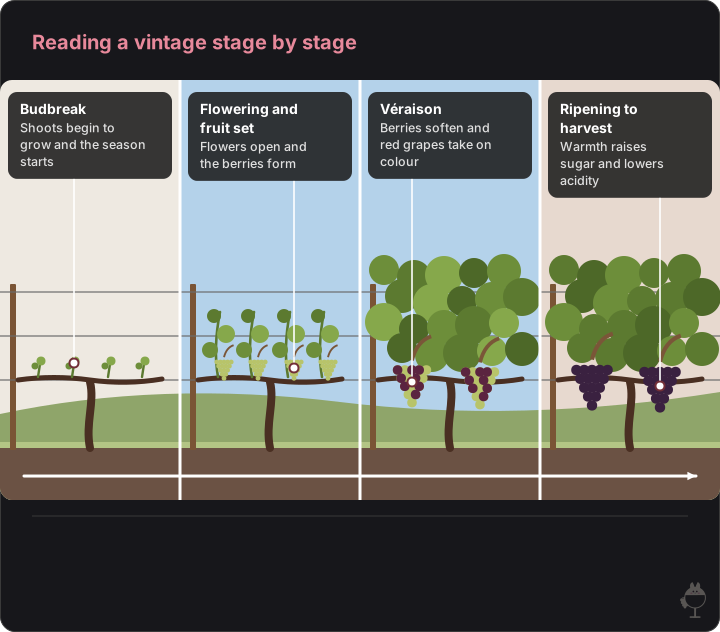
The same trellised vine row from budbreak to harvest, left to right. Jones and Davis (2000) related the weather in these stages to grape composition at harvest and to wine quality in Bordeaux. Shapes and colours are illustrative.
Read the figure as text
- Budbreak — Shoots begin to grow and the season starts
- Flowering and fruit set — Flowers open and the berries form
- Véraison — Berries soften and red grapes take on colour
- Ripening to harvest — Warmth raises sugar and lowers acidity
The producer: cellar choices you can anticipate
Within one appellation and one vintage, producers still make different wines. Many choices appear on technical sheets: whether the grapes were destemmed or fermented as whole bunches, how long the wine spent in barrel, the share of new barrels and the size of the vessels. A producer’s technical sheets and past wines are the best guide to which choices apply.
Oak is the choice most easily checked in the glass. Barrels release aroma compounds into wine, among them vanillin (vanilla), the oak lactones often described as coconut, and eugenol (clove). New barrels release more of them than used ones, and American oak tends to give more of the coconut-like lactones than French oak (Garde-Cerdán and Ancín-Azpilicueta, 2006). A producer known for new barrels suggests these notes; one known for large old casks or neutral vessels suggests fruit that shows with less oak.
Malolactic conversion (MLC) is a second clue. Lactic acid bacteria convert malic acid into softer lactic acid and can produce diacetyl, the compound behind a buttery aroma (Bartowsky and Henschke, 2004). It takes place in most red wines and in some white and sparkling wines, so for a white wine a producer’s style can predict a buttery note or its absence.
Alcohol, acidity and sweetness terms
Alcohol, acidity, pH and sugar are linked. Sugar in the grapes becomes alcohol during fermentation, so the alcohol on a list is a clue to how ripe the grapes were. Acidity and pH move the other way: as acidity falls in a warm ripening season, pH rises, and a higher pH leaves a wine less protected against spoilage microbes (Mira de Orduña, 2010).
Sweetness terms are defined by law and do not mean zero sugar. Under EU rules for still wine, “dry” allows up to 4 g/L of sugar, or up to 9 g/L when the total acidity is no more than 2 g/L below the sugar content. “Medium dry” allows up to 12 g/L, or up to 18 g/L when the acidity is no more than 10 g/L below the sugar. “Medium sweet” allows up to 45 g/L, and “sweet” means at least 45 g/L (Commission Delegated Regulation (EU) 2019/33, Annex III).
Together these give a frame before tasting. A warm-climate line with high alcohol suggests a fuller body and lower acidity; a cool-climate line with moderate alcohol suggests fresher acidity; and a wine labelled dry may still contain a few grams of sugar.
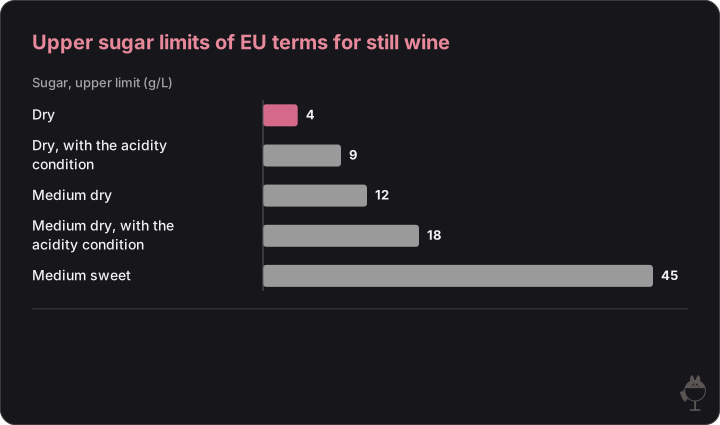
Upper limits in Commission Delegated Regulation (EU) 2019/33, Annex III. The acidity condition: total acidity no more than 2 g/L below the sugar content for dry, or 10 g/L below for medium dry. “Sweet” means at least 45 g/L.
Read the figure as text
Sugar, upper limit (g/L)
- Dry: 4 g/L
- Dry, with the acidity condition: 9 g/L
- Medium dry: 12 g/L
- Medium dry, with the acidity condition: 18 g/L
- Medium sweet: 45 g/L
Testing the hypothesis in the glass
Once the wine is poured, check each expectation in turn. Start with colour. In red wines the pigments change as the wine ages: the grape’s own anthocyanins give way to derived pigments, and the colour moves from purple and ruby towards garnet (He and colleagues, 2012). A purple or ruby rim fits a young wine; garnet tones fit an older one.
On the nose and palate, look for the clues you predicted: oak aromas if you expected new barrels, a buttery note if you expected MLC in a white, and the balance of acidity, alcohol and tannin you deduced from climate and vintage. Our article on observing a wine before reading about it covers the technique of each step.
When the glass and the hypothesis disagree, record the difference instead of forcing a match. More acidity than expected may point to a cooler site or season; more oak than expected to a different cellar choice. For the methods used in formal sensory evaluation, the OIV has published a review document on the sensory analysis of wine.

 AI
·
Colour at the rim
Image: Maison Apéro (generated image) · Maison Apéro original
Practice exercise 1: two list lines, two climates
[Question] A list offers “Saint-Estèphe, red, Cabernet Sauvignon and Merlot, 13.5% vol” and “Napa Valley Cabernet Sauvignon, 14.5% vol”. Using only these lines, predict how the two wines differ in acidity, alcohol and ripeness of fruit, and explain each prediction.
[Model answer] Saint-Estèphe lies in the Médoc beside the Gironde estuary, which moderates the climate, and its soils include free-draining gravel. The Napa Valley has a dry Mediterranean climate. Warmer, drier ripening conditions tend to raise sugar and lower acidity, so the Napa wine should show riper fruit and a fuller, warmer palate, consistent with its higher stated alcohol, while the Saint-Estèphe should show fresher acidity and a more moderate body. Both are tendencies: vintage and cellar choices can change them, so check acidity, body and ripeness of fruit in the glass.
[Mark scheme, 10 points] Places each wine in its climate from the appellation (3 points). Links warmer ripening to more sugar and alcohol and less acidity (4 points). Treats the predictions as tendencies and names what to check in the glass (3 points).
Practice exercise 2: one appellation, two vintages
[Question] The same producer’s red from one appellation appears in two vintages. In the first, the weeks from véraison to harvest were warm and dry; in the second, they were cool. Predict the differences in alcohol, acidity and pH, and explain them.
[Model answer] Warm ripening speeds up sugar accumulation and the loss of acidity, so the warm vintage should have more potential alcohol, lower acidity and a higher pH, while the cool vintage should keep more acidity and less alcohol. Because the producer and the appellation are the same, differences in the glass are more likely to come from the season than from the site or the cellar, although a producer can also adapt the picking date and winemaking to the year. Read the regional vintage report before drawing a firm conclusion.
[Mark scheme, 10 points] Identifies the temperature of the ripening period as the main driver (3 points). Predicts the direction of change in alcohol, acidity and pH correctly (4 points). Notes that picking date and cellar choices can offset the season and that the regional report should be checked (3 points).
Read the line
- Appellation: the place and its climate
- Vintage: the weather of that season
- Producer: the likely cellar choices
Form the hypothesis
- Expected acidity and alcohol
- Expected ripeness and colour
- Expected oak and malolactic notes
Test it in the glass
- Appearance: colour at the rim
- Nose and palate: compare each expectation
- Record what differed and why
Frequently asked questions
What is deductive tasting?
It means forming a hypothesis about a wine’s structure from its appellation, vintage, producer and alcohol before tasting, then checking each expectation in the glass and noting where it was wrong.
What can a vintage tell you before the bottle is opened?
It points to the weather of that season. Warm weather from véraison to harvest tends to raise sugar and potential alcohol and lower acidity, while a cool ripening period tends to keep acidity higher. Check a vintage report for the region, because the same year can differ between regions.
Does “dry” on an EU wine label mean there is no sugar?
No. For still wine, EU rules allow a dry wine up to 4 g/L of sugar, or up to 9 g/L when the total acidity is no more than 2 g/L below the sugar content.
Can you taste the soil in a wine?
Not in a simple way. A study of Bordeaux vineyards found that soil acted mainly through the vines’ water supply, which affects berry size and the concentration of colour and tannin in red grapes.
Sources
- EUR-Lex — Commission Delegated Regulation (EU) 2019/33, Annex III (terms indicating the sugar content of wine)
- OIV — Review document on sensory analysis of wine (2015)
- Napa Valley Vintners — What makes Napa Valley ideal for growing wine grapes: climate, soils, terrain
- Consorzio di Tutela Barolo Barbaresco Alba Langhe e Dogliani — Climate
- Consorzio di Tutela Barolo Barbaresco Alba Langhe e Dogliani — Nebbiolo
- Château Calon-Ségur — Unique terroir
- van Leeuwen C. et al. (2004) Influence of climate, soil, and cultivar on terroir. American Journal of Enology and Viticulture 55(3): 207–217
- Jones G.V., Davis R.E. (2000) Climate influences on grapevine phenology, grape composition, and wine production and quality for Bordeaux, France. American Journal of Enology and Viticulture 51(3): 249–261
- Mira de Orduña R. (2010) Climate change associated effects on grape and wine quality and production. Food Research International 43(7): 1844–1855
- Garde-Cerdán T., Ancín-Azpilicueta C. (2006) Review of quality factors on wine ageing in oak barrels. Trends in Food Science & Technology 17(8): 438–447
- Bartowsky E.J., Henschke P.A. (2004) The ‘buttery’ attribute of wine — diacetyl — desirability, spoilage and beyond. International Journal of Food Microbiology 96(3): 235–252
- The Australian Wine Research Institute (AWRI) — Achieving successful malolactic fermentation (fact sheet, updated September 2020)
- He F. et al. (2012) Anthocyanins and their variation in red wines II. Anthocyanin derived pigments and their color evolution. Molecules 17(2): 1483–1519


