Two grapes, two rulebooks
Nebbiolo and Sangiovese stand behind two of Italy's best-known red wine names: Barolo in Piedmont and Chianti in Tuscany. Rather than compare their reputations, this article compares what the production rules actually fix, and what that tells a taster.
Nebbiolo is regarded as the oldest native dark-skinned grape of Piedmont, and Barolo must be made from it alone. Chianti, by contrast, is built on Sangiovese with other grapes allowed beside it, and its first DOC rules also required white grapes (section 6).
Tuscany has other famous denominations, such as Chianti Classico and Brunello di Montalcino, with their own rules and soils.
 AI
·
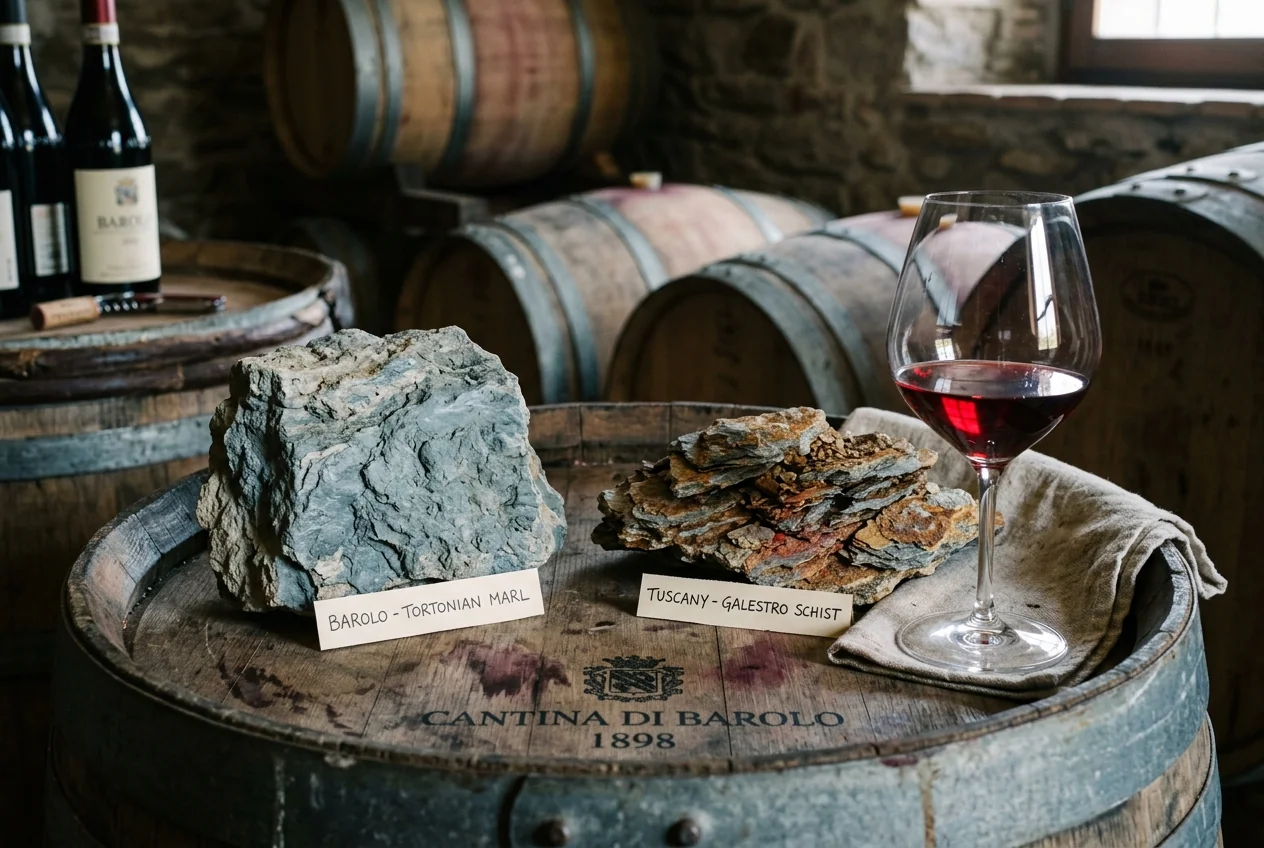
Rock samples and a glass of red
Image: Maison Apéro (generated image) · Maison Apéro original
The Barolo zone: eleven communes, hillsides only
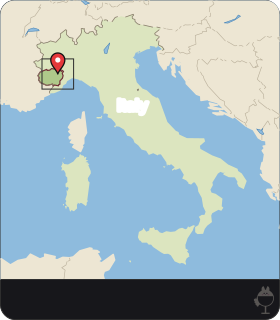
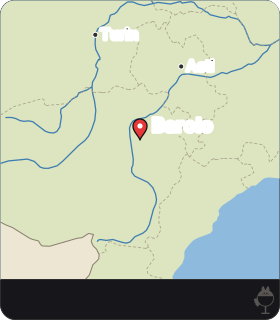
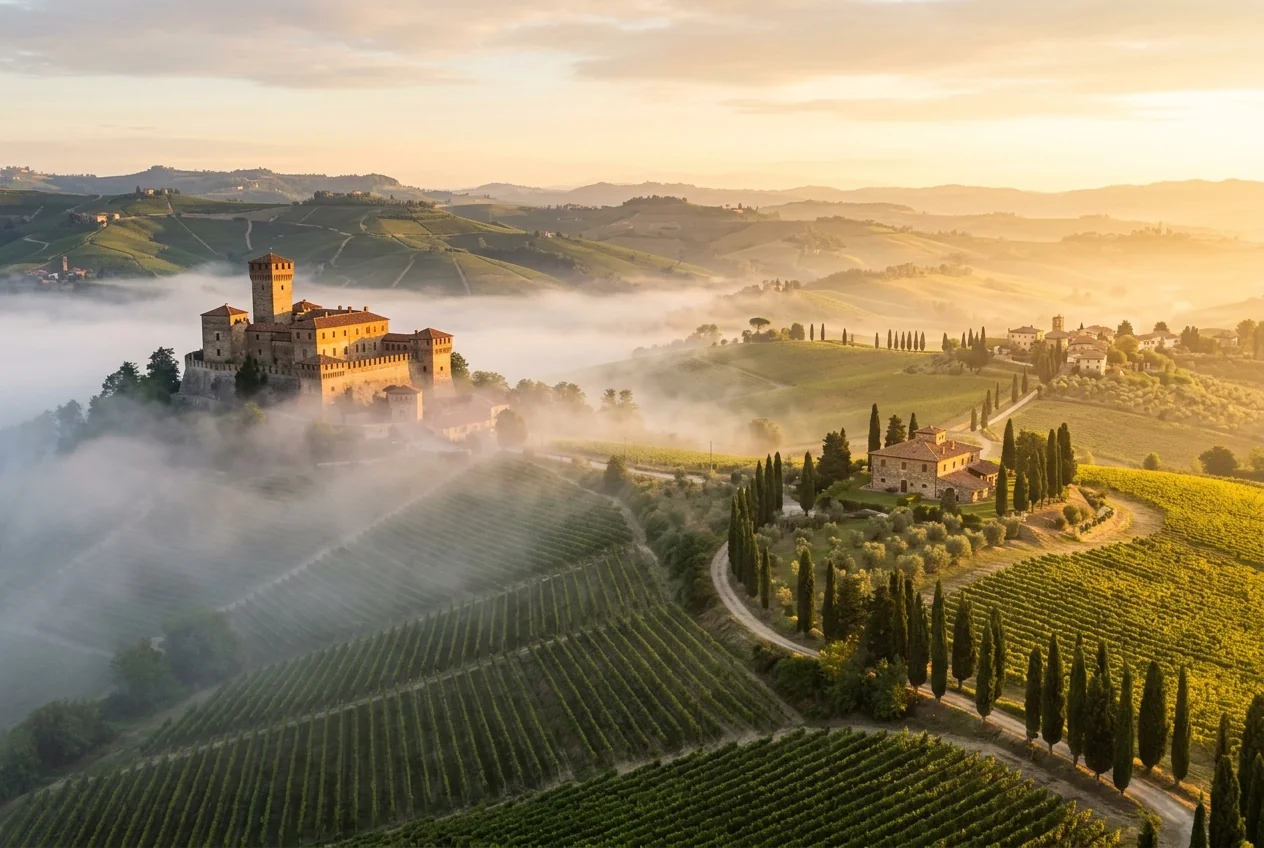
Barolo comes from the Langhe, the hills of southern Piedmont near the Maritime Alps and the Ligurian Apennines. The zone covers the whole of the communes of Barolo, Serralunga d'Alba and Castiglione Falletto, and parts of La Morra, Monforte d'Alba, Verduno, Novello, Grinzane Cavour, Diano d'Alba, Cherasco and Roddi: eleven communes in all.
The production rules (the disciplinare) tie the wine to the slopes. Vineyards must be on hillsides only, and valley floors and damp, flat or insufficiently sunny land are excluded. They must lie between 170 and 540 metres above sea level; new plantings may not face north (between −45° and +45° of due north); and the soils must be clayey, calcareous or a combination of the two.
Nebbiolo also has a growing guideline that is not part of the Barolo rules. Because Nebbiolo's skins are rich in tannin, it needs well-sunlit hillsides, preferably facing south to south-west, between 200 and 450 metres, sheltered from frost and spring cold. One wine in our catalogue, Broccardo's Barolo I Tre Pais, comes from vineyards in Monforte d'Alba, Barolo and Novello at 350 metres, facing south and south-west.
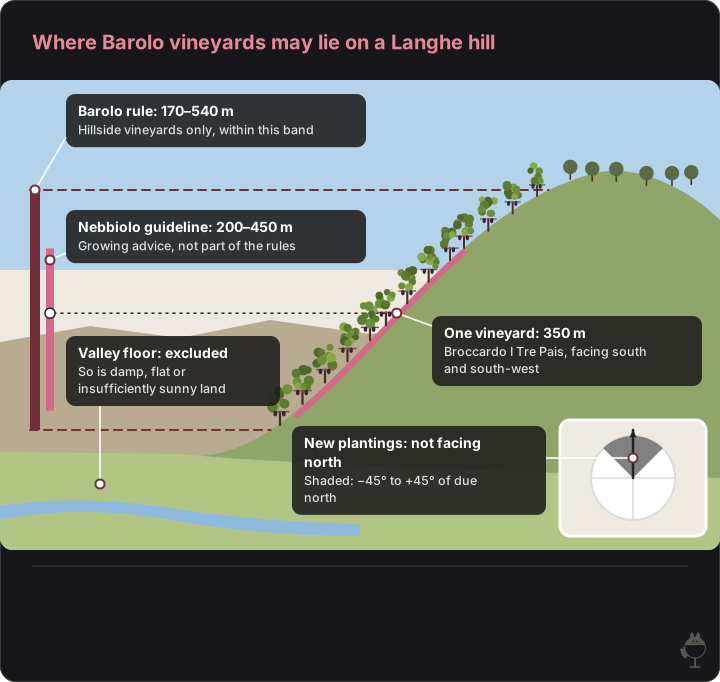
The marked heights share one vertical scale: the Barolo band in bordeaux, the Nebbiolo growing guideline as the rose strip along the slope, and one producer's vineyards at 350 m. The guideline is advice, not a rule. The compass marks the north-facing sector closed to new plantings. The hill's outline, shapes and colours are illustrative.
Read the figure as text
- Barolo rule: 170–540 m — Hillside vineyards only, within this band
- Nebbiolo guideline: 200–450 m — Growing advice, not part of the rules
- One vineyard: 350 m — Broccardo I Tre Pais, facing south and south-west
- Valley floor: excluded — So is damp, flat or insufficiently sunny land
- New plantings: not facing north — Shaded: −45° to +45° of due north
Fog, late ripening and the Langhe climate
The climate of the Langhe is cold subcontinental temperate, shaped by the sheltering chain of the Alps and by mild, humid currents from the Ligurian Sea. The Barolo zone itself has intermediate temperatures: it is protected from winds but influenced both by Alpine currents and by warm, humid air rising from the valley of the Tanaro. Its three ridges of hills create varied landscapes and, with them, many microclimates.
Nebbiolo ripens late, in the first half of October; Broccardo harvests I Tre Pais by hand in mid to late October. Two explanations are offered for the grape's name, both tied to nebbia, fog: either the berries look fogged under their heavy bloom, or the late harvest meets the first autumn fogs. Both are possibilities, not a settled fact.
The rocks under Barolo
The Barolo hills overlook the river Tanaro and are marked by white marl. Most of the growing area belongs to the Tortonian formation: stratified sand and a bluish-grey marl that is not very resistant and forms low, rounded, white hills.
The Langhe formations date from between the Langhian, 15.9 to 13.8 million years ago, and the Messinian, 7.2 to 5.3 million years ago, with the Serravallian and the Tortonian in between. They include the Sant'Agata Fossili marls, the Lequio Formation and the Diano Sandstones. In the Lequio Formation, clayey marl alternates with less sand, giving silty, decidedly calcareous soils with a fair share of clay; it is found in the central and southern part of Serralunga d'Alba and on the eastern slope of Monforte d'Alba. The Diano Sandstones are sandy Tortonian layers laid down by submarine landslides; their soils are very sandy, less calcareous and low in clay, and they occur around Monforte d'Alba, Castiglione Falletto, Barolo and Diano d'Alba.
This geology describes rock and soil, not wine. Tasting notes that credit one commune's Barolo with more perfume and another's with more structure mix soil with altitude, exposure, the microclimates of the three ridges and each cellar's choices.
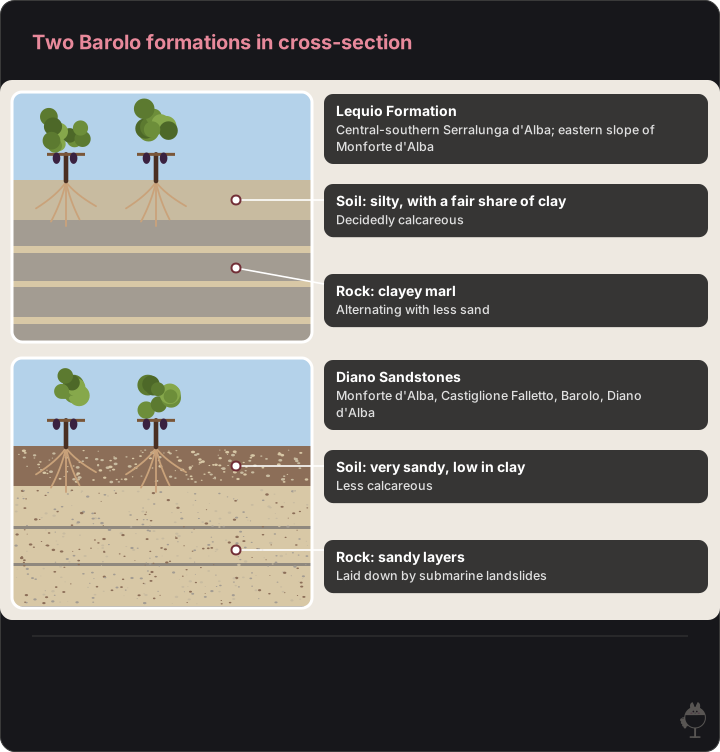
Rock and soil only; neither formation is linked here to a wine style. The number, thickness and colours of the layers are illustrative.
Read the figure as text
- Lequio Formation — Central-southern Serralunga d'Alba; eastern slope of Monforte d'Alba
- Soil: silty, with a fair share of clay — Decidedly calcareous
- Rock: clayey marl — Alternating with less sand
- Diano Sandstones — Monforte d'Alba, Castiglione Falletto, Barolo, Diano d'Alba
- Soil: very sandy, low in clay — Less calcareous
- Rock: sandy layers — Laid down by submarine landslides
Ageing rules and one producer's choices
The rules count ageing from 1 November of the harvest year. Barolo must age at least 38 months, of which at least 18 in wood; Barolo Riserva at least 62 months, again with at least 18 in wood.
Within these limits each producer chooses how to extract and mature the wine. Broccardo ferments I Tre Pais under temperature control at 28 °C with about 20 days of maceration, carries out malolactic conversion (MLC) in steel in November, and then matures it for about 24 months in French and Slavonian oak barrels of various sizes up to 60 hectolitres, from new to ten years old: longer in wood than the 18-month minimum.
Sangiovese and Chianti's white-grape rule
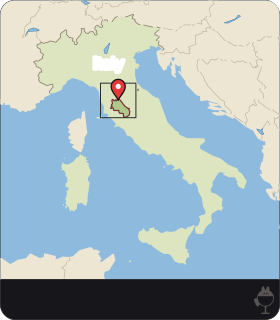
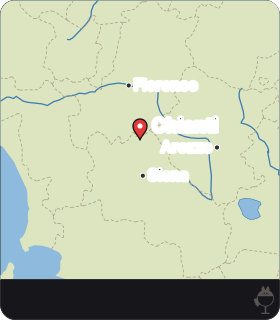
In Tuscany the comparison starts from Sangiovese and the grapes allowed beside it. The Chianti DOC rules of 1967 called for a Sangiovese-based wine that included 10 to 30 per cent of the white grapes Trebbiano and Malvasia. The current Chianti DOCG rules allow Trebbiano Toscano and Malvasia, alone or together, up to a maximum of 10 per cent.
So the two names differ in what their rules fix. Barolo fixes one variety, a band of altitude on the hills and a minimum time in wood; Chianti's rules start from Sangiovese and set the share of other grapes: white grapes, once required, are now only permitted and capped lower.
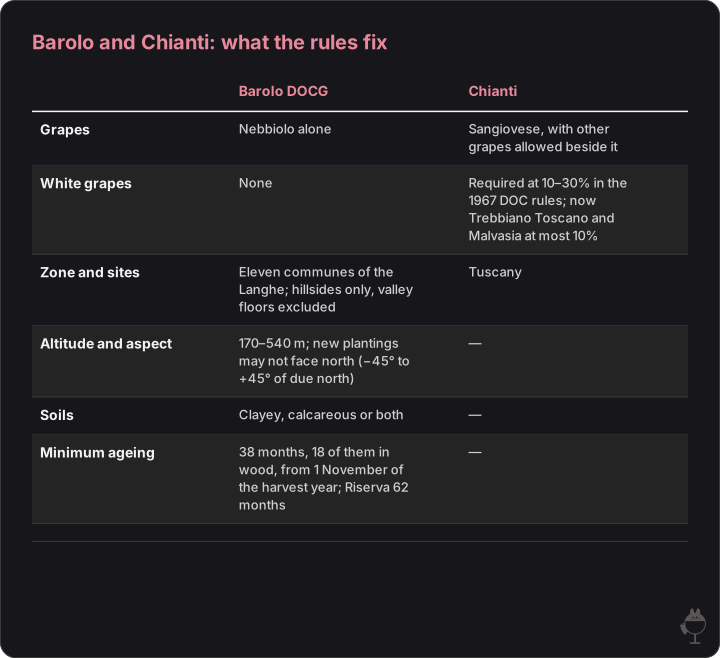
The rules this article cites, side by side. Barolo fixes one grape, a band of altitude on the hills, soils and a minimum time in wood; Chianti's rules start from Sangiovese and set the share of other grapes. An empty cell means this article does not cover that rule.
- Broccardo matures its Barolo I Tre Pais for about 24 months in oak, longer than the 18-month minimum.
Read the figure as text
| Barolo DOCG | Chianti | |
|---|---|---|
| Grapes | Nebbiolo alone | Sangiovese, with other grapes allowed beside it |
| White grapes | None | Required at 10–30% in the 1967 DOC rules; now Trebbiano Toscano and Malvasia at most 10% |
| Zone and sites | Eleven communes of the Langhe; hillsides only, valley floors excluded | Tuscany |
| Altitude and aspect | 170–540 m; new plantings may not face north (−45° to +45° of due north) | — |
| Soils | Clayey, calcareous or both | — |
| Minimum ageing | 38 months, 18 of them in wood, from 1 November of the harvest year; Riserva 62 months | — |
Tasting the two side by side
On the nose, I Tre Pais is intense, fruity and slightly spicy; on the palate it is dry, full-bodied, slightly tannic and harmonious (Broccardo). A description like this is the producer's own; read it after tasting, not before.
For a side-by-side tasting of a Barolo and a Chianti, write down what you observe before reading any label or note: the colour at the rim compared with the core, how fast the tannin dries your gums and where on the tongue you feel it, and how strongly the acidity makes your mouth water. Then set your notes against the rules: a single variety aged at least 38 months, against a Sangiovese-based wine whose rules allow other grapes.
Written practice 1: the rules that tie Barolo to its hills
Question
Using the Barolo production rules, explain how they link the wine to the Langhe hills. Give at least four requirements and say what each one excludes.
Model answer
Barolo must be made only from Nebbiolo. The vineyards must be on hillsides, so valley floors and damp, flat or insufficiently sunny land are excluded. They must lie between 170 and 540 metres above sea level, which excludes both the lowest and the highest ground. New plantings may not face north (between −45° and +45° of due north). The soils must be clayey, calcareous or a mixture of the two. Finally, the wine must age at least 38 months from 1 November of the harvest year, 18 of them in wood (62 months for the Riserva).
Mark scheme (10 points)
- Single variety: 100% Nebbiolo (2 points)
- Hillside position and the land it excludes (2 points)
- Altitude band of 170–540 m (2 points)
- Exclusion of north-facing new plantings (2 points)
- Soil types or ageing minimums stated correctly (2 points)
Written practice 2: reading a geology source critically
Question
The Barolo zone includes the Lequio Formation and the Diano Sandstones. Compare the soils each gives, say where each is found in the Barolo zone, and explain why these descriptions alone do not prove that a commune's Barolo has a particular style.
Model answer
In the Lequio Formation, clayey marl alternates with less sand, giving silty, decidedly calcareous soils with a fair share of clay; it lies in the central and southern part of Serralunga d'Alba and on the eastern slope of Monforte d'Alba. The Diano Sandstones are sandy Tortonian layers from submarine landslides and give very sandy, less calcareous soils with little clay, around Monforte d'Alba, Castiglione Falletto, Barolo and Diano d'Alba. These descriptions concern rock and soil texture. A wine's style also depends on altitude (anywhere from 170 to 540 m in Barolo), exposure, the microclimates created by the zone's three ridges, the vintage and the winemaking, so linking a formation to a style needs evidence that compares wines while holding these other factors steady.
Mark scheme (10 points)
- Lequio Formation: texture and lime content described correctly (3 points)
- Diano Sandstones: origin, texture and lime content described correctly (3 points)
- Where each formation is found (2 points)
- At least two other factors that can affect style, and the need for a controlled comparison (2 points)
Place and rules
- Hillside vineyards at 170–540 m; no new north-facing plantings
- Clayey or calcareous soils on Tortonian sand and bluish-grey marl
Climate and ripening
- Alpine currents and warm, humid air rising from the Tanaro valley
- Nebbiolo ripens late, in the first half of October
Cellar and label
- At least 38 months of ageing, 18 of them in wood
- Only Nebbiolo may be used for Barolo
Frequently asked questions
What do the Barolo DOCG rules require?
Barolo must be made only from Nebbiolo grown on hillside vineyards between 170 and 540 metres above sea level, on clayey or calcareous soils, with no new north-facing plantings. It must age at least 38 months from 1 November of the harvest year, 18 of them in wood; the Riserva needs 62 months.
Where does the name Nebbiolo come from?
Two explanations are offered, both tied to nebbia, fog: the berries look fogged under their heavy bloom, or the late harvest, after ripening in the first half of October, meets the first autumn fogs.
What rocks lie under the Barolo vineyards?
Most of the area belongs to the Tortonian formation of stratified sand and bluish-grey marl. The Langhe formations include the Sant'Agata Fossili marls, the Lequio Formation (silty, calcareous soils with clay) and the Diano Sandstones (very sandy, less calcareous soils).
How did Chianti's rule on white grapes change?
The 1967 Chianti DOC rules called for a Sangiovese-based wine with 10 to 30 per cent of the white grapes Trebbiano and Malvasia. The current Chianti DOCG rules allow these white grapes up to a maximum of 10 per cent.
Sources
- Consorzio di Tutela Barolo Barbaresco Alba Langhe e Dogliani — Production regulations for “Barolo” DOCG (English text)
- Consorzio di Tutela Barolo Barbaresco Alba Langhe e Dogliani — Barolo DOCG
- Consorzio di Tutela Barolo Barbaresco Alba Langhe e Dogliani — Climate and geology (Clima e geologia)
- Consorzio di Tutela Barolo Barbaresco Alba Langhe e Dogliani — Nebbiolo
- Consorzio di Tutela Barolo Barbaresco Alba Langhe e Dogliani — The Langhe
- Broccardo — Barolo DOCG I Tre Pais (wine sheet)
- Wikipedia — Chianti (1967 DOC regulation)
- Agraria.org — Disciplinare di produzione del vino Chianti DOCG