
Two kinds of fog: radiation and advection
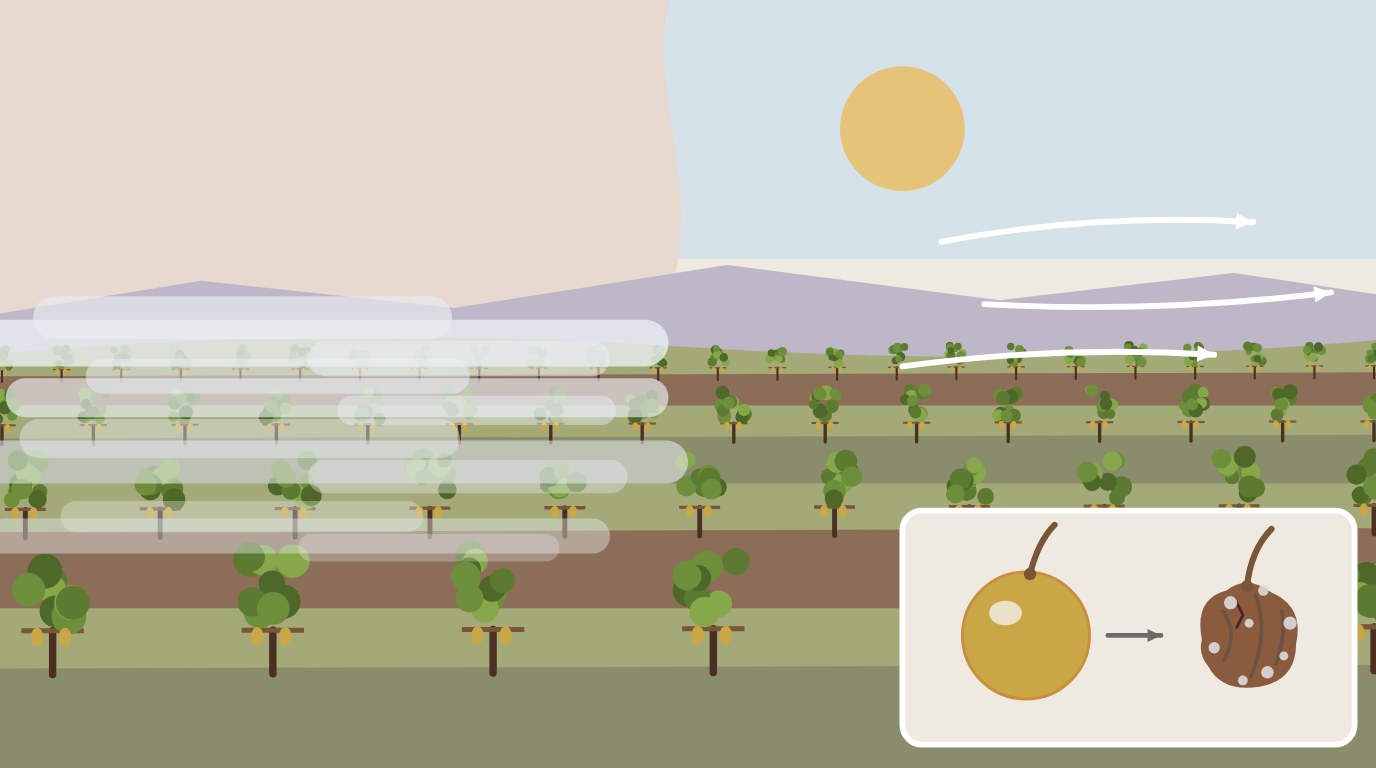
The US National Weather Service describes two kinds of fog that matter for vineyards. Radiation fog forms on clear, calm nights, when the ground loses heat and cools the air beside it below its dew point. It is patchy, tends to stay where it forms, is favoured in sheltered valleys and near bodies of water, and burns off once the sun warms the ground. Advection fog forms when warm, moist air moves over a colder surface and is cooled from below until it is saturated. It can form under cloud and in moderate to strong wind, it can last for days, and the Weather Service calls it most common on the US West Coast.
The difference matters because the two fogs do different things to a vineyard. Radiation fog belongs to a calm, clear night, the same kind of night that cools the ground and can bring frost. Advection fog is a weather pattern that can cool a whole district through the day. This article uses the two labels only where a source or standard meteorology supports them; where a wine tradition names a fog without measuring it, the text says so.
Napa: sea fog that cools by day
The Napa Valley Vintners describe a Mediterranean climate in which the south of the valley is cooled by marine breezes and fog from San Pablo Bay and the Petaluma Gap. In Los Carneros, summer highs rarely exceed 80 °F (27 °C), while in Calistoga, at the northern end, daytime summer temperatures may exceed 100 °F (38 °C). The Vintners note a difference of 10 °F (about 6 °C) or more between the cooler south and the warmer north.
Fog and cool air carried inland by sea breezes is what the Weather Service classes as advection fog, although the Vintners’ page speaks of fog and breezes without using that term. This cooling is regional and works through the day, so it shapes which grapes and styles suit a district. It is a different effect from the local one of a lake, described below.
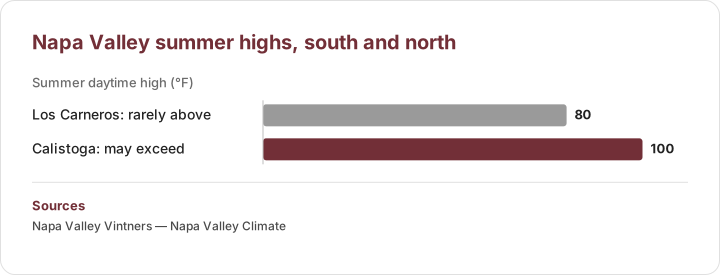
Diagram drawn from sourced data
Summer daytime highs as the Napa Valley Vintners describe them: in Los Carneros rarely above 80 °F (27 °C), in Calistoga possibly above 100 °F (38 °C). The bars show these thresholds, not measured averages.
Summer daytime high (°F)
- Los Carneros: rarely above: 80 °F
- Calistoga: may exceed: 100 °F
Cold air drains downhill: valley floors can be frost pockets
The University of California’s frost-protection guidance for vineyards explains what happens on a calm, clear night: the soil radiates heat to the sky, the air nearest the ground cools, and this cold, dense air flows downhill and pools in low spots. The result is a temperature inversion, with the coldest air on the vineyard floor. A slope speeds the drainage unless something blocks the flow. Penn State Extension adds that cold-air drainage leaves mid-slope sites warmer than the valley floor, and Cornell’s Finger Lakes Grape Program reports that slope and air drainage reduce spring and fall frost and winter injury, while flat or bottom sites suffered serious injury in freezes that hillsides came through with normal crops.
So a river valley is not simply a warm place. Its floor can host radiation fog, which the Weather Service says is favoured in sheltered valleys and near water, and it can collect cold air, while the slope above stays warmer. A large body of water that stores heat is a separate effect, and it works the other way; which one dominates depends on scale and site.
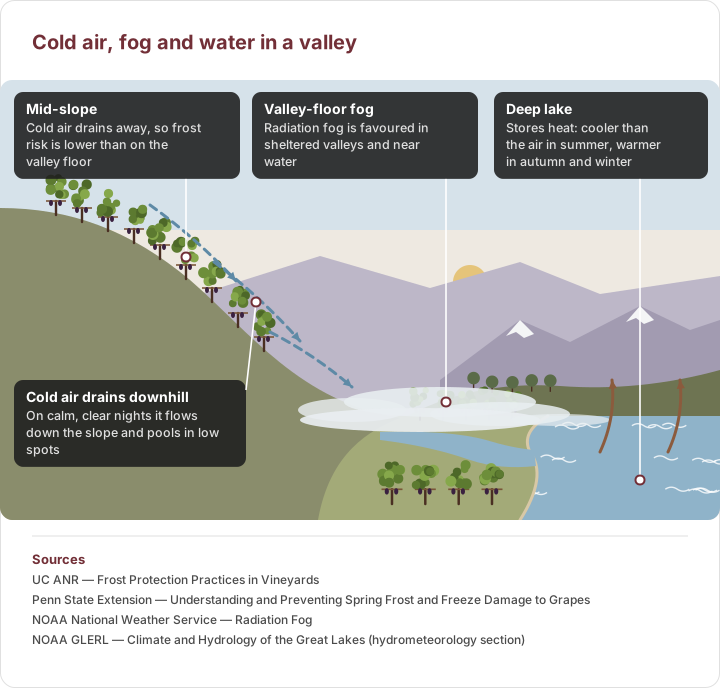
Diagram drawn from sourced data
A valley seen from the side. Cold, dense air flows down the slope and pools on the floor, where radiation fog can form; the slope above stays warmer, and a deep lake stores heat. Shapes are illustrative; no temperatures are shown.
- Mid-slope — Cold air drains away, so frost risk is lower than on the valley floor
- Valley-floor fog — Radiation fog is favoured in sheltered valleys and near water
- Deep lake — Stores heat: cooler than the air in summer, warmer in autumn and winter
- Cold air drains downhill — On calm, clear nights it flows down the slope and pools in low spots
River mist and noble rot: Sauternes and Barsac
Sauternes and Barsac lie on the left bank of the Garonne, where the small river Ciron flows into it. The Bordeaux wine council (CIVB) and the Sauternes and Barsac growers’ union describe how, in autumn, the meeting of the waters brings morning mist over the vines, and how this favours Botrytis cinerea, the noble rot that concentrates the sugar in the berries.
The mist is necessary but not sufficient. According to the CIVB, humid mornings followed by warm, sunny afternoons that dry the grapes give noble rot, while prolonged rain or humidity gives grey rot. A peer-reviewed study of Botrytis on Garganega grapes names the same pair of conditions: humid nights, foggy mornings and dry, sunny days for noble rot, strong rain or humidity for grey rot.
Growers often explain the mist by the difference in temperature between the cooler Ciron and the Garonne. The sources used here give no measured temperatures for the two rivers, so none are quoted.
Langhe nebbia: a name and a harvest tradition
The consortium for Barolo, Barbaresco, Alba, Langhe and Dogliani says that the name Nebbiolo is said to come from nebbia, the Italian word for fog. It gives two explanations: the bloom on the berries, or the fact that the variety ripens so late that the harvest meets the first autumn fogs. Nebbiolo ripens in the first half of October and does best on hillsides between 200 and 450 m, facing south to south-west and sheltered from frost.
The fog here is a naming and harvest-season tradition. No meteorological study was found that links fog to the ripening or quality of Nebbiolo. As general meteorology, autumn valley fog is usually radiation fog, but that is not a measured finding for the Langhe. What the consortium does state in measurable terms is height, aspect and frost shelter, which connect to the cold-air drainage described above.
Large lakes store heat: the Finger Lakes
NOAA’s Great Lakes laboratory (GLERL) describes large lakes as having a large capacity to store heat. They are cooler than the air in spring and summer and warmer than the air in autumn and winter, so they moderate the air temperature near them and also affect wind and humidity.
Cornell’s Finger Lakes Grape Program applies this to the four larger Finger Lakes: Canandaigua, Keuka, Seneca and Cayuga. They are 300 to 650 feet deep (about 90 to 200 m) and rarely freeze. Though much smaller than the Great Lakes, they moderate winter lows and buffer temperatures at sites within a few miles. Seneca and Cayuga give the most moderation; Keuka and Canandaigua give less, with earlier autumn frost at higher elevations.
The moderation is partial. Cornell’s regional overview says that severe winter injury to vinifera vines still occurs about once a decade, and slope and air drainage still matter. The scale is also worth keeping apart: a lake effect reaches a few miles, while the sea fog of Napa is regional.
Lakes in Switzerland and Italy, and one in Hungary
Lavaux: UNESCO inscribed about 30 km of south-facing vineyard terraces on the north shore of Lake Geneva, from Chillon to Lausanne, in 2007. Local bodies, the Lavaux heritage association and the Swiss Chasselas promotion, describe “three suns”: direct sunshine, light reflected from the lake, and heat stored in the terrace walls and released at night. This is a local, traditional explanation. The UNESCO text speaks of terraces and the use of local resources, not of measured reflection. How much sunlight a water surface reflects depends strongly on the angle of the sun, so the share that reaches the vines is not a figure these sources give. The lake’s heat storage in general is documented (see above); the reflected light is not quantified.
Lake Neuchâtel: the Chasselas promotion places Vaud’s vineyards around Lakes Geneva, Neuchâtel and Morat and describes Bonvillars, on the Vaud shore of Lake Neuchâtel, as favoured by the lake’s thermal advantages. The Swiss federal climate-adaptation programme lists a pilot project in which the University of Neuchâtel studies viticulture on the lake shores under rising temperatures. These sources give no figures for the lake’s effect, so none are quoted.
Lake Garda: the Bardolino consortium describes a temperate, sub-continental climate shaped by Lake Garda, the moraine hills and Monte Baldo, in which the lake attenuates temperature swings and breezes ventilate the vines. The consortium speaks of Mediterranean, continental and mountain microclimates within one area, and its zonation work (2002 to 2007) defined the Montebaldo, La Rocca and Sommacampagna subzones.
Lake Balaton in Hungary is often described with the same moderating-lake story. The pages found for this article were trade and tourism pages, not a weather service or a university, so the article makes no claim about it.
Rivers as heat buffers: Mosel, Rhine and Loire
The German Wine Institute describes the Mosel as a region of steep, terraced slopes above the river, where slate stores daytime heat and releases it at night. It describes the Rheingau as the Taunus foothills with south-facing slopes along the stretch where the Rhine runs east to west between Wiesbaden and Rüdesheim. The Rhine is often called a reflector and a heat store for those slopes, but the Institute’s text describes the slopes, not measurements of the river, so treat that as a traditional explanation. InterLoire describes a temperate oceanic climate on the Loire that becomes more continental away from the river.
In these three cases the sources name slope, aspect, rock and distance from the Atlantic. The river’s own contribution as a heat buffer is not measured in them, and the cold-air pooling described earlier shows that a valley can also be colder than the slope above it.
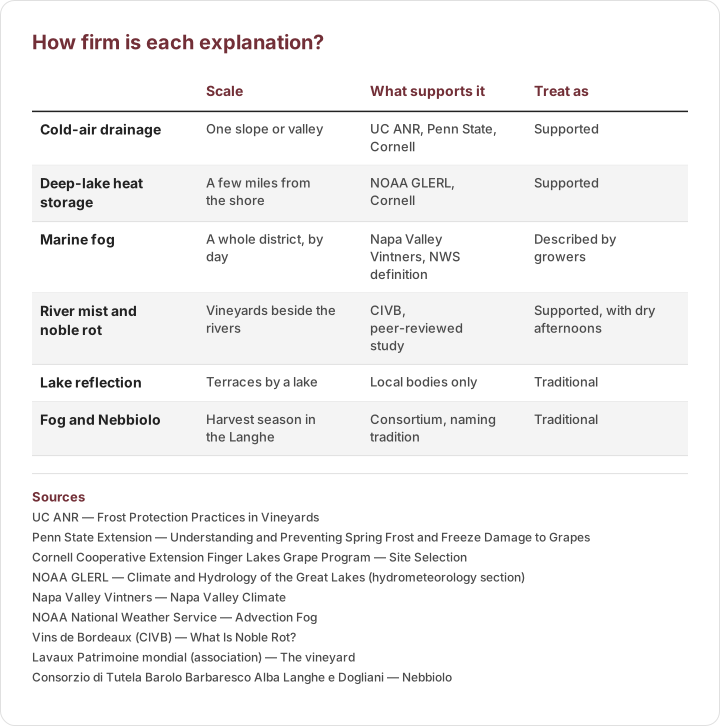
Diagram drawn from sourced data
The mechanisms of this article by scale, by what supports them and by how firmly. “Supported” means a weather service, university or appellation body states it; “Traditional” means it is repeated locally without measurement.
| Scale | What supports it | Treat as | |
|---|---|---|---|
| Cold-air drainage | One slope or valley | UC ANR, Penn State, Cornell | Supported |
| Deep-lake heat storage | A few miles from the shore | NOAA GLERL, Cornell | Supported |
| Marine fog | A whole district, by day | Napa Valley Vintners, NWS definition | Described by growers |
| River mist and noble rot | Vineyards beside the rivers | CIVB, peer-reviewed study | Supported, with dry afternoons |
| Lake reflection | Terraces by a lake | Local bodies only | Traditional |
| Fog and Nebbiolo | Harvest season in the Langhe | Consortium, naming tradition | Traditional |
Sources
- UC ANR — Frost Protection Practices in Vineyards
- Penn State Extension — Understanding and Preventing Spring Frost and Freeze Damage to Grapes
- Cornell Cooperative Extension Finger Lakes Grape Program — Site Selection
- NOAA GLERL — Climate and Hydrology of the Great Lakes (hydrometeorology section)
- Napa Valley Vintners — Napa Valley Climate
- NOAA National Weather Service — Advection Fog
- Vins de Bordeaux (CIVB) — What Is Noble Rot?
- Lavaux Patrimoine mondial (association) — The vineyard
- Consorzio di Tutela Barolo Barbaresco Alba Langhe e Dogliani — Nebbiolo
Exercise: valley floor or slope above a lake?
[Question]
A grower compares two sites: a flat site beside a small river on a valley floor, and a mid-slope site a few miles from a deep lake. Explain what fog, cold air and heat storage may do at each site, and separate what is supported by weather and farm sources from what is tradition.
[Model answer]
On the valley floor, radiation fog is favoured in sheltered valleys and near water, and cold, dense air drains downhill and pools there, so the floor is the coldest part of the site and carries the greater frost risk. River mist helps noble rot only when it is followed by dry, sunny afternoons. On the mid-slope, air drainage keeps the site warmer than the floor, and a deep lake within a few miles stores heat and moderates winter lows, although severe winter injury can still occur about once a decade. Supported: the Weather Service’s fog definitions, the frost-drainage guidance from the University of California and Penn State, and Cornell’s account of lake moderation. Tradition: lake reflection (“three suns”), the river as a reflector, and fog as a cause of Nebbiolo’s quality.
[Mark scheme (6 marks)]
• Explains radiation fog and cold-air pooling on the valley floor, and the condition for noble rot (2 marks)
• Explains the warmer mid-slope and the lake’s heat storage, with its limits and its reach of a few miles (2 marks)
• Separates supported mechanisms from traditional explanations, with examples (2 marks)
Fog
- Radiation fog: a clear, calm night cools the air
- Advection fog: moist air moves over a cold surface
- Mist helps noble rot only with dry, sunny afternoons
Water
- Large, deep lakes store heat
- The moderation reaches a few miles
- Reflection claims are traditional
Slope
- Cold air drains downhill and pools
- Mid-slope stays warmer than the floor
- Check the source of each claim
Frequently asked questions
What is the difference between radiation fog and advection fog?
Radiation fog forms on clear, calm nights when the ground cools the air below its dew point; it is patchy and burns off with the sun. Advection fog forms when warm, moist air moves over a colder surface; it can occur under cloud and in wind and can last for days (US National Weather Service).
Does fog cause noble rot?
Not by itself. Morning mist favours Botrytis cinerea in Sauternes and Barsac, but noble rot needs humid mornings followed by warm, sunny, drying afternoons. Prolonged rain or humidity gives grey rot instead (Bordeaux wine council, CIVB).
Do lakes really make vineyards warmer?
Large, deep lakes store heat and moderate the air temperature within a few miles; in the Finger Lakes the moderation is partial, and severe winter injury still occurs about once a decade (Cornell). The idea that lakes reflect extra sunlight onto the vines is a local, traditional explanation that these sources do not quantify.
Sources
- NOAA National Weather Service — Radiation Fog
- NOAA National Weather Service — Advection Fog
- UC ANR — Frost Protection Practices in Vineyards
- Penn State Extension — Understanding and Preventing Spring Frost and Freeze Damage to Grapes
- Napa Valley Vintners — Napa Valley Climate
- Vins de Bordeaux (CIVB) — What Is Noble Rot?
- Syndicat viticole de Sauternes et Barsac — The wines
- Frontiers in Plant Science via PMC — The Induction of Noble Rot (Botrytis cinerea) Infection during Postharvest Withering Changes the Metabolome of Grapevine Berries (Garganega)
- Consorzio di Tutela Barolo Barbaresco Alba Langhe e Dogliani — Nebbiolo
- NOAA GLERL — Climate and Hydrology of the Great Lakes (hydrometeorology section)
- Cornell Cooperative Extension Finger Lakes Grape Program — Site Selection
- Cornell CALS — New York Grape Growing Regions
- UNESCO World Heritage Centre — Lavaux, Vineyard Terraces
- Lavaux Patrimoine mondial (association) — The vineyard
- Chasselas.ch — The Chasselas wine regions
- Swiss Confederation (NCCS) — D.01 Viticulture on Lake Neuchâtel (climate adaptation pilot project)
- Consorzio di Tutela Chiaretto e Bardolino — Zonation and microclimates
- German Wine Institute (DWI) — Mosel (wine region)
- German Wine Institute (DWI) — Rheingau (wine region)
- InterLoire — Loire Valley wines (protected geographical names)