
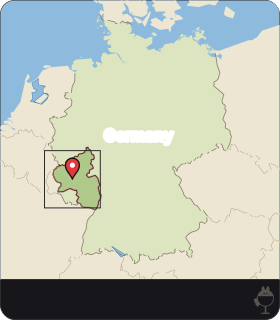
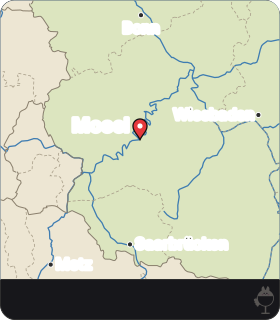
The region: one river, two tributaries and a change of name
The region takes its name from the river, called the Moselle in French and the Mosel in German. Its vineyards follow the winding main valley and the side valleys of the Saar and the Ruwer. Until 2007 the region's official name was Mosel-Saar-Ruwer; since then it has simply been called Mosel.
Riesling is the grape the region is best known for, and its wines are typically light in body and alcohol, with high acidity. This article follows three questions: why the vineyards sit on such steep slopes, what the slate does and does not do, and how German wine law separates the ripeness of the grapes at harvest from the sweetness of the finished wine.
Some statements about the Mosel are repeated so often that they sound like measurements: that slate stores heat and warms the vines at night, or that the rock gives the wine a mineral taste.
Slope, aspect and elevation
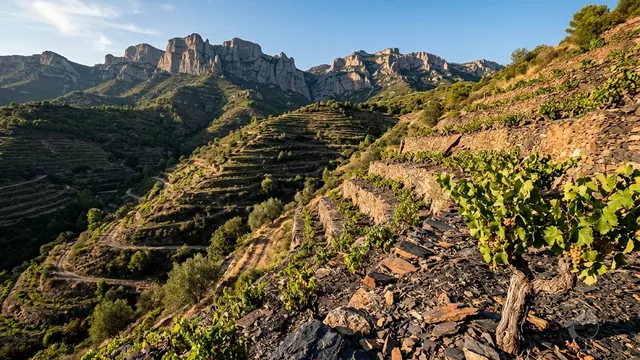
The Mosel is known for some of the steepest vineyards in Europe. The best-known example is the Bremmer Calmont, above the village of Bremm; published figures for its steepest gradient range from about 65 to 68 degrees.
Aspect matters as much as angle. The Calmont's stone terraces face south, and they are described as catching the sun and giving off its warmth. Because the river winds, the valley sides face many directions.
On slopes like these, machines can rarely do the work. The steepest sites are built as terraces held by retaining walls and reached by stairs, and much of the work is done by hand with the help of specialised equipment, which makes it labour-intensive.
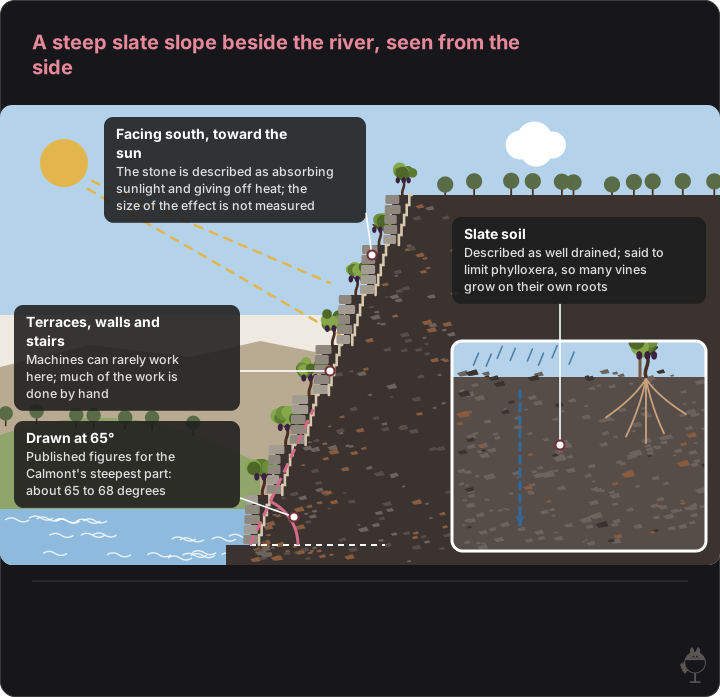
The terraced face is drawn at 65°, the lower end of the published figures (about 65 to 68 degrees) for the steepest part of the Bremmer Calmont; most Mosel slopes are less steep. The cutaway shows stony slate soil, with rain draining down through it. Shapes and colours are illustrative.
Read the figure as text
- Facing south, toward the sun — The stone is described as absorbing sunlight and giving off heat; the size of the effect is not measured
- Terraces, walls and stairs — Machines can rarely work here; much of the work is done by hand
- Drawn at 65° — Published figures for the Calmont's steepest part: about 65 to 68 degrees
- Slate soil — Described as well drained; said to limit phylloxera, so many vines grow on their own roots
Slate: what the rock is, and what it is said to do
Slate is a fine-grained metamorphic rock formed from shale-like sediment, and it splits into thin, flat plates. The Mosel's slopes are known for slate of Devonian age. For a sense of that age: the Hunsrück Slate, a Lower Devonian unit named after the Hunsrück uplands, is dated to about 408 to 400 million years ago.
Three effects are commonly attributed to the slate on these slopes. First, drainage: the soils are described as well drained. Second, warmth: the dark stone is described as absorbing sunlight by day and giving off heat afterwards. Third, protection from phylloxera, which section 5 covers. The first two are described but not measured.
Tasting notes for Mosel Riesling often use words such as slate or wet stone. Treat them as tasting vocabulary. Such tasting terms do not establish that minerals from the rock pass into the wine and create that taste.

 AI
·
Slate plates in the hand
Image: Maison Apéro (generated image) · Maison Apéro original
A cool climate and the question of ripeness
The Mosel is a cool-climate wine region. Its Rieslings are generally described as light in body, often low in alcohol and high in acidity.
How ripe the grapes become varies by site and by year, and German wine law ties the levels of Prädikatswein to that ripeness, measured as the must weight at harvest. Section 6 explains how ripeness and the label connect.
Own-rooted vines and work by hand
Phylloxera is an insect that attacks the roots of the vine; because of it, most European vines are now grafted onto resistant American rootstocks. Specialist writers report that the Mosel's steep, well-drained slate soils limit the pest's ability to spread, and that many Mosel vines still grow on their own roots (in German, wurzelecht) rather than being grafted.
That does not mean the slate makes vines immune. What is reported is a limit on spread, not an absence of the pest.
The same slopes that protect old vines make them hard to farm. Where machines cannot go, pruning, canopy work and harvest are done by hand, on terraces and stairs.
Prädikat: ripeness at harvest, and no added sugar
The upper quality tiers of German wine are Qualitätswein and Prädikatswein. Prädikatswein carries one of six terms based on how ripe the grapes were at harvest, measured as must weight: Kabinett, Spätlese, Auslese, Beerenauslese, Eiswein and Trockenbeerenauslese.
The key rule: Prädikatswein may not be enriched. No sugar may be added to the must to raise the alcohol, so all of its alcohol comes from the grapes' own sugar. Qualitätswein, by contrast, may be enriched within the limits of EU and German rules.
The Prädikat says nothing direct about how sweet the finished wine is. A Kabinett or a Spätlese can be fermented fully dry or left with sugar. For the sweetness itself, look for a separate term on the label (next section).
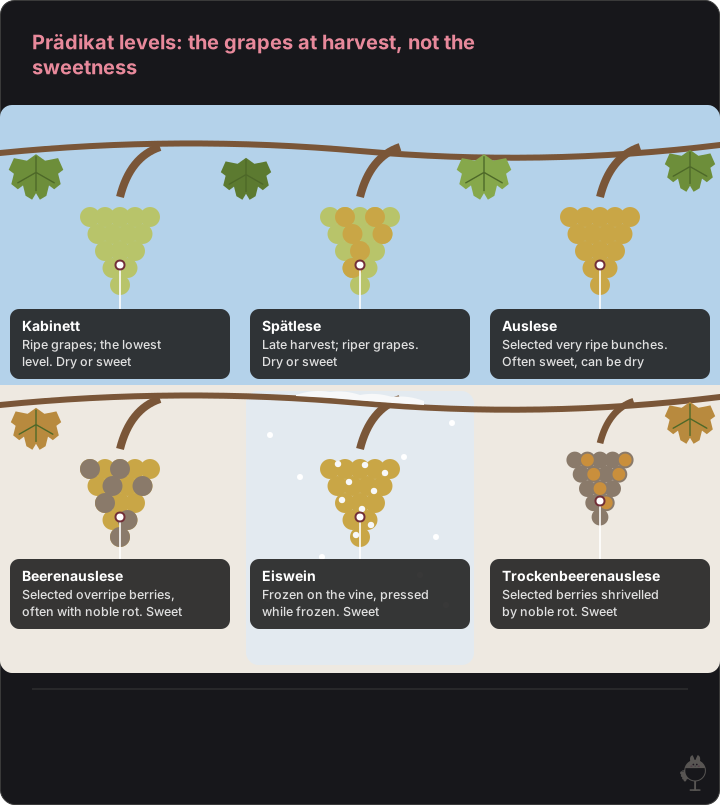
Each bunch shows the state of the grapes a level calls for at harvest, from Kabinett to Trockenbeerenauslese; ripeness is measured as must weight. No Prädikatswein may be enriched with added sugar, and the wine's sweetness is shown by separate terms. Shapes and colours are illustrative.
Read the figure as text
- Kabinett — Ripe grapes; the lowest level. Dry or sweet
- Spätlese — Late harvest; riper grapes. Dry or sweet
- Auslese — Selected very ripe bunches. Often sweet, can be dry
- Beerenauslese — Selected overripe berries, often with noble rot. Sweet
- Eiswein — Frozen on the vine, pressed while frozen. Sweet
- Trockenbeerenauslese — Selected berries shrivelled by noble rot. Sweet
Sweetness on the label, and the role of acidity
EU rules set the terms that describe the sugar content of still wine, and German labels use the German forms: trocken (dry), halbtrocken (medium-dry), lieblich (medium-sweet) and süß (sweet). The limits are set in grams of residual sugar per litre.
A wine may be called trocken with up to 4 g/L of sugar, or with up to 9 g/L if its total acidity, expressed as tartaric acid, is no more than 2 g/L below the sugar. Halbtrocken allows up to 12 g/L, or up to 18 g/L if the total acidity is no more than 10 g/L below the sugar. Lieblich covers wines above the halbtrocken limit up to 45 g/L, and süß means at least 45 g/L.
That acidity condition is what makes these rules interesting for the Mosel. A Riesling with 9 g/L of sugar and 7 g/L of total acidity meets the trocken condition, because its acidity is only 2 g/L below the sugar. The same 9 g/L in a wine with 5 g/L of acidity would not: its acidity is 4 g/L below the sugar, so the wine falls under halbtrocken instead. In the same way, a wine with 18 g/L of sugar and 8 g/L of acidity can still be called halbtrocken, because its acidity is 10 g/L below the sugar. The rules therefore let a high-acid wine carry more sugar under the same word.
If a label carries no sweetness term, the label alone does not tell you how sweet the wine is; a producer's technical sheet that gives residual sugar and total acidity will.
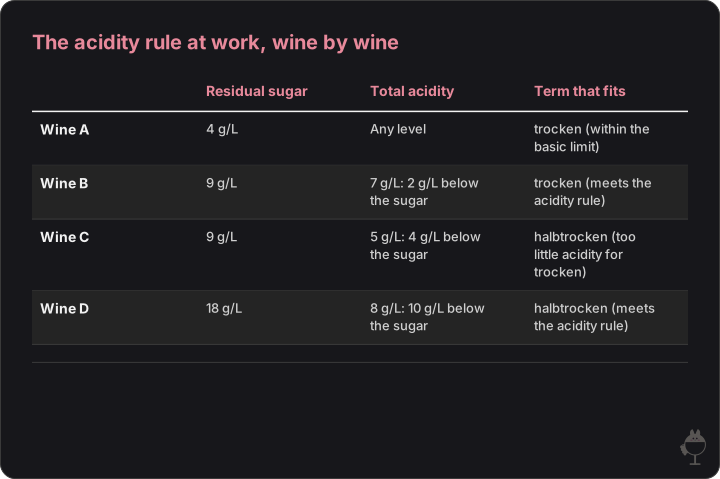
Illustrative wines, not real ones, checked against the EU sugar terms for still wine. Total acidity is expressed as tartaric acid; trocken = dry, halbtrocken = medium-dry.
Read the figure as text
| Residual sugar | Total acidity | Term that fits | |
|---|---|---|---|
| Wine A | 4 g/L | Any level | trocken (within the basic limit) |
| Wine B | 9 g/L | 7 g/L: 2 g/L below the sugar | trocken (meets the acidity rule) |
| Wine C | 9 g/L | 5 g/L: 4 g/L below the sugar | halbtrocken (too little acidity for trocken) |
| Wine D | 18 g/L | 8 g/L: 10 g/L below the sugar | halbtrocken (meets the acidity rule) |
In the glass: judging sweetness and acidity separately
Taste with the label in mind, but test it against the glass. First, note alcohol and body: Mosel Riesling is typically light in both. Second, judge acidity on its own: how much it makes your mouth water. Third, judge sweetness separately: how much sugar you perceive, from the first sip to the finish.
Then put the three together. Check whether the acidity makes the sugar seem less obvious, and whether a wine labelled trocken can still taste ripe. If the producer publishes a technical sheet, compare your impression with its figures for residual sugar and total acidity.
Finally, describe the aroma in your own words. Notes such as citrus, apple, white flowers or slate are common in tasting notes, but they are impressions, not proof of where the wine comes from.
Written exercise 1: slopes and slate
Question
Explain how the steep slopes of the Mosel are said to help Riesling ripen, and separate what is measured from what is only described.
Model answer
The steepest sites are very steep: published figures for the steepest gradient of the Bremmer Calmont range from about 65 to 68 degrees. Its terraces face south, toward the sun, and the stone is described as absorbing sunlight and giving off heat. The slate soils are also described as well drained. The gradient is a measured figure, although sources differ slightly; the warming effect of the stone and the drainage are described, but their size is not measured. A complete answer also notes the cost: machine work is often impractical, so the steepest terraces are worked largely by hand.
Points to check
- Names the Calmont and gives its gradient as a range (about 65 to 68 degrees).
- Links the south-facing aspect to sunlight.
- States that heat and drainage are described rather than measured.
- Mentions hand work as the practical consequence.
Written exercise 2: two terms on one label
Question
A Mosel label reads "Riesling Kabinett trocken". Explain what each of the two German terms tells you, and whether sugar may have been added before fermentation.
Model answer
Kabinett is a Prädikat: it describes the ripeness of the grapes at harvest, measured as must weight. Because the wine is a Prädikatswein, it may not be enriched, so no sugar was added to raise its alcohol. Trocken is a separate, EU-defined sweetness term: the wine has at most 4 g/L of residual sugar, or at most 9 g/L if its total acidity is no more than 2 g/L below the sugar. With 9 g/L of sugar, it would therefore need at least 7 g/L of total acidity to be called trocken. Kabinett alone would not tell you whether the wine is dry or sweet.
Points to check
- Identifies Kabinett as a level of ripeness at harvest, not a sweetness term.
- States that Prädikatswein may not be enriched.
- Gives the trocken limits (4 g/L, or 9 g/L with the acidity condition) and applies them.
- Concludes that the two terms answer different questions.
The site
- Steep slopes, some facing south (Calmont about 65–68°)
- Devonian slate soils, described as well drained
The vineyard
- Hand work on terraces where machines cannot go
- Slate limits phylloxera's spread; many own-rooted vines
The wine and its label
- Light body, often low alcohol, high acidity
- Prädikat shows ripeness; trocken or süß shows sweetness
Frequently asked questions
How steep are the Mosel's steepest vineyards?
The Bremmer Calmont, above the village of Bremm, is often called Europe's steepest vineyard; published figures for its steepest gradient range from about 65 to 68 degrees. On slopes like this machines can rarely work, so the terraces are farmed largely by hand.
Is a Mosel Riesling Kabinett always sweet?
No. Kabinett is a Prädikat, a level based on the ripeness of the grapes at harvest, and the wine may be fermented dry or left with sugar. Sweetness is shown by a separate term such as trocken (dry), which under EU rules means at most 4 g/L of sugar, or up to 9 g/L when the acidity is high enough.
Why are there own-rooted vines in the Mosel?
Specialist writers report that the steep, well-drained slate soils limit the spread of phylloxera, the root pest that forced most European vineyards onto grafted rootstocks. Many Mosel vines therefore still grow on their own roots (wurzelecht), although the slate does not make them immune.
Sources
- Wikipedia — Mosel (wine region)
- Wines of Germany — Mosel (growing area)
- Wine-atlas — Bremmer Calmont
- Wine Enthusiast (partner content) — Iconic German Vineyards: a guide to some of Germany's great vineyard sites
- Wikipedia — Hunsrück Slate
- Wikipedia — Slate
- Wine-Searcher — Ungrafted Vines: Wine from a Time Capsule (May 2020)
- Jesse Becker MS — Mosel: Winding Slopes of Slate
- Wikipedia — German wine classification
- Grape Guru — Prädikatswein (glossary)
- EUR-Lex — Commission Delegated Regulation (EU) 2019/33, Annex III Part B (sugar-content terms for still wine)