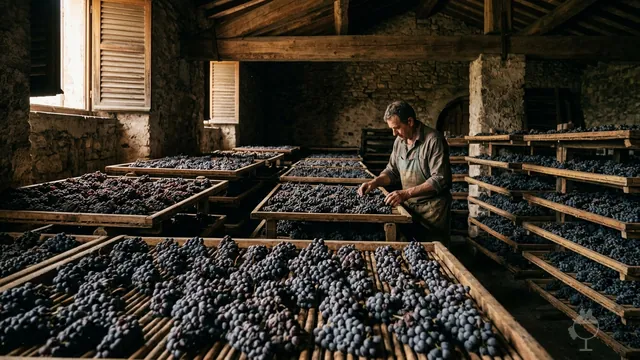

Where Sauternes is and what the appellation covers
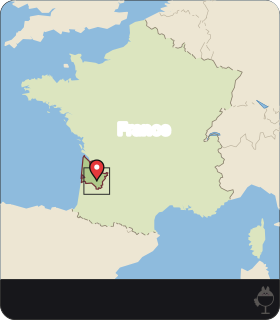
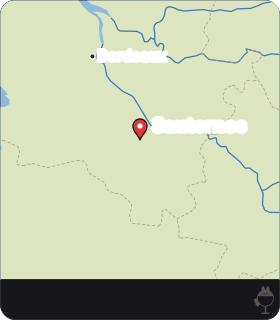
Sauternes lies about 40 kilometres south-east of Bordeaux, in the valley of the Garonne. The appellation's rules confine the harvest, winemaking and ageing to five communes of the Gironde: Barsac, Bommes, Fargues, Preignac and Sauternes. Barsac also has an appellation of its own.
Sauternes is a sweet white wine. The rules require grapes harvested overripe, with noble rot present, and picked by hand in successive passes through the vineyard, known as tries. The Sauternes and Barsac vineyard covers about 2,200 hectares.
This article follows the chain from the river mist to the berry and then to the rules that define the wine.
 AI
·
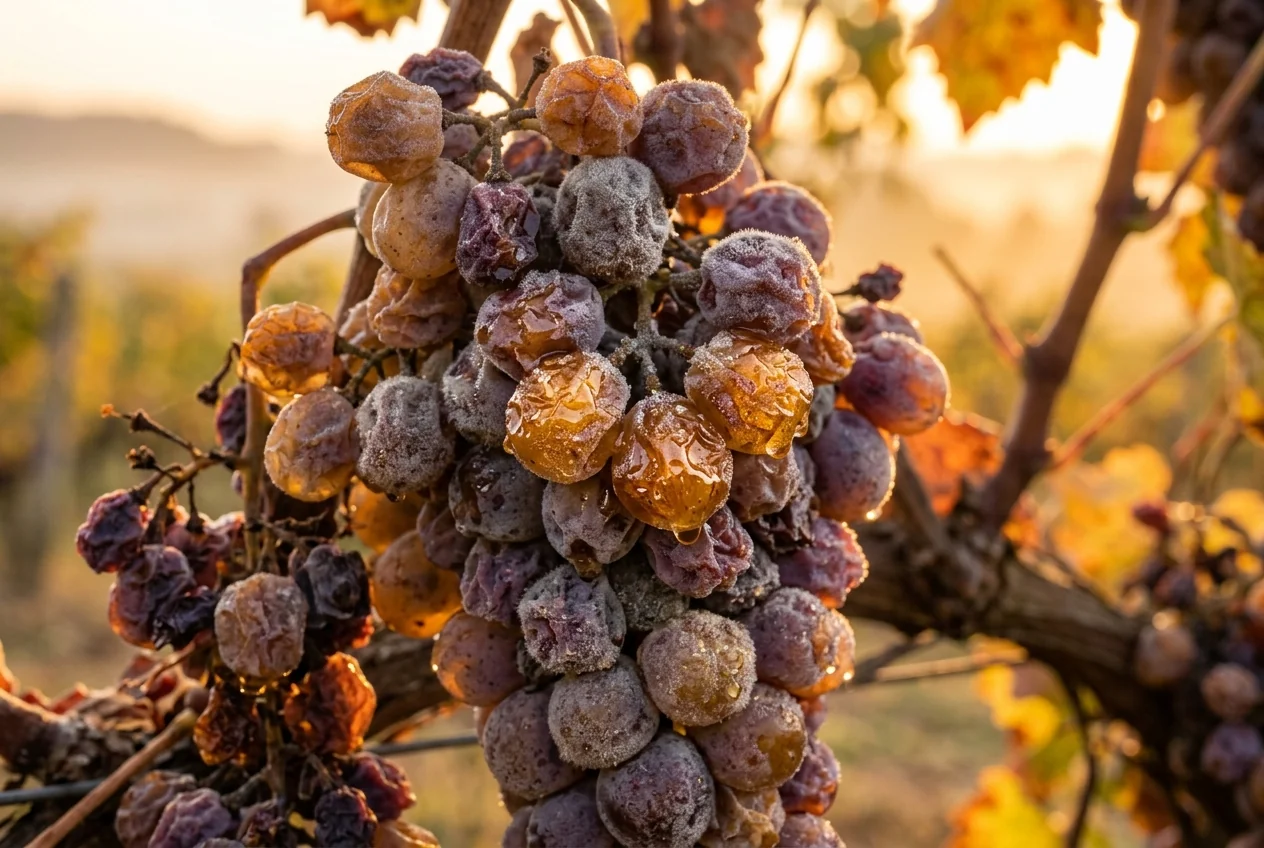
Close-up: shrivelled, mould-coated berries
Image: Maison Apéro (generated image) · Maison Apéro original
Terroir: soils, relief, elevation and aspect
Gravel is the signature of the slopes. The Sauternes gravels were torn from the Pyrenees and the Massif Central and carried down by the Garonne and its tributaries; the pebbles, from one to several centimetres across, sit in a mostly sandy matrix that may be calcareous or clayey.
Erosion has shaped these gravels into low rounded hills, the croupes, between 15 and 60 metres above sea level. On the right bank of the Ciron, the communes of Preignac, Fargues, Sauternes and Bommes lie on an inclined plateau whose substrate of shelly limestone, marl or clayey sand dates from the Tertiary.
The vineyard faces east-south-east, which favours natural ventilation. Air movement matters here because the grapes must dry after damp nights, as the next section explains.
Climate: the Ciron, the Garonne and autumn mist
The Ciron is a small river that rises in the Landes and flows into the Garonne in the Sauternes area. Its water is cooler than the Garonne's. Where the two meet, condensation brings abundant humidity, and the resulting autumn mists favour the development of Botrytis cinerea.
The appellation depends on an alternation: humid nights, then rapid and strong ventilation by day. The damp phase lets the fungus establish itself on ripe grapes; the drying phase stops the infection from turning into a destructive rot. Neither phase alone produces noble rot.
 AI
·
Grape bunches and river mist
Image: Maison Apéro (generated image) · Maison Apéro original
Noble rot or grey rot: the weather decides
Botrytis cinerea is a grey fungus. Infection needs moist conditions, and grapes are typically infected when they are ripe. What happens next depends on the weather: if it stays wet, the infection takes its damaging form, grey rot, which can destroy the crop.
If the infected ripe grapes are then exposed to drier conditions, they become partially raisined: this beneficial form is noble rot. Picked at the right point, such grapes can give a particularly concentrated sweet wine. Sauternes depends on exactly this result: noble rot that concentrates the grapes.
The figure below sets the two outcomes of the same fungus side by side.
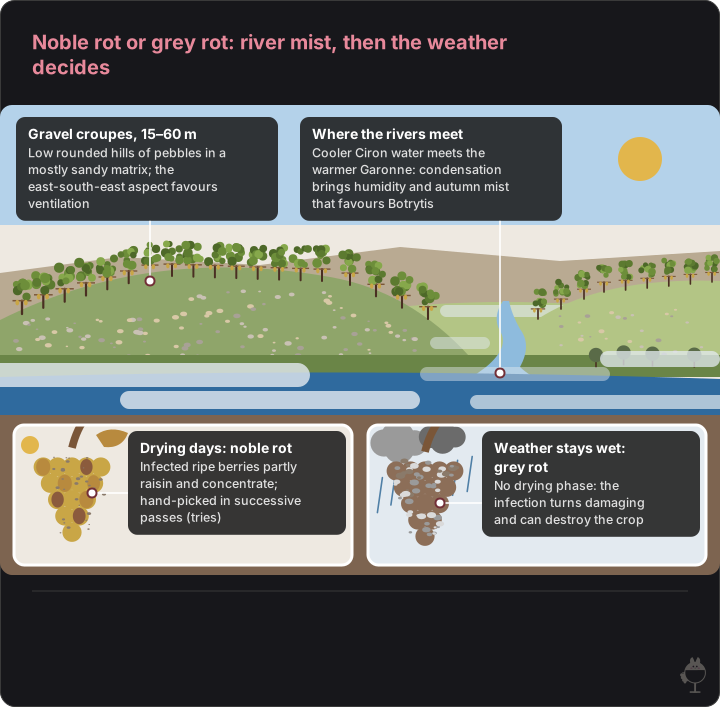
Damp autumn nights and mist where the cooler Ciron meets the Garonne let Botrytis cinerea settle on ripe grapes. If drying days follow, the berries shrivel into noble rot (left); if the weather stays wet, grey rot sets in (right). Shapes and colours are illustrative; hill heights and river widths are not to scale.
Read the figure as text
- Where the rivers meet — Cooler Ciron water meets the warmer Garonne: condensation brings humidity and autumn mist that favours Botrytis
- Gravel croupes, 15–60 m — Low rounded hills of pebbles in a mostly sandy matrix; the east-south-east aspect favours ventilation
- Drying days: noble rot — Infected ripe berries partly raisin and concentrate; hand-picked in successive passes (tries)
- Weather stays wet: grey rot — No drying phase: the infection turns damaging and can destroy the crop
Grapes, harvest and the appellation rules
Four grape varieties are allowed: Sémillon, Sauvignon blanc, Sauvignon gris and Muscadelle. Sémillon is the principal variety.
The rules require picking by hand in successive passes (tries), taking grapes that are overripe with noble rot. Grapes with less than 221 grams of sugar per litre of must are not considered properly ripe, and the yield is set at 25 hectolitres per hectare.
The wine must reach a natural alcoholic strength of at least 15%, and wine sold in bulk or in bottle must contain at least 45 grams per litre of fermentable sugars (glucose and fructose). Together, these limits mean that a Sauternes keeps part of its grape sugar as sweetness.
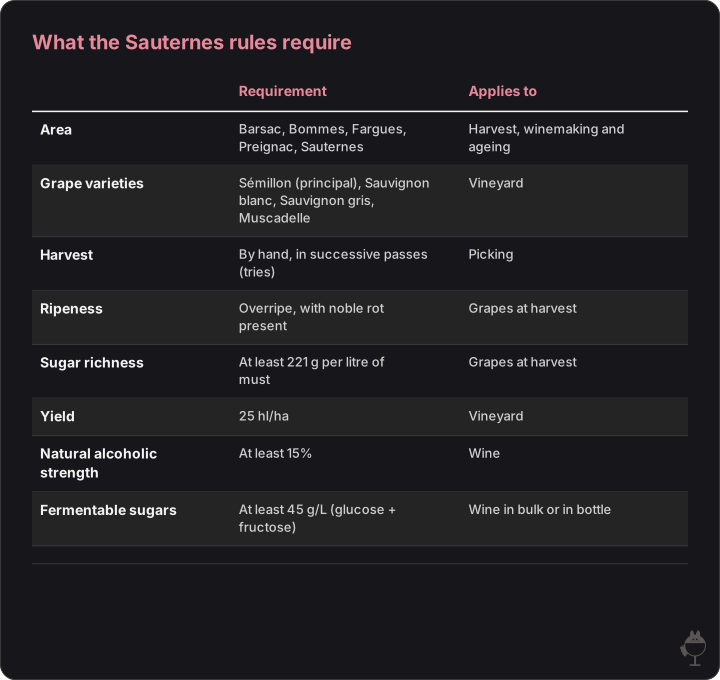
Requirements of the Sauternes appellation rules. Every wine labelled Sauternes, classified or not, must meet them.
Read the figure as text
| Requirement | Applies to | |
|---|---|---|
| Area | Barsac, Bommes, Fargues, Preignac, Sauternes | Harvest, winemaking and ageing |
| Grape varieties | Sémillon (principal), Sauvignon blanc, Sauvignon gris, Muscadelle | Vineyard |
| Harvest | By hand, in successive passes (tries) | Picking |
| Ripeness | Overripe, with noble rot present | Grapes at harvest |
| Sugar richness | At least 221 g per litre of must | Grapes at harvest |
| Yield | 25 hl/ha | Vineyard |
| Natural alcoholic strength | At least 15% | Wine |
| Fermentable sugars | At least 45 g/L (glucose + fructose) | Wine in bulk or in bottle |
1855: Sauternes on a list of its own, and Château d'Yquem
The 1855 classification of Bordeaux wines ranked the sweet white wines of Sauternes and Barsac in a list of their own, separate from the red wines. In it, Château d'Yquem alone received the rank of Premier Cru Supérieur, above the first growths.
The classification ranks châteaux and does not change the appellation rules: classified or not, every producer who labels a wine Sauternes follows the same rules. The classification itself is explained in a separate article.
In the glass: what to look for
Start with sweetness and balance. Every Sauternes contains at least 45 grams of sugar per litre, so the question is not whether the wine is sweet but whether its acidity keeps that sweetness lively or lets it feel heavy.
Then describe colour and aroma in your own words: note whether the colour sits nearer to pale gold or to deep amber, and which aromas you actually find. Write down what you observe before reading a producer's description, so that your note records the wine rather than the label.
Practice question 1: how the mist helps noble rot
Question
Explain how the meeting of the Ciron and the Garonne, together with the daily pattern of the weather, allows Botrytis cinerea to become noble rot rather than grey rot.
Model answer
The Ciron's water is cooler than the Garonne's. Where the two rivers meet, condensation brings abundant humidity, and mists form in autumn. In this damp phase, at night and in the morning, Botrytis cinerea establishes itself on ripe grapes. By day, rapid and strong ventilation, helped by the vineyard's east-south-east orientation, dries the grapes. Because the damp phase is followed by drying, the infected berries become partially raisined and concentrated (noble rot); if the weather stayed wet, the infection would turn into damaging grey rot.
Self-check
- Did you explain why mist forms where the rivers meet?
- Did you link humidity to the development of the fungus?
- Did you explain why daytime drying is what keeps the rot noble?
Practice question 2: what the rules require
Question
Summarise how the Sauternes appellation rules control the harvest and the sweetness of the wine, and explain what their figures tell you.
Model answer
The grapes must be picked by hand in successive passes (tries), overripe and with noble rot present. Grapes with less than 221 g of sugar per litre of must are not considered ripe, and the yield is set at 25 hl/ha. The wine must reach a natural alcoholic strength of at least 15% and keep at least 45 g/L of fermentable sugars. The high sugar threshold at harvest and the residual-sugar floor together guarantee a sweet wine made from concentrated grapes; the yield of 25 hl/ha and the repeated hand-picking reflect the selection the rules demand.
Self-check
- Did you mention hand-picking in successive passes and noble rot?
- Did you give the sugar threshold at harvest and the yield, with units?
- Did you state the minimum natural alcoholic strength and residual sugar, and what they mean together?
Setting
- Cooler Ciron water meets the warmer Garonne: autumn mist
- East-south-east aspect and daytime ventilation dry the grapes
In the berry
- In the damp, Botrytis cinerea establishes itself on ripe grapes
- Drying turns the infection into noble rot: berries raisin and concentrate
In the wine
- Picked by hand in successive passes (tries)
- A sweet wine with at least 45 g/L of sugar
Frequently asked questions
Where is Sauternes, and how big is its vineyard?
Sauternes lies about 40 km south-east of Bordeaux, in the Garonne valley. Harvest, winemaking and ageing are confined to five communes of the Gironde, and the Sauternes and Barsac vineyard covers about 2,200 hectares. Its gravels form low rounded hills, the croupes, 15 to 60 m above sea level, facing east-south-east.
Why does mist form in Sauternes?
The small Ciron river, which rises in the Landes, has cooler water than the Garonne it flows into. Where the two meet, condensation brings abundant humidity and autumn mists. Humid nights followed by strong daytime ventilation are what allow noble rot to develop.
What do the Sauternes appellation rules require?
Grapes from five communes (Barsac, Bommes, Fargues, Preignac and Sauternes) and from Sémillon, Sauvignon blanc, Sauvignon gris and Muscadelle, picked by hand in successive passes when overripe with noble rot. The grapes need at least 221 g/L of sugar, the yield is set at 25 hl/ha, and the wine must have a natural alcoholic strength of at least 15% and at least 45 g/L of fermentable sugars.
Which Sauternes estate was ranked highest in 1855?
Château d'Yquem. In the 1855 classification, which ranked the sweet wines of Sauternes and Barsac separately from the reds, it alone was ranked Premier Cru Supérieur.
See also: What is noble rot? (Noble Rot Sweet Wines Compared: Sauternes, Loire, Alsace, Germany, Austria and Tokaj)
Sources
- INAO — Specification (cahier des charges) of the Sauternes controlled designation of origin
- INAO — Specification (cahier des charges) of the Barsac controlled designation of origin
- Conseil des Grands Crus Classés en 1855 — Sauternes and Barsac: the terroir
- Conseil des Grands Crus Classés en 1855 — Sauternes and Barsac terroir sheet (PDF, French)
- Wikipedia — Noble rot
- Wikipedia — Ciron (river)
- Wikipedia — Bordeaux Wine Official Classification of 1855
- Wikipedia — Château d’Yquem