

What the canopy is and what it controls
A vine's canopy is the whole of its shoots and leaves. It intercepts the sunlight that drives photosynthesis, and it also sets the microclimate of the fruit zone: how much light reaches the clusters, how warm they become and how quickly they dry after rain or dew.
Growers change that microclimate with a set of tools: shoot thinning, shoot positioning, trimming, leaf removal and dividing the canopy. This article follows the light from the leaf wall to the berry, through shade, skin flavonols, the green-pepper compound IBMP and the risk of sunburn.
Dense canopies and the shade inside them
When shoots are crowded, the outer leaves intercept most of the light and the inside of the canopy stays in deep shade. Fruit from such shaded canopies tends to have less sugar, anthocyanin and phenolics, and more potassium and malic acid with a higher pH. Dense canopies also stay humid for longer, which favours fungal disease.
Canopy work aims to keep the leaf wall thin. Shoot thinning removes surplus shoots, shoot positioning spreads the remaining ones into a thin wall, trimming cuts shoots that outgrow the wall, and leaf removal opens the fruit zone.
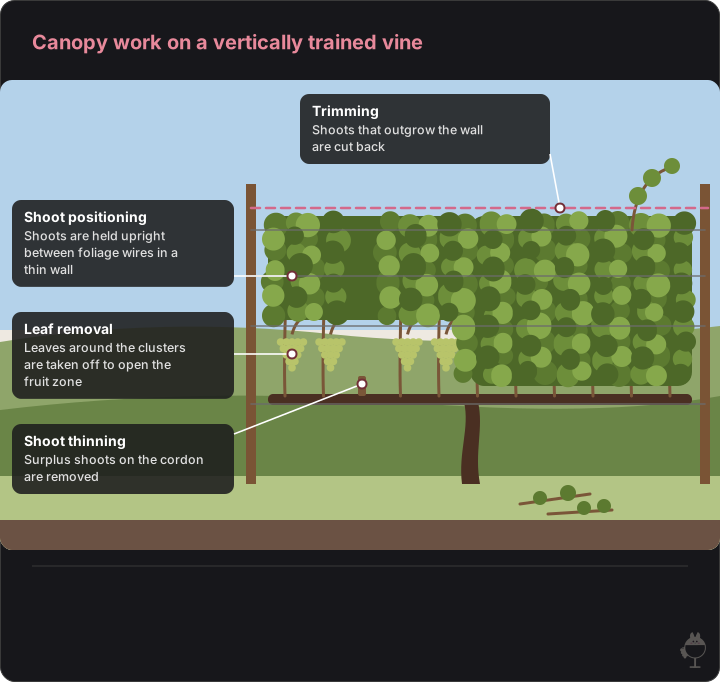
A stretch of a row with vertical shoot positioning. On the left the fruit zone has been opened; on the right leaves still cover the clusters. Shoot thinning, shoot positioning, trimming and leaf removal together keep the leaf wall thin. Shapes and colours are illustrative.
Read the figure as text
- Trimming — Shoots that outgrow the wall are cut back
- Shoot positioning — Shoots are held upright between foliage wires in a thin wall
- Leaf removal — Leaves around the clusters are taken off to open the fruit zone
- Shoot thinning — Surplus shoots on the cordon are removed
Sunlight, UV-B and skin flavonols
Sunlight on the skin changes the berry's phenolic make-up, but not every compound responds in the same way. Ultraviolet B is the part of sunlight between 280 and 315 nm. Flavonols such as quercetin glycosides respond to it most clearly: in a field study of Merlot, Spayd and colleagues (2002) found higher flavonol levels in sun-exposed clusters, and screening out ultraviolet lowered them.
Anthocyanins, the red pigments, behaved differently. In the same study, the clusters exposed on the side of the row that takes the afternoon sun ran hottest, and the authors attributed their lower anthocyanin levels mainly to temperature rather than to light. More generally, flavonol synthesis depends strongly on light, while high temperature can reduce anthocyanin accumulation, so the benefit of exposure depends on how hot the fruit becomes.
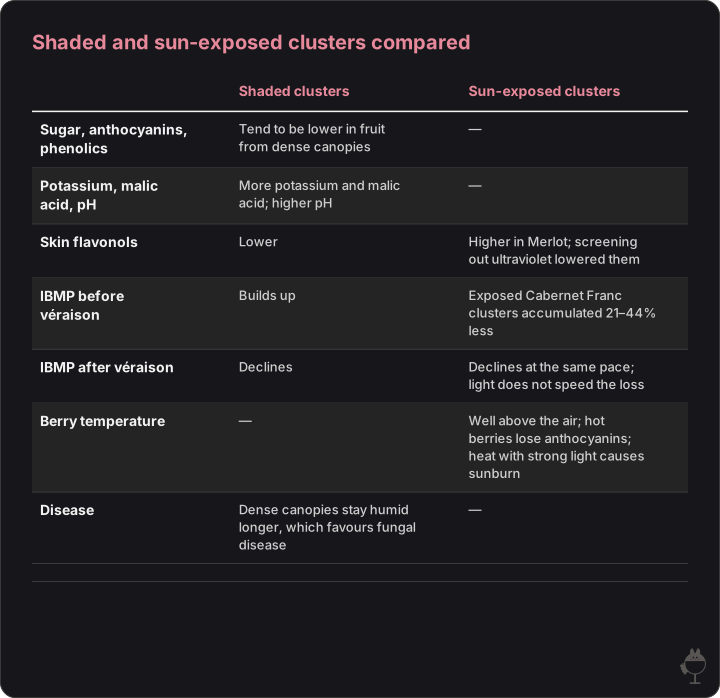
What the studies cited in this article found for fruit inside a dense canopy and for fruit exposed to the sun. The IBMP rows are from one study on Cabernet Franc; the heat rows from Merlot in a warm site.
Read the figure as text
| Shaded clusters | Sun-exposed clusters | |
|---|---|---|
| Sugar, anthocyanins, phenolics | Tend to be lower in fruit from dense canopies | — |
| Potassium, malic acid, pH | More potassium and malic acid; higher pH | — |
| Skin flavonols | Lower | Higher in Merlot; screening out ultraviolet lowered them |
| IBMP before véraison | Builds up | Exposed Cabernet Franc clusters accumulated 21–44% less |
| IBMP after véraison | Declines | Declines at the same pace; light does not speed the loss |
| Berry temperature | — | Well above the air; hot berries lose anthocyanins; heat with strong light causes sunburn |
| Disease | Dense canopies stay humid longer, which favours fungal disease | — |
IBMP: why the timing of exposure matters
3-Isobutyl-2-methoxypyrazine (IBMP) is the methoxypyrazine behind green-pepper and herbaceous aromas in grapes such as Cabernet Franc, Cabernet Sauvignon and Sauvignon Blanc. It builds up in the berries before véraison and declines afterwards.
Ryona and colleagues (2008) followed IBMP in exposed and shaded Cabernet Franc clusters. Exposed clusters accumulated 21–44% less IBMP before véraison, but light did not speed up its decline after véraison. Light exposure, in other words, changed how much IBMP accumulated, not how fast it was broken down.
The practical conclusion is that exposure has to come early, between fruit set and véraison, if the aim is lower IBMP. Leaves removed after véraison add light and heat to the fruit without hastening the loss of IBMP. Sunlight does not simply burn off pyrazines late in ripening.
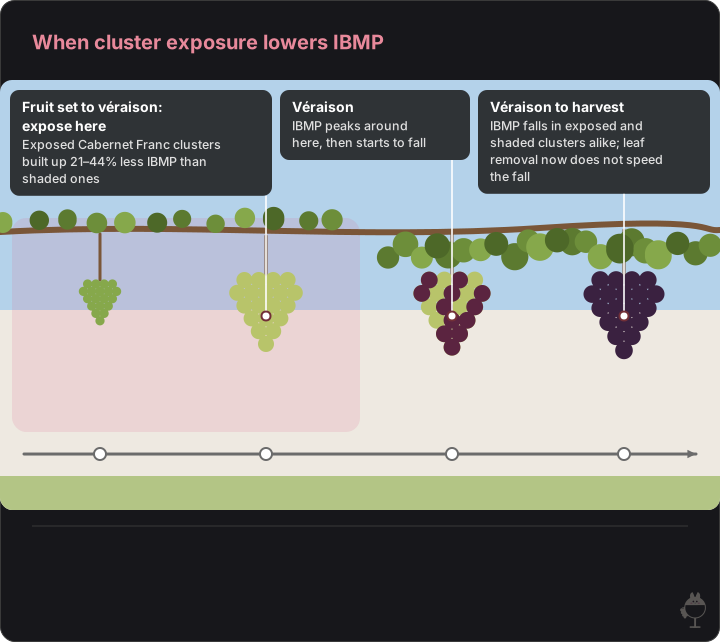
Clusters from fruit set (left) to harvest (right). Opening the fruit zone between fruit set and véraison is what lowers IBMP; after véraison IBMP falls anyway, and light does not speed the fall. Shapes and colours are illustrative.
Read the figure as text
- Fruit set to véraison: expose here — Exposed Cabernet Franc clusters built up 21–44% less IBMP than shaded ones
- Véraison — IBMP peaks around here, then starts to fall
- Véraison to harvest — IBMP falls in exposed and shaded clusters alike; leaf removal now does not speed the fall
Heat and sunburn in warm climates
In hot, sunny regions, full exposure can do harm. Berries in direct sun can become considerably warmer than the surrounding air, and heat combined with strong radiation causes browning and, in severe cases, death of skin tissue (Gambetta and colleagues, 2021). Hot berries lose anthocyanins even when they receive plenty of light (Spayd and colleagues, 2002).
Growers therefore match leaf removal to the sun's path. On rows that run north–south, the west side of the canopy takes the afternoon sun, when the air is hottest, so in warm sites leaves are often kept on that side and removed mainly on the side that receives the morning sun. Shade cloth over the fruit zone and particle films of kaolin clay sprayed onto the fruit to reflect radiation are further options, and fruit exposed early in the season copes better with sun than fruit exposed suddenly in mid-summer.

 AI
·
Working in the fruit zone
Image: Maison Apéro (generated image) · Maison Apéro original
Training systems: VSP and divided canopies
The trellis sets the starting shape of the canopy. Vertical shoot positioning (VSP) trains the shoots upward between foliage wires into a narrow, vertical wall, with the fruit zone along the bottom. On fertile sites with vigorous vines the wall thickens, and the fruit zone falls into shade.
For vigorous vines, dividing the canopy is an option. Systems such as the Geneva Double Curtain and the lyre split the leaf wall into two thinner curtains, so that a larger share of the leaves and fruit is exposed to light.
What reaches the glass
Because each mechanism acts on a different compound, canopy work leaves several traces in a wine. Fruit with less IBMP gives less green-pepper character in varieties prone to it. Exposed skins carry more flavonols, and fruit that stayed cool enough keeps more of its anthocyanins, whereas sunburnt berries bring browned, damaged skins to the fermenter. Fruit from shaded canopies tends to arrive with a higher pH, more malic acid and less colour.
None of these is a single setting to maximise. The right canopy depends on the climate, the vigour of the site and the variety: more light in cool, cloudy places, protection from afternoon heat in hot ones, and early timing wherever IBMP is the concern.
Practice question 1: shade, IBMP and timing
Question
A Cabernet Franc vineyard has a dense, shaded fruit zone, and its wines show strong green-pepper aromas. Explain what IBMP is, how cluster shading affects it, and when leaf removal should be done to lower it.
Model answer
IBMP (3-isobutyl-2-methoxypyrazine) is the methoxypyrazine responsible for green-pepper aromas. It accumulates in the berries before véraison and declines after it. Ryona and colleagues (2008) found that exposed Cabernet Franc clusters accumulated 21–44% less IBMP before véraison than shaded clusters, while light did not speed up the decline after véraison. Leaf removal in the fruit zone should therefore be done between fruit set and véraison. Removing leaves after véraison will not lower IBMP and may expose the fruit to heat. Opening the canopy also lets the fruit zone dry faster, which reduces the risk of fungal disease.
Mark scheme (self-check, 10 points)
- Identifies IBMP as the source of green-pepper aroma and describes accumulation before véraison and decline after it (3 points)
- Explains, with evidence, that exposure reduces accumulation but does not speed up degradation after véraison (4 points)
- Recommends early leaf removal and explains why late removal does not help (3 points)
Practice question 2: leaf removal in a hot climate
Question
A grower in a hot, sunny region plans to strip all the leaves around the clusters on both sides of north–south rows. Explain the risks and propose a better approach.
Model answer
Full exposure in a hot climate can overheat the fruit. Berries in direct sun can be much warmer than the air, and heat combined with strong radiation causes sunburn browning or, in severe cases, necrosis of the skin (Gambetta and colleagues, 2021). High berry temperature also lowers anthocyanins even when light is plentiful (Spayd and colleagues, 2002), so stripping the fruit zone may cost colour rather than add it. A better approach is to remove leaves mainly on the side that receives the morning sun and keep them on the west side, which takes the afternoon sun; to do any leaf removal early, since fruit exposed early copes better with sun than fruit exposed suddenly later; and, where needed, to use shade cloth or a kaolin particle film. Early leaf removal on the morning side still lets light reach the clusters before véraison, which also limits IBMP.
Mark scheme (self-check, 10 points)
- Explains sunburn and the loss of anthocyanins under heat (4 points)
- Proposes leaf removal on the morning side, done early (3 points)
- Names at least one further measure, such as shade cloth or kaolin (3 points)
Canopy practices
- Shoot thinning and shoot positioning into a thin wall
- Leaf removal in the fruit zone between fruit set and véraison
- Leaves kept on the afternoon side in hot sites
Fruit-zone microclimate
- Less shade inside the canopy and faster drying
- More light and UV on the clusters before véraison
- Cooler clusters in the afternoon
Berry composition
- Less of the high pH and malic acid linked to shade
- Less IBMP accumulated; more skin flavonols
- Anthocyanins protected from heat loss
Frequently asked questions
What does canopy management change in the grapes?
It changes the light and temperature the clusters experience. Fruit from dense, shaded canopies tends to have less sugar and colour and a higher pH, with more potassium and malic acid (Smart, 1985). Sun-exposed skins accumulate more flavonols (Spayd and colleagues, 2002), and exposure before véraison limits the green-pepper compound IBMP (Ryona and colleagues, 2008).
When should leaves be removed to reduce green-pepper aromas?
Before véraison. In Cabernet Franc, exposed clusters accumulated 21–44% less IBMP before véraison than shaded ones, while light did not speed up the decline of IBMP after véraison (Ryona and colleagues, 2008). Leaf removal after véraison therefore does little for IBMP.
Why do growers in hot regions keep leaves on the afternoon side?
Berries in direct afternoon sun can become much warmer than the air, which leads to sunburn and to a loss of anthocyanins (Spayd and colleagues, 2002; Gambetta and colleagues, 2021). On north–south rows the west side takes the afternoon sun, so leaves are often kept there and removed mainly on the morning side. Shade cloth and kaolin particle films are further options.
Sources
- Smart, R. E. (1985). Principles of Grapevine Canopy Microclimate Manipulation with Implications for Yield and Quality. A Review. American Journal of Enology and Viticulture 36(3): 230–239
- Ryona, I. et al. (2008). Effects of cluster light exposure on 3-isobutyl-2-methoxypyrazine accumulation and degradation patterns in red wine grapes (Vitis vinifera L. cv. Cabernet Franc). Journal of Agricultural and Food Chemistry 56(22): 10838–10846 (PubMed)
- Spayd, S. E., Tarara, J. M., Mee, D. L. & Ferguson, J. C. (2002). Separation of Sunlight and Temperature Effects on the Composition of Vitis vinifera cv. Merlot Berries. American Journal of Enology and Viticulture 53(3): 171–182
- Downey, M. O., Dokoozlian, N. K. & Krstic, M. P. (2006). Cultural Practice and Environmental Impacts on the Flavonoid Composition of Grapes and Wine: A Review of Recent Research. American Journal of Enology and Viticulture 57(3): 257–268
- Gambetta, J. M., Holzapfel, B. P., Stoll, M. & Friedel, M. (2021). Sunburn in Grapes: A Review. Frontiers in Plant Science 11: 604691
- World Health Organization. Ultraviolet radiation (fact sheet)


