
Destemmed, whole bunch, or a share of each
Before a red wine ferments, the winemaker decides what to do with the stems. A destemmer separates the berries from the stems, and the berries may then be crushed. In whole-bunch fermentation, intact bunches go into the fermenter instead, stems and all.
The choice need not be all or nothing. The technique is most often used for Pinot Noir and Shiraz; with Pinot Noir the share of whole bunches is sometimes as high as 100%, but 15–20% is more common, especially with Shiraz. The rest of the fruit is destemmed as usual.
Putting bunches in whole changes two things at once: some berries stay intact and can ferment from within, and the stems release their own compounds into the wine. The sections below take them one at a time.
Two fermentations in one vat
Carbonic maceration is the extreme case. It is a whole-bunch technique in which the first phase of fermentation takes place in a completely anaerobic atmosphere: 100% intact bunches, with no free juice, are placed in a closed vessel filled with carbon dioxide, and enzymes inside the berries work without yeast.
An ordinary whole-bunch vat does not meet those conditions. Berries that break release juice, and yeast ferments it in the usual way. Berries that stay intact, surrounded by the carbon dioxide that this fermentation gives off, can meanwhile ferment inside their skins. The two processes run side by side, and the share of the second depends on how much of the fruit stays whole.
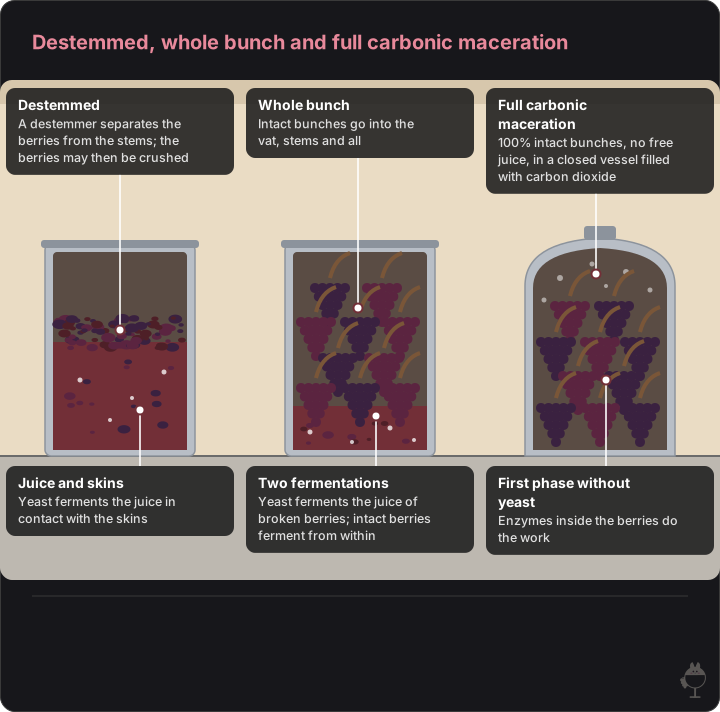
Three vessels drawn cut open. A whole-bunch vat sits between the two extremes: yeast ferments the juice of broken berries while intact berries ferment from within. Shapes, colours and juice levels are illustrative.
Read the figure as text
- Destemmed — A destemmer separates the berries from the stems; the berries may then be crushed
- Whole bunch — Intact bunches go into the vat, stems and all
- Full carbonic maceration — 100% intact bunches, no free juice, in a closed vessel filled with carbon dioxide
- Juice and skins — Yeast ferments the juice in contact with the skins
- Two fermentations — Yeast ferments the juice of broken berries; intact berries ferment from within
- First phase without yeast — Enzymes inside the berries do the work
What happens inside an intact berry
Held in an atmosphere rich in carbon dioxide, grape cells switch from respiration to an anaerobic metabolism called intracellular fermentation. It produces ethanol, breaks down malic acid, sets off pectolytic and proteolytic changes, forms volatile compounds and lets phenolic compounds diffuse from the skin into the pulp.
The amounts are small. The alcohol formed this way is about 1.5–2% and the loss of malic acid about half, with a small amount of sugar and malic acid turned into ethanol and traces of many aromatic compounds. These figures describe full carbonic maceration; in a whole-bunch vat only the intact part of the fruit is in that state.
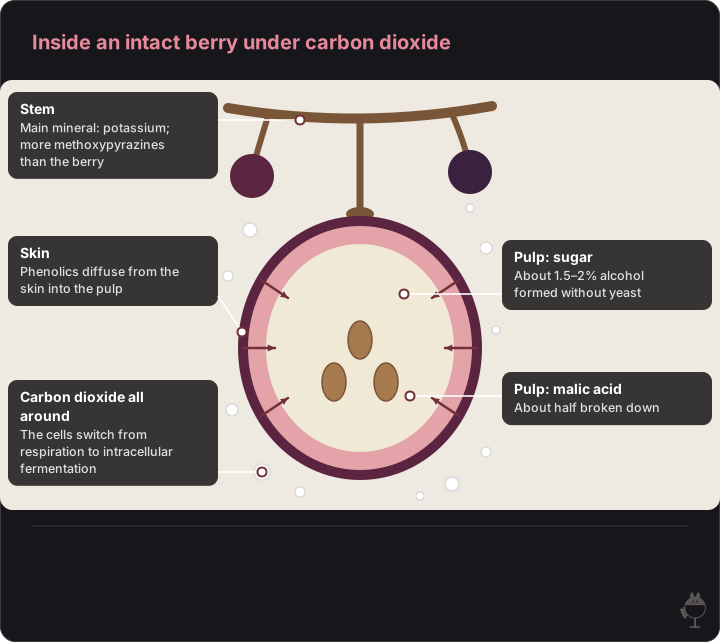
An intact berry in an atmosphere rich in carbon dioxide, drawn enlarged and cut open to show the skin, pulp and seeds. The quantities refer to full carbonic maceration; in a whole-bunch vat only the intact berries are in this state. Shapes and colours are illustrative.
Read the figure as text
- Stem — Main mineral: potassium; more methoxypyrazines than the berry
- Skin — Phenolics diffuse from the skin into the pulp
- Carbon dioxide all around — The cells switch from respiration to intracellular fermentation
- Pulp: sugar — About 1.5–2% alcohol formed without yeast
- Pulp: malic acid — About half broken down
What the stems release: potassium, pH, tannin and colour
Potassium is the main mineral element in grape stems, and adding stems raises the potassium, phosphorus and calcium content of the wine. These data support the hypothesis that potassium combines with tartaric acid and precipitates as potassium bitartrate; with less tartaric acid left, the pH rises and the titratable acidity can fall. In a Pinot Noir trial, the wines made with stems had a significantly higher pH than the destemmed wine, which the authors linked to the likely extraction of potassium from the stems.
Contact time seems to matter as well. In published data, the pH had not risen significantly after 7 days of contact with stems, but it had after 21 days.
Stems also change the phenolics. Higher proportions of whole bunches have been reported to increase tannin and monomeric phenolics significantly and to decrease anthocyanins. The effect on colour is less clear: winemakers generally see less colour, yet some published data show higher colour density. In the Pinot Noir trial, alcohol was lower when the share of whole bunches was high, possibly because of water released from the stems and a lower conversion of sugar into alcohol.
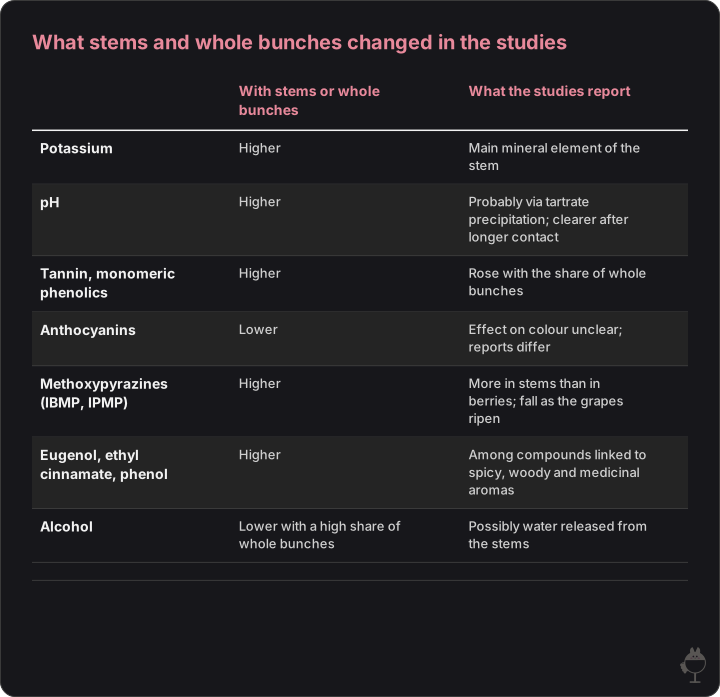
Directions of change reported against destemmed wine. Much of the data comes from Pinot Noir; these are tendencies, not fixed amounts.
Read the figure as text
| With stems or whole bunches | What the studies report | |
|---|---|---|
| Potassium | Higher | Main mineral element of the stem |
| pH | Higher | Probably via tartrate precipitation; clearer after longer contact |
| Tannin, monomeric phenolics | Higher | Rose with the share of whole bunches |
| Anthocyanins | Lower | Effect on colour unclear; reports differ |
| Methoxypyrazines (IBMP, IPMP) | Higher | More in stems than in berries; fall as the grapes ripen |
| Eugenol, ethyl cinnamate, phenol | Higher | Among compounds linked to spicy, woody and medicinal aromas |
| Alcohol | Lower with a high share of whole bunches | Possibly water released from the stems |
Green stems and woody stems
The biggest risk of whole bunches is grassy and herbal aromas and flavours, and overly astringent tannins, extracted from the stems. The best results come from bunches whose stems are highly lignified, woody rather than green.
Part of the reason is chemical. Of all the parts of the bunch, the stems hold the highest proportion of methoxypyrazines. IBMP, which has a herbaceous, earthy odour, and IPMP occur in larger amounts in stems than in berries, and their levels in the stems fall as the grapes ripen. IBMP is also easily extracted during pressing and maceration (Blackford and colleagues).
This is why the condition of the stems, and not only the ripeness of the berries, enters the decision.

 AI
·
Brown, woody stems in the vat
Image: Maison Apéro (generated image) · Maison Apéro original
One trial in detail: 30, 60 and 100% whole bunches
Wimalasiri and colleagues made five small-batch Pinot Noir wines: destemmed; destemmed with 100% of the stems added back; and 30%, 60% and 100% whole bunches.
Compounds linked to green or vegetal, spicy, woody and medicinal aromas (IBMP, IPMP, eugenol, ethyl cinnamate and phenol) rose significantly in the 60% and 100% whole-bunch wines and in the destemmed wine with its stems returned. That last wine had no intact bunches, so the stems themselves drove part of the change, not only intracellular fermentation.
One trial on one variety does not set a rule. It does show why a winemaker can treat the share of whole bunches as a dial rather than a switch.
In the glass: clues, not proof
What a taster can look for follows from the chemistry above. More tannin and a firmer, sometimes astringent texture can point to stems; grassy or herbal notes suggest stems that were not fully woody. Spicy or woody notes may come with them: in the Pinot Noir trial, the compounds that rose with stems included some that the authors link to spicy and woody aromas.
Colour is a poor clue: anthocyanins fell with more whole bunches in the reported data, but, as section 4 noted, the effect on colour itself is unclear. Treat these signs as hints to check against the producer's own notes, not as proof.
Practice questions, model answers and mark schemes
These two questions were written by Maison for self-study; they are not questions from any examination body.
[Question 1]
Explain what happens inside intact berries during whole-bunch fermentation, and why the effect is smaller than in full carbonic maceration.
[Model answer]
Intact berries surrounded by carbon dioxide switch from respiration to intracellular fermentation. Without yeast, enzymes in the berry turn a small amount of sugar into ethanol (about 1.5–2% in full carbonic maceration), break down malic acid (by about half), form volatile compounds and let phenolics diffuse from the skin into the pulp. Full carbonic maceration needs 100% intact bunches, no free juice and a closed vessel filled with carbon dioxide. In a whole-bunch vat some berries break and yeast ferments their juice, so only the intact share of the fruit undergoes intracellular fermentation.
[Mark scheme (10 marks)]
- Anaerobic, enzyme-driven metabolism inside the berry, without yeast (3 marks)
- The products: a little ethanol, less malic acid, volatile compounds, diffusion of phenolics (4 marks)
- The conditions of full carbonic maceration compared with a whole-bunch vat (3 marks)
[Question 2]
A winemaker adds whole bunches with green stems to a Pinot Noir ferment. Predict two chemical changes and one sensory risk, and explain each.
[Model answer]
First, potassium extracted from the stems can combine with tartaric acid and precipitate as potassium bitartrate, so the pH rises and acidity can fall; in published data, the rise was significant after 21 days of contact but not after 7. Second, tannin and monomeric phenolics increase while anthocyanins decrease. The sensory risk is grassy, herbal character and marked astringency: stems contain more methoxypyrazines, such as IBMP and IPMP, than berries, and their levels fall as the grapes ripen. The best results come with highly lignified, woody stems rather than green ones.
[Mark scheme (10 marks)]
- Potassium, tartrate precipitation and the direction of the change in pH and acidity (4 marks)
- More tannin and fewer anthocyanins (3 marks)
- The green-stem risk explained through methoxypyrazines and lignification (3 marks)
Cellar decision
- Intact bunches go into the vat, ideally with woody stems
In the vat
- Intact berries ferment from within; the stems release potassium, tannin and methoxypyrazines
In the glass
- Higher pH, more tannin, and a risk of grassy, herbal notes from green stems
Frequently asked questions
What is the difference between whole-bunch fermentation and carbonic maceration?
In whole-bunch fermentation, intact bunches are placed in an ordinary fermenter. Full carbonic maceration needs 100% intact bunches with no free juice in a closed vessel filled with carbon dioxide, and its first phase of fermentation is completely anaerobic. In a whole-bunch vat, yeast ferments the juice from broken berries while intact berries can ferment from within.
Why should the stems be woody (lignified)?
The biggest risk of whole bunches is grassy and herbal aromas and overly astringent tannins extracted from the stems, and the best results come with highly lignified stems. Stems contain more methoxypyrazines (IBMP, IPMP) than berries, and their levels fall as the grapes ripen.
Do stems change a wine's pH?
They tend to raise it. Potassium is the main mineral element in stems, and it can combine with tartaric acid and precipitate as potassium bitartrate; the pH then rises and titratable acidity can fall. In a Pinot Noir trial, wines made with stems had a higher pH than the destemmed wine, and in published data the rise was not significant after 7 days of contact but was after 21 days.
Sources
- The Australian Wine Research Institute (AWRI) — Winemaking treatment: whole bunch fermentation
- The Australian Wine Research Institute (AWRI) — Winemaking treatment: carbonic maceration
- Tesnière C., Flanzy C. (2011) Carbonic maceration wines: characteristics and winemaking process. Advances in Food and Nutrition Research 63: 1–15 (PubMed abstract)
- ScienceDirect Topics — Carbonic maceration (overview of book chapters)
- Blackford M. et al. (2021) A Review on Stems Composition and Their Impact on Wine Quality. Molecules 26(5): 1240
- Wimalasiri P.M. et al. (2022) Whole bunch fermentation and the use of grape stems: effect on phenolic and volatile aroma composition of Vitis vinifera cv. Pinot Noir wine. Australian Journal of Grape and Wine Research 28(3): 395–406