The background that matters
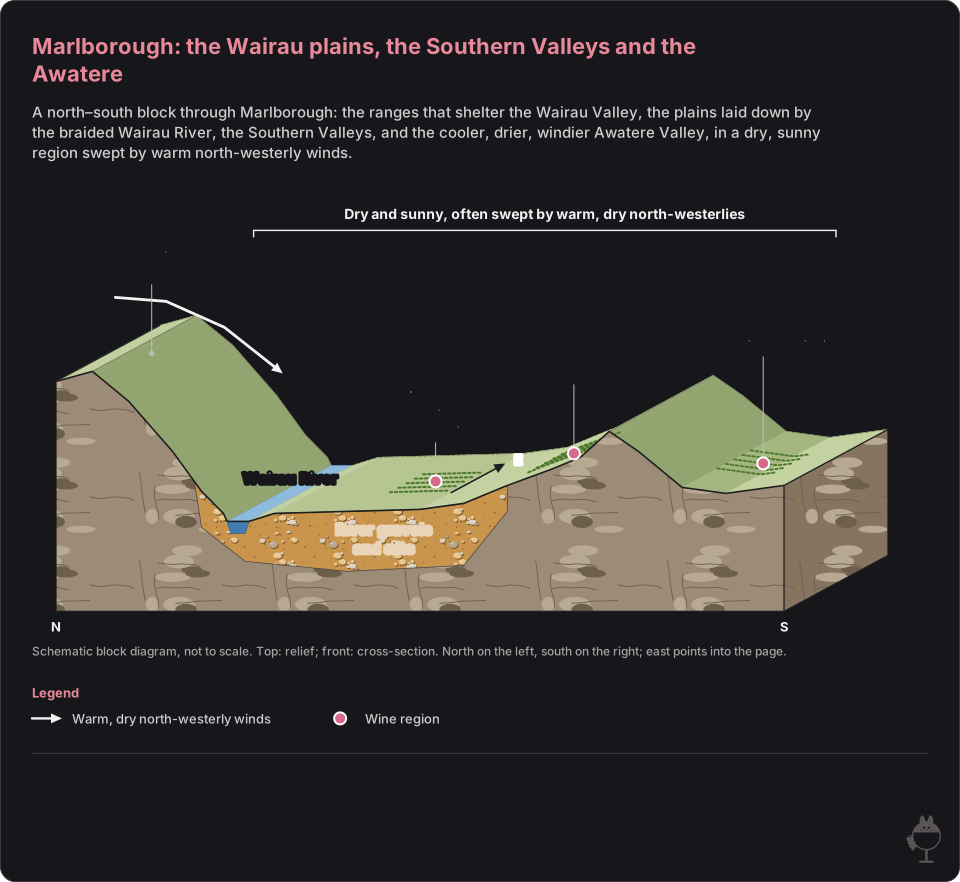
Marlborough is New Zealand’s largest winegrowing region; it has three sub-regions, the Wairau Valley, the Southern Valleys and the Awatere Valley, and the Awatere is cooler, drier and windier. The Wairau Valley has more than 2,400 hours of bright sunshine a year, the highest in the region. On the Wairau Plains, soil texture changes over short distances, reflecting the Wairau River’s braided past; one study found vines on near-surface gravel developing earlier than those on deep silt.
Read it alongside this wine
Both wines carry Marlborough, a geographical indication registered in 2018 that covers all three sub-regions, so the name alone does not tell you which valley or soil the fruit came from. Their published profiles agree on dry, high acidity, medium body and medium alcohol; the 2025 is recorded as youthful, with green fruit among its aroma groups, and the 2018 as developing, with bottle-age notes. Vintage and age differ at the same time, so treat them as two data points, not a rule for how Marlborough wines age.
Try it with the review
Read the two reviews side by side and list what stays the same and what changes. For each difference, ask whether bottle age, the vintage or both could explain it, and mark what the reviews alone cannot settle.
These are learning prompts, not guaranteed tasting results. Separate the published facts from your own observations.
Sources
- New Zealand Winegrowers – Marlborough regionChecked 2026-10-06
- IPONZ Geographical Indications Register – Marlborough (GI 1004)Checked 2026-10-06
- NIWA – The Climate and Weather of Marlborough, 2nd editionChecked 2026-10-06
- OENO One – The impact of differences in soil texture within a vineyard on vine vigour, vine earliness and juice compositionChecked 2026-10-06
- IVES Open Science – The impact of differences in soil texture within a vineyard on vine development and wine qualityChecked 2026-10-06