
What Port is, and who sets its rules
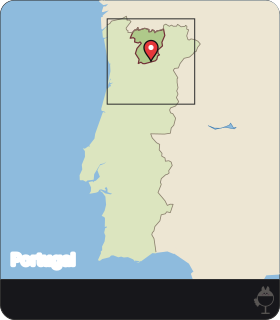
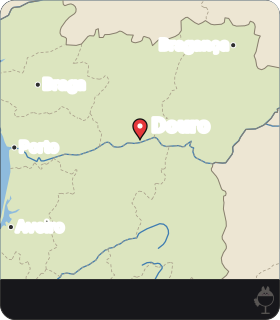
Port is made from grapes grown in the Douro Demarcated Region of north-eastern Portugal. The step that defines it happens in the cellar: grape spirit is added while the must is still fermenting, so the yeast stops working and part of the natural grape sugar remains in the wine.
The region’s regulation is old. On 10 September 1756, under the Marquis of Pombal, the Companhia Geral da Agricultura das Vinhas do Alto Douro was created to guarantee the origin and quality of the wine, and between 1757 and 1758 the first boundaries of the Douro were drawn and marked with stone posts. Today the Instituto dos Vinhos do Douro e do Porto (IVDP) certifies the spirit used, recognises the special categories and decides each year how much must may become Port. In 2001 UNESCO inscribed the Alto Douro Wine Region on the World Heritage List as a cultural landscape.
Three sub-regions, from the wetter west to the drier east
The Douro Demarcated Region covers about 250,000 hectares of the river’s basin and is divided into three sub-regions. As of 2020, the Baixo Corgo in the west has 45,000 ha, of which 13,204 ha (29%) are vineyard; the Cima Corgo, upstream as far as the Cachão da Valeira, has 95,000 ha with 20,427 ha of vines (22%); and the Douro Superior, which runs to the Spanish border, has 110,000 ha with 10,077 ha of vines (9%).
The Marão and Montemuro mountains shelter the region from humid air masses arriving from the west. Rainfall decreases towards the east: about 1,200 mm a year falls at Fontes in the Baixo Corgo and about 380 mm at Barca d’Alva in the Douro Superior. Mean annual temperatures range from 11.8 to 16.5 °C; the highest are found along the river and in the valleys of its tributaries, especially those that join it from the north bank.
The same variety can therefore ripen under very different water supplies at the two ends of the region. Location within the region is also one of the factors in the IVDP’s scoring of each parcel, described in the next section.
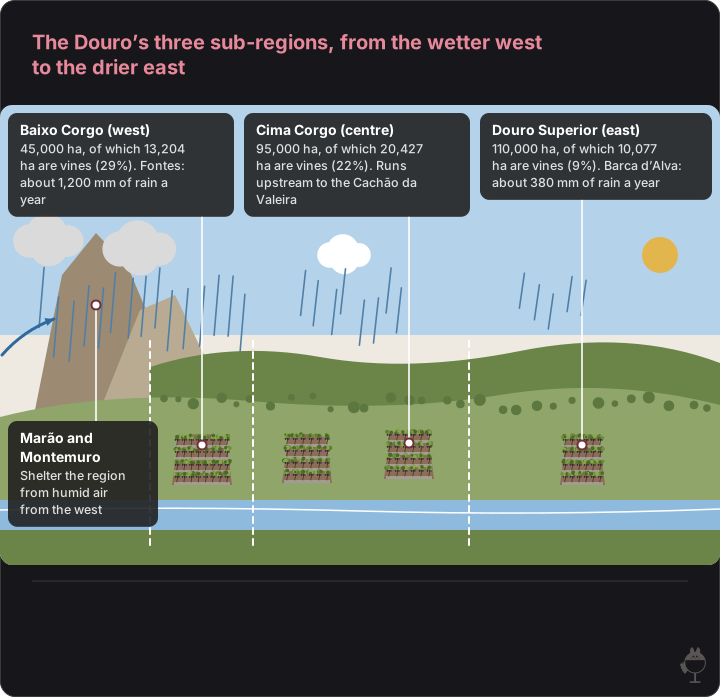
West is on the left. The width of each sub-region follows its total area and the terraced strips follow its share of vineyard (IVDP figures for 2020); the rain thins from west to east. Mountain heights, shapes and colours are illustrative.
Read the figure as text
- Marão and Montemuro — Shelter the region from humid air from the west
- Baixo Corgo (west) — 45,000 ha, of which 13,204 ha are vines (29%). Fontes: about 1,200 mm of rain a year
- Cima Corgo (centre) — 95,000 ha, of which 20,427 ha are vines (22%). Runs upstream to the Cachão da Valeira
- Douro Superior (east) — 110,000 ha, of which 10,077 ha are vines (9%). Barca d’Alva: about 380 mm of rain a year
Schist, terraces and the score of each parcel
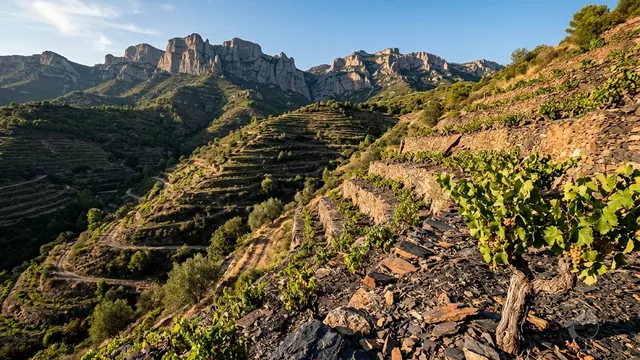
Most of the region, especially along the Douro and its tributaries, lies on schist, with granite around its edges. Vineyard soils have been heavily shaped by people: building the terraces broke up the schist, and the resulting soils are classed as anthrosols. They are mostly acidic, with a pH of 4.6 to 5.5, and generally very low in extractable phosphorus. The oldest terraces, from before phylloxera, are narrow and irregular, held up by walls of schist stone.
Not every parcel may produce Port in the same proportion. Under a scoring method proposed in 1947 by the agronomist Álvaro Moreira da Fonseca, the IVDP scores each vineyard parcel on 12 factors, including location, altitude, exposure, slope, shelter, the nature of the terrain and its stoniness, and ranks it in classes from A to F.
Each year the IVDP also fixes the benefício, the quantity of must that may be made into Port, taking account of sales and stocks, and shares it among parcels according to their class. It is counted in pipas, the region’s traditional unit of 550 litres: for 2026 the benefício was set at 76,000 pipas, against 75,000 in 2025.
The grape varieties
As of 2023, the red grapes that dominate the region’s vineyard are Touriga Franca with 25% of the area (10,727 ha), Tinta Roriz with 14.3% (6,163 ha), Touriga Nacional with 10.3% (4,432 ha), Tinta Barroca with 8.9% (3,828 ha) and Tinta Amarela with 3.1% (1,330 ha). Tinto Cão is also among the native varieties from which the region’s red wines are made.
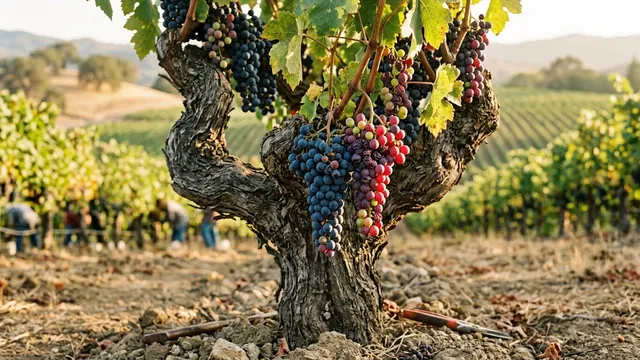
Touriga Nacional is a variety with thick skins rich in anthocyanins, which give deep colour. For Port this matters because, as the next section explains, the time available to draw colour from the skins is short.
Treading in the lagar: extraction against the clock
In red winemaking, colour and tannin pass from the skins into the liquid while it ferments in contact with them. For Port that window is short: the grape spirit is added two to three days after fermentation starts, and the fermentation is stopped when the wine has reached between 6 and 9% vol of alcohol, depending on the style and sweetness wanted.
The traditional tool for fast extraction is the lagar, a granite tank in which the grapes are trodden by foot, breaking the berries and keeping the skins mixed with the fermenting juice. Some producers now use stainless-steel lagares in which automated treaders take the place of the human foot.

 AI
·
Treading in a stone lagar
Image: Maison Apéro (generated image) · Maison Apéro original
Mutage: grape spirit stops the fermentation
When the must reaches the sweetness the producer wants, it is fortified with aguardente vínica, a grape spirit of 77% vol that must first be certified by the IVDP. The IVDP sets the quantity for each harvest. In 2011 the maximum was 115 litres of spirit for every 435 litres of must suitable for Port; together these make 550 litres, one pipa, so the spirit was roughly one part to four parts of must. For 2012 the IVDP replaced this fixed maximum with a range of 65 to 120 litres of spirit for every 550 litres of Port.
The added spirit interrupts the fermentation and keeps part of the natural grape sugar in the wine. The finished Port has about 18 to 22% vol. The earlier the spirit goes in, the more sugar remains, so the timing of fortification sets sweetness and strength at the same time. A considerable part of the alcohol in Port comes from this spirit rather than from fermentation.
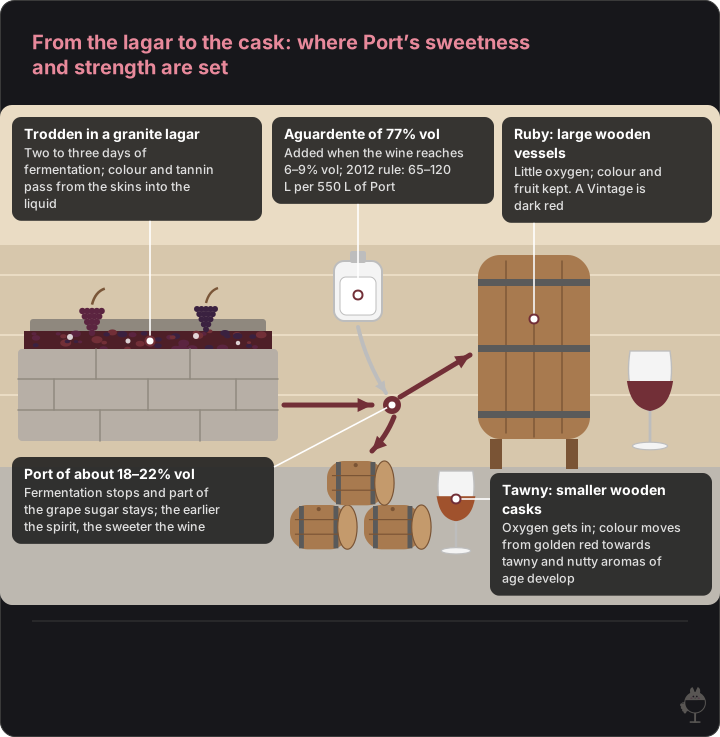
The spirit joins the fermenting wine after two to three days, at 6–9% vol; the vessel in which it is added is not drawn. After fortification the wine goes either to large vessels with little oxygen (ruby) or to smaller casks that let oxygen in (tawny). Sizes, shapes and colours are illustrative.
Read the figure as text
- Trodden in a granite lagar — Two to three days of fermentation; colour and tannin pass from the skins into the liquid
- Aguardente of 77% vol — Added when the wine reaches 6–9% vol; 2012 rule: 65–120 L per 550 L of Port
- Ruby: large wooden vessels — Little oxygen; colour and fruit kept. A Vintage is dark red
- Port of about 18–22% vol — Fermentation stops and part of the grape sugar stays; the earlier the spirit, the sweeter the wine
- Tawny: smaller wooden casks — Oxygen gets in; colour moves from golden red towards tawny and nutty aromas of age develop
Ruby styles: little oxygen, fruit and colour kept
After fortification, Port divides according to how much oxygen reaches it as it matures. Wines destined to become ruby and Vintage Port are aged in large wooden vessels, where oxidation is limited; this is often called reductive ageing. Ruby and Reserve Ports usually spend two or three years in these large vessels; LBV stays longer in vats and is bottled four to six years after the harvest.
Vintage Port comes from a single harvest. Before bottling it matures in wood, usually large vessels, or in inert containers; the IVDP certifies it between January and June of the second year after the harvest, and it may be bottled until 30 July of the third year. It is dark red and full-bodied; after bottling it can go on developing slowly for decades.
Late Bottled Vintage (LBV) also comes from a single harvest but is bottled later: it is certified between 1 March and 31 December of the fourth year after the harvest and may be bottled until 31 December of the sixth year.
Tawny styles: slow oxidation in wood
Tawny Ports take the opposite route. They age in smaller wooden casks that let oxygen in, and the aroma compounds that develop there are what give an aged tawny its value. The outcome depends on time, temperature and oxygen. One of the compounds studied in aged Port is sotolon, associated with nutty, spicy aromas of age.
The colour changes too. A Colheita, a tawny from a single harvest, must spend at least 7 years in wood, and Colheitas range in colour from golden red to tawny depending on their age. A tawny with an indication of age is instead a blend of wines from different years aged in wood; the permitted indications are 10, 20, 30, 40 and 50 years, and since 2025 also 80 years.
In the glass the two routes can be told apart: a Vintage is dark red and full-bodied, while an old tawny or a Colheita moves from golden red towards tawny and takes on nutty notes of age.
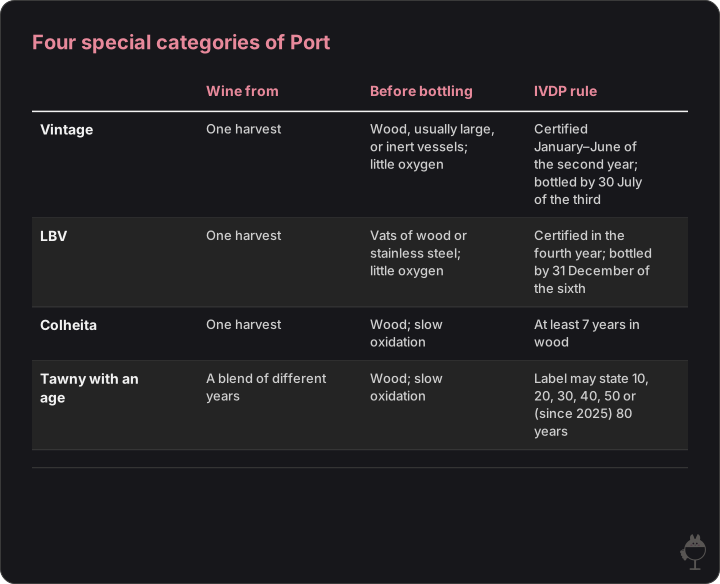
Years are counted from the harvest. Vintage and LBV take the ruby route with little oxygen; Colheita and tawnies with an indication of age take the oxidative route in wood.
Read the figure as text
| Wine from | Before bottling | IVDP rule | |
|---|---|---|---|
| Vintage | One harvest | Wood, usually large, or inert vessels; little oxygen | Certified January–June of the second year; bottled by 30 July of the third |
| LBV | One harvest | Vats of wood or stainless steel; little oxygen | Certified in the fourth year; bottled by 31 December of the sixth |
| Colheita | One harvest | Wood; slow oxidation | At least 7 years in wood |
| Tawny with an age | A blend of different years | Wood; slow oxidation | Label may state 10, 20, 30, 40, 50 or (since 2025) 80 years |
Practice question 1: why the timing matters
These practice questions and answers were written for this article; they are not questions or answers from any examination body.
Question: Explain why extraction has to be fast when making Port, and how the moment of fortification decides the wine’s sweetness and strength.
Model answer: The grape spirit is added about two to three days after fermentation starts, when the wine has reached 6 to 9% vol, so colour and tannin must be drawn from the skins in that short time. Treading by foot in a granite lagar, or robotic treading, breaks the berries and keeps the skins in contact with the fermenting juice; thick-skinned varieties rich in anthocyanins, such as Touriga Nacional, help to give colour. The spirit is aguardente of 77% vol certified by the IVDP; the IVDP set the amount for the 2012 harvest at 65 to 120 litres per 550 litres of Port. It interrupts fermentation and keeps part of the grape sugar, and the finished Port has about 18 to 22% vol. The earlier it is added, the more sugar remains.
Mark scheme (self-check, 10 points): short fermentation, stopped after two to three days at 6–9% vol (3); the role of treading by foot or robotic treading (2); aguardente at 77% vol and the proportion added (2); fortification keeps sugar and sets the final strength of about 18–22% vol (3).
Practice question 2: Vintage against an aged tawny
Question: Contrast Vintage Port with a tawny carrying an indication of age: how each matures, and how this shows in the glass.
Model answer: Vintage Port comes from a single harvest. Before bottling it matures in wood, usually large vessels, or in inert containers, with little oxygen; the IVDP certifies it between January and June of the second year after the harvest and it is bottled by 30 July of the third year, after which it goes on developing in bottle for decades. It is dark red and full-bodied. A tawny with an indication of age blends wines from different years aged in wooden casks that let oxygen in; the label may state 10, 20, 30, 40, 50 or, since 2025, 80 years. Oxidative ageing moves the colour towards tawny and forms compounds such as sotolon, associated with nutty aromas of age.
Mark scheme (self-check, 10 points): Vintage as a single-harvest wine, with its certification and bottling window (3); little oxygen before and after bottling (2); the aged tawny as a blend of years matured in wood with oxygen, and the permitted age indications (3); the contrast in colour and aroma (2).
Vineyard
- Schist slopes; rain decreases from west to east
- Parcels scored A to F; a yearly benefício
Cellar
- Treading through two to three days of fermentation
- Spirit of 77% vol stops it at 6–9% vol
Maturation
- Ruby and Vintage: large vessels, little oxygen
- Tawny and Colheita: wooden casks, slow oxidation
Frequently asked questions
When is the grape spirit added to Port?
About two to three days after fermentation starts, when the wine has reached 6 to 9% vol, depending on the style and sweetness wanted. The spirit is aguardente of 77% vol; for the 2012 harvest the IVDP set the amount at 65 to 120 litres for every 550 litres of Port.
How do ruby and tawny Port differ?
Ruby and Vintage Ports age with little oxygen, in large vessels or in bottle, and keep a deep red colour. Tawnies age in smaller wooden casks that let oxygen in, so the colour moves towards tawny and aromas of age develop, such as the nutty notes associated with sotolon.
How long do Vintage, LBV and Colheita Port mature before bottling?
Vintage is certified between January and June of the second year after the harvest and bottled by 30 July of the third year. LBV is certified in the fourth year and may be bottled until 31 December of the sixth. A Colheita must spend at least 7 years in wood.
Sources
- IVDP — Historical milestones of Port wine
- UNESCO World Heritage Centre — Alto Douro Wine Region
- UNESCO World Heritage Centre — Alto Douro (Portugal) No 1046: advisory body evaluation (ICOMOS)
- IVDP — The region: characteristics
- IVDP — Characteristics of the Douro Demarcated Region
- IVDP — Parcel classification: the classification system
- IVDP — Parcel classification: introduction
- Portuguese Times (Lusa) — Douro raises Port production to 76,000 pipas
- IVDP — Grape varieties
- Volatile Composition of Fortification Grape Spirit and Port Wine: Where Do We Stand? Foods 12(12), 2432 (2023)
- IntechOpen — Port Wine: Production and Ageing (chapter 74303)
- IVDP — Port wines: winemaking
- IVDP — Harvest communiqué 2011
- IVDP — Harvest communiqué 2012
- Symington Family Estates — Modern lagares
- IVDP — Port wines: special categories
- IVDP — Port Wines: Special Categories
- IVDP — Guide to oenology and oenological practices, chapter 1: definitions
- Público (2025) — Port: tawnies with an indication of age gain a new category, 80 years