
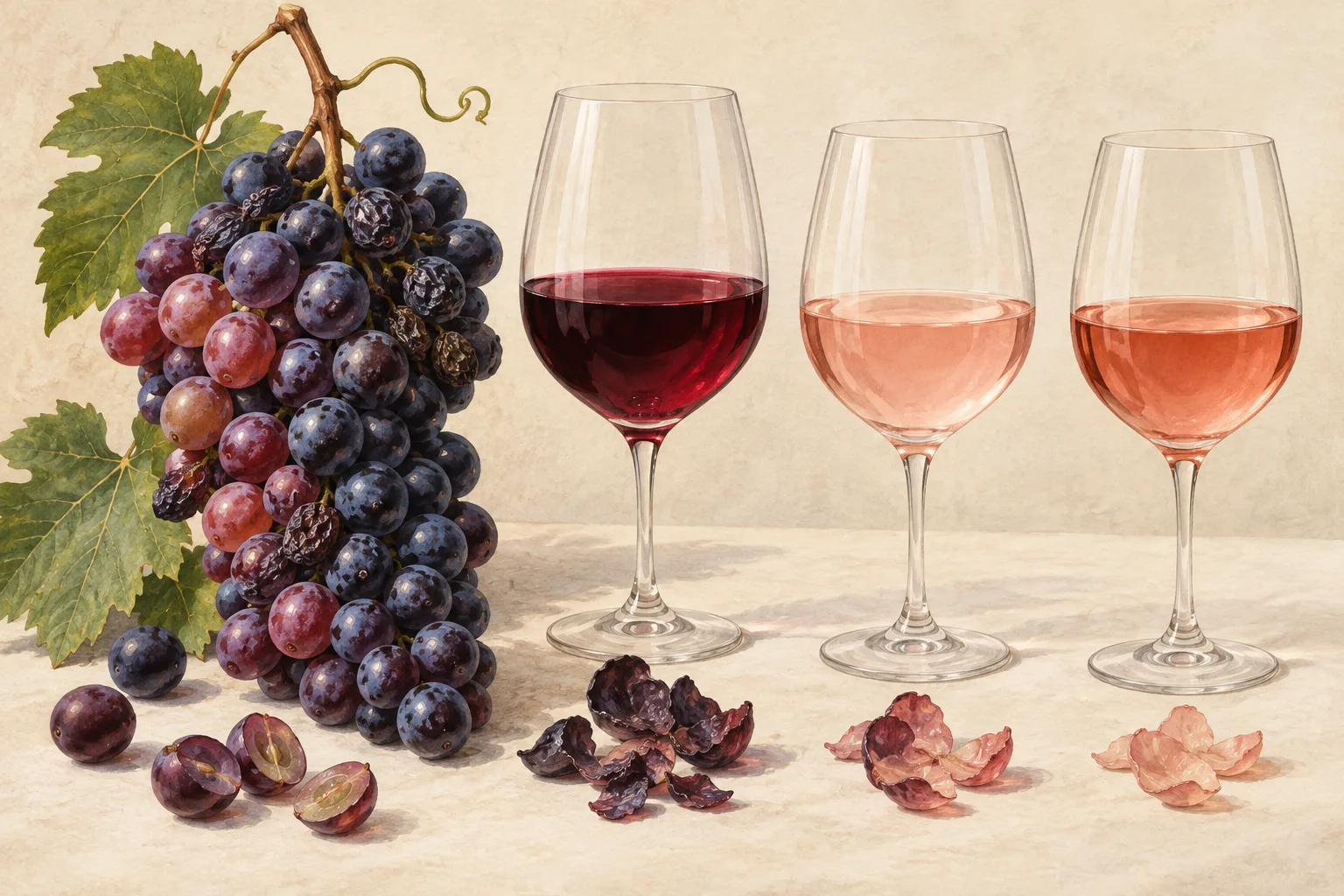
Two decisions explain three styles
Zinfandel is a black grape. Its juice is largely colourless, while the skins hold the pigments that make red or pink wine. White Zinfandel is therefore a pink wine made from a black grape, not a white grape variety. Primitivo in Italy is the same variety, although place, growing choices and winemaking can produce different styles.
Keep two controls separate. Contact with skins determines how much colour and tannin can be extracted; the progress of alcoholic fermentation determines how much fermentable sugar is converted into alcohol. Brief skin contact can produce either sweet or dry pink wine. Long skin contact does not, by itself, tell us whether a wine is sweet.
Uneven ripening makes the harvest decision difficult
A Zinfandel bunch can contain less-ripe berries, fully ripe berries and shrivelled berries at the same time. Less-ripe berries can contribute higher acidity and less-ripe flavours. Riper berries contribute more developed fruit character, while water loss from shrivelled berries concentrates sugar. A single average sugar reading may hide these differences.
Waiting can allow some lagging berries to ripen, but already-ripe fruit may become more dehydrated and the potential alcohol can rise. Picking earlier can preserve freshness but may include more unripe material. The grower and winemaker therefore assess flavour, berry condition and the intended style as well as sugar. Selective harvesting and sorting help control the mixture, but add labour and can reduce the usable crop.
Climate and canopy management influence the choices
Zinfandel benefits from a sufficiently warm, long growing season, but excessive heat can produce dehydration or sun damage. Tight bunches can also be vulnerable to rot when moisture persists. Site selection and canopy management therefore need to balance ripening, airflow and protection: opening the canopy can help ventilation, while stripping away too much shade in a hot site can expose the fruit to damaging temperatures.
Old, head-trained vineyards are an important part of California’s Zinfandel heritage. Some yield small crops and require hand work, which can increase production costs. However, old vines are not a separate grape variety and do not automatically guarantee concentration or quality. The condition of the vineyard and the balance between leaf area, available water and crop still matter.
Red Zinfandel: ripe grapes, skins and extraction
For a rich red style, the producer can harvest ripe fruit with substantial sugar and ferment the crushed grapes with their skins. Colour and tannin are extracted during this contact. Temperature, cap management and maceration time determine how much structure is obtained; careful extraction avoids hard tannins overwhelming the fruit. Fermenting a high-sugar must towards dryness can produce a high-alcohol, full-bodied wine.
Depending on ripeness, fruit character can range from fresh raspberry and blackberry to plum, jam or dried fruit. These aromas do not prove that sugar remains. A wine can smell like ripe jam and still taste dry because the fermentable sugar has largely become alcohol. Conversely, a particular red may retain some sugar: assess sweetness independently rather than infer it from the grape name.
White Zinfandel: explain both the pale colour and the sweetness
For the familiar pale-pink style, juice has only short contact with skins before they are separated. This limits pigment and tannin extraction, so the finished wine is paler and less tannic than a red made with prolonged skin contact. Harvesting at lower sugar than for a powerful red can also help produce a lighter, fresher style.
Typical White Zinfandel retains fermentable sugar because fermentation is stopped before dryness. Chilling can slow yeast activity, and filtration can remove yeast to prevent continued fermentation. Leaving some sugar unfermented means less alcohol is produced than would be obtained by fully fermenting the same starting juice. The result is commonly a light, fruity wine with noticeable sweetness and relatively low alcohol. Sugar-containing wine needs effective microbial stabilisation before bottling to avoid unwanted refermentation.
Dry Zinfandel rosé: similar colour, a different fermentation endpoint
A dry rosé may also be made by direct pressing or a brief period of skin contact followed by separation. The small amount of extracted pigment produces a pink colour, and limited tannin gives a lighter texture. Grapes can be harvested specifically for rosé, often earlier than fruit intended for a powerful red, to retain acidity and avoid excessive potential alcohol.
Unlike typical White Zinfandel, this juice is fermented towards dryness. Temperature-controlled fermentation in neutral vessels can preserve fresh fruit aromas without adding oak flavours. The finished style can combine red-berry fruit, refreshing acidity and little residual sugar. Dry rosé is not necessarily lower in alcohol than sweet rosé: if identical juice is used, fermenting more of its sugar creates more alcohol. Starting sugar and fermentation endpoint must both be considered.
Oak, release timing and price
Red Zinfandel can be matured in oak, which may add vanilla, toast or spice as well as changing tannin texture. Newer, smaller barrels generally have a stronger direct flavour impact than older or larger vessels. The choice should suit the fruit; oak is not required for every red Zinfandel and more oak does not automatically mean better quality.
Many fresh pink styles are made in neutral tanks and released young. This avoids the cost of new barrels and lengthy cellar storage, and supports a fruit-led style. Efficient large-scale production can reduce the cost per bottle, whereas hand-worked old-vine parcels, selective harvesting and barrel maturation can increase it. These production choices explain price differences more usefully than assuming that every red is expensive and every rosé is inexpensive.
Written-answer example: compare red and White Zinfandel
For a powerful red Zinfandel, ripe grapes with high sugar are fermented with the skins, allowing extraction of colour and tannin. Fermenting that sugar towards dryness produces substantial alcohol and contributes to a full body. Oak maturation may add spice and complexity. Typical White Zinfandel has brief skin contact, so it is paler and less tannic. It is commonly made from grapes with less potential alcohol than a powerful red, and fermentation is stopped with sugar remaining, giving sweetness and reducing the alcohol produced from the starting juice. Neutral vessels and early release preserve a simple, fresh fruit style. Thus skin contact explains the colour and tannin difference, while harvest sugar and fermentation explain the alcohol and sweetness difference.
Written-answer example: why pale pink does not mean sweet
Both White Zinfandel and dry Zinfandel rosé can be pale because the juice is separated from the black skins early, limiting pigment extraction. Their sweetness differs because the fermentation endpoints differ: typical White Zinfandel retains sugar, whereas the dry rosé ferments much further. The dry rosé can remain moderate in alcohol if grapes were harvested at a lower sugar level, but dryness alone does not make it lower in alcohol. A fair comparison therefore addresses skin contact, initial sugar and fermentation separately.
These are original practice explanations, not official WSET answers or guaranteed scoring points. For an actual wine, confirm sweetness, acidity, alcohol, tannin and fruit character independently in the glass.
Skin contact explains colour; fermentation explains sweetness
Rich red Zinfandel
- Ripe, high-sugar fruit
- Ferment with skins and manage extraction
- Typically dry, coloured, structured and full-bodied
Typical White Zinfandel
- Brief skin contact, then separate
- Stop fermentation with sugar remaining
- Pale pink, sweet and relatively low in alcohol
Dry Zinfandel rosé
- Brief skin contact or direct pressing
- Ferment towards dryness
- Pink, fresh and low in residual sugar
Sources
- ZAP — Growing Differences
- ZAP — The Many Styles of Zinfandel
- ZAP — History of Zin
- Wine Institute — Zinfandel
- WSET — Wine production and sweet styles (public teaching guide)
- WSET — Acidity, climate and harvest timing
- AWRI — Red-wine extraction trials (Technical Review 252)
- WSET — Oak and wine maturation