Two regions, two lessons
The Barossa Valley and Coonawarra are both in South Australia, but they teach different things. The Barossa Valley is one of the two wine regions of the Barossa zone, recognised in 1997; the other is Eden Valley, which contains the sub-region High Eden. Coonawarra lies in the south-east of the state, on the Limestone Coast.
In the Barossa, the lesson is history: a state that kept phylloxera out still has very old vines growing on their own roots. In Coonawarra, the lesson is a soil profile: a thin red clay over limestone. A third thread runs through both: the eucalyptus or mint note found in some Australian reds, which research traces to trees and leaves, not to the soil.
Why South Australia's vines can stay on their own roots
Phylloxera is a root-feeding insect that caused enormous damage to vineyards in Europe and elsewhere in the late nineteenth century. In most places the remedy was to replant on resistant rootstocks. South Australia took another route: keeping the insect out.
Industry leaders persuaded the state government to pass the Vine Protection Act in 1874, which prohibited the import of vine material from countries and other parts of Australia infested with phylloxera. When phylloxera was confirmed in vineyards at Geelong, Victoria, in 1877, prevention efforts intensified. The Phylloxera Act of 1899 created the Phylloxera Board, a statutory body that registers vineyards and controls the entry of grape material; it now trades as Vinehealth Australia.
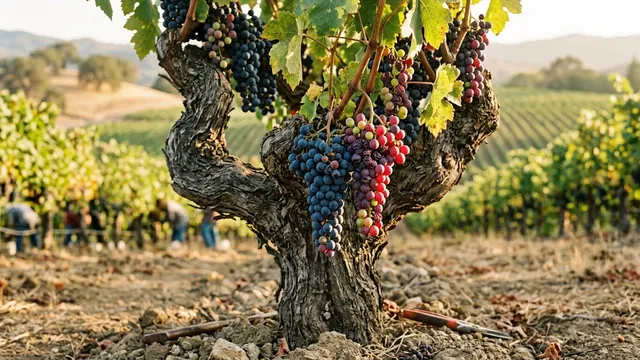
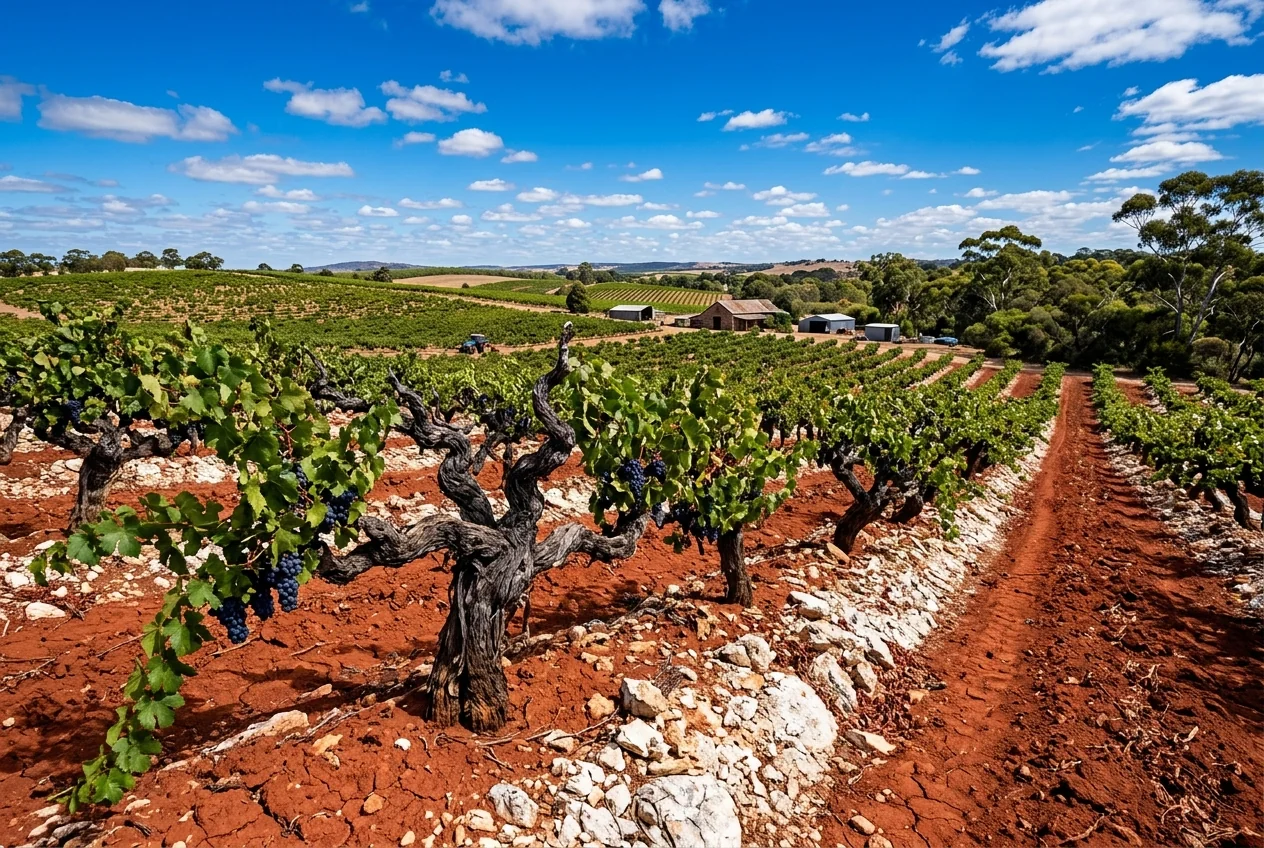
Because the pest has been kept out, growers in South Australia were never forced to replant on rootstocks, and very old own-rooted vines could survive. Langmeil Winery says its Freedom vineyard in the Barossa Valley is believed to have been planted in 1843 by Christian Auricht, a settler from Prussia, and that the vines are believed to be the oldest surviving Shiraz in the world.
Counting vine age: the Barossa Old Vine Charter
Old vines mean something to a buyer only if their age is recorded. The Barossa Old Vine Charter began as a Yalumba initiative in 2007 and was adopted at regional level in 2009. It sorts vineyards into four categories by age: Barossa Old Vine (35 years or more), Survivor Vine (70 years or more), Centenarian Vine (100 years or more) and Ancestor Vine (125 years or more).
A vineyard planted in 1843 would be 183 years old in 2026, well inside the Ancestor category. The charter is a register of age. It does not by itself measure yield, concentration or quality, so a category on a label should be read as a fact about the vines, not as a tasting note.
Barossa Valley: altitude and a warm, dry valley floor
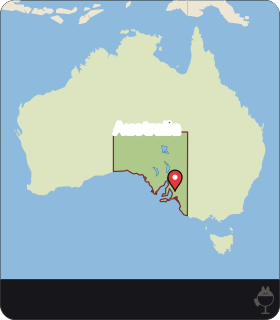
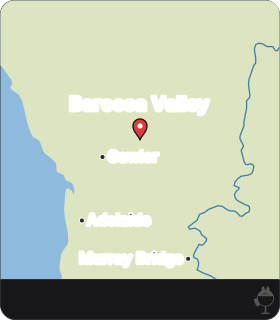
The Barossa Valley lies at 112–597 m (Barossa Australia), with 53% of the region below 280 m; Eden Valley spans 217–630 m, with 99% above 280 m. Eden Valley, the higher of the two, is the cooler region.
The valley floor is warm and dry, with low humidity and little rain in the growing season. These conditions suit full-bodied reds, above all Shiraz.
Coonawarra: a red strip over limestone
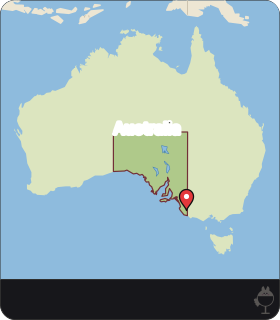
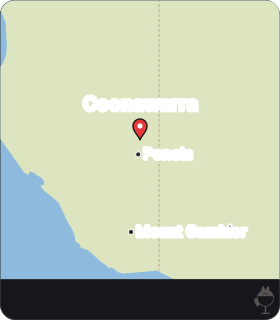
The region is defined by a cigar-shaped strip of terra rossa about 27 km long and 2 km wide (Coonawarra Vignerons). The terra rossa is a permeable light clay, averaging about 50 cm deep over a limestone base; it lets water drain freely and leaves air in the soil for roots. The region is very flat.
The red soil is young. A study of four Coonawarra soil profiles (Mee, Bestland and Spooner, Geomorphology, 2004) found that the terra rossa is dominated by locally derived wind-blown dust that probably accumulated over the last 120,000–130,000 years. It is therefore not simply the weathered top of the limestone beneath it. In plainer words: old seabeds became limestone, ice ages moved the shoreline, and the wind brought the dust.

 AI
·
Soil pit: red soil over pale rock
Image: Maison Apéro (generated image) · Maison Apéro original
Water, drainage and a cool influence from the ocean
Two more features shape conditions in Coonawarra. Underground, a limestone aquifer holds a permanent supply of pure water. Above ground, the climate is moderate: ocean currents from the Antarctic cool the vines on late-summer afternoons, giving warm days and mild to cool nights.
Coonawarra Vignerons links the region's suitability for Cabernet Sauvignon to the combination of terra rossa, a long cool ripening season and water from the limestone aquifer. These are conditions, not a guaranteed result: how much water a vine actually receives also depends on rainfall, irrigation and management in each vineyard.
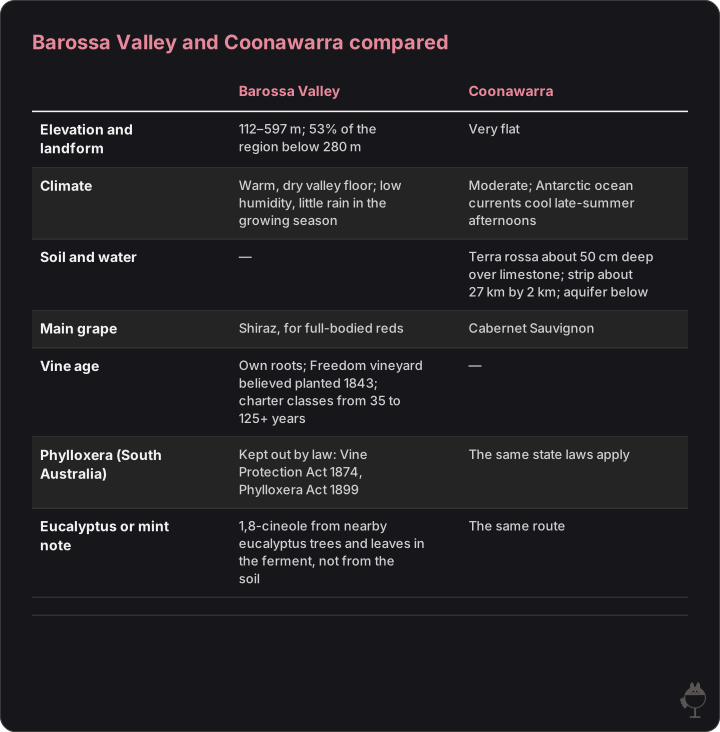
The sourced facts of this article, region by region. Phylloxera and the mint note are rows that apply to both regions. Where a source gives no figure for one region, the cell is left blank.
Read the figure as text
| Barossa Valley | Coonawarra | |
|---|---|---|
| Elevation and landform | 112–597 m; 53% of the region below 280 m | Very flat |
| Climate | Warm, dry valley floor; low humidity, little rain in the growing season | Moderate; Antarctic ocean currents cool late-summer afternoons |
| Soil and water | — | Terra rossa about 50 cm deep over limestone; strip about 27 km by 2 km; aquifer below |
| Main grape | Shiraz, for full-bodied reds | Cabernet Sauvignon |
| Vine age | Own roots; Freedom vineyard believed planted 1843; charter classes from 35 to 125+ years | — |
| Phylloxera (South Australia) | Kept out by law: Vine Protection Act 1874, Phylloxera Act 1899 | The same state laws apply |
| Eucalyptus or mint note | 1,8-cineole from nearby eucalyptus trees and leaves in the ferment, not from the soil | The same route |
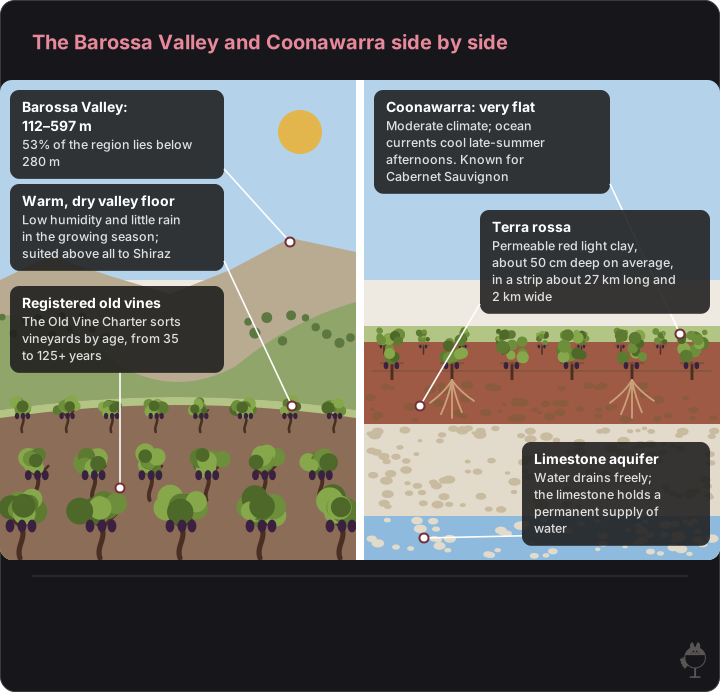
Left, the warm Barossa Valley floor between hills. Right, very flat Coonawarra, cut open to show red terra rossa over limestone, with water in the limestone aquifer. Heights, layer thicknesses and colours are illustrative, not to scale.
Read the figure as text
- Barossa Valley: 112–597 m — 53% of the region lies below 280 m
- Warm, dry valley floor — Low humidity and little rain in the growing season; suited above all to Shiraz
- Registered old vines — The Old Vine Charter sorts vineyards by age, from 35 to 125+ years
- Coonawarra: very flat — Moderate climate; ocean currents cool late-summer afternoons. Known for Cabernet Sauvignon
- Terra rossa — Permeable red light clay, about 50 cm deep on average, in a strip about 27 km long and 2 km wide
- Limestone aquifer — Water drains freely; the limestone holds a permanent supply of water
Eucalyptus and mint: where 1,8-cineole comes from
A eucalyptus or mint note is often linked with Australian reds, and some explanations credit the soil, the groundwater or the sea wind. Research at the Australian Wine Research Institute (AWRI) points elsewhere. The compound responsible is 1,8-cineole (eucalyptol). AWRI found more of it in grapes and vine leaves closest to eucalyptus trees, with less further away, and identified eucalyptus leaves and other material other than grapes (MOG) picked with the fruit as a major route into the wine during fermentation.
So a minty Coonawarra Cabernet or Barossa Shiraz says more about the trees near a block and the cleanliness of the harvest than about terra rossa. Winemakers who want less of the note can sort out leaves before fermentation; those who like it can keep it.
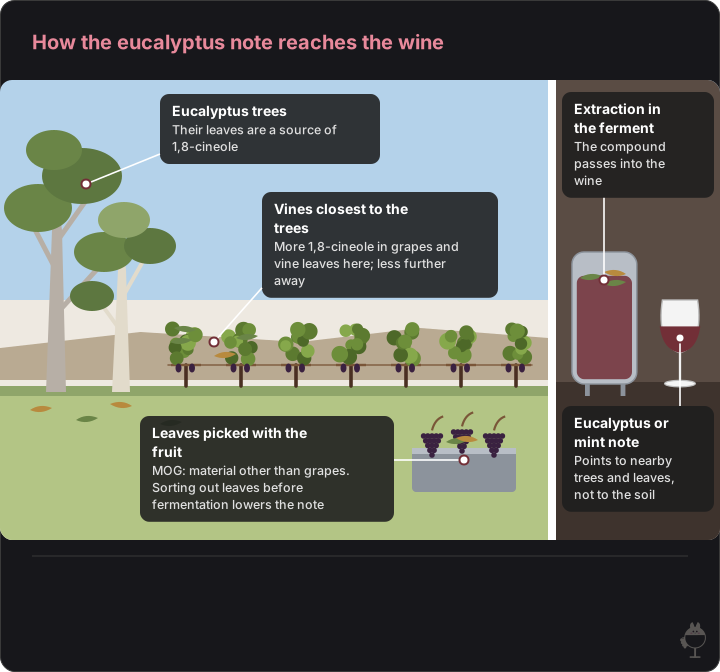
Based on AWRI research: 1,8-cineole comes from eucalyptus trees near the vines and from leaves and other MOG that go into the ferment; the research does not point to the soil. Shapes and colours are illustrative.
Read the figure as text
- Eucalyptus trees — Their leaves are a source of 1,8-cineole
- Vines closest to the trees — More 1,8-cineole in grapes and vine leaves here; less further away
- Leaves picked with the fruit — MOG: material other than grapes. Sorting out leaves before fermentation lowers the note
- Extraction in the ferment — The compound passes into the wine
- Eucalyptus or mint note — Points to nearby trees and leaves, not to the soil
Blending across regions, and what the glass can tell you
Some Australian reds are blended from fruit grown in several regions. Penfolds Grange 2021 is a blend of 94% Shiraz and 6% Cabernet Sauvignon, drawn from more than one South Australian region; Grange is therefore a Shiraz-led multi-regional blend, not a portrait of one vineyard.
When tasting a Barossa Shiraz beside a Coonawarra Cabernet, separate what the site gives from what the cellar adds. Note the ripeness of the fruit, the acidity, the tannin and any eucalyptus or mint note, then check the producer's notes for vineyard location, oak and blending. Oak type, barrel age and blending are winemaking choices, so the glass alone cannot prove a soil effect.
Exercise 1: own roots and the Old Vine Charter
Question
Explain why very old own-rooted vines survive in the Barossa Valley, and say what the Barossa Old Vine Charter does and does not tell a buyer.
Model answer
South Australia kept phylloxera out instead of replanting on rootstocks. The Vine Protection Act of 1874 banned vine material from infested places, prevention was stepped up after phylloxera was confirmed at Geelong in 1877, and the Phylloxera Act of 1899 created the Phylloxera Board, now Vinehealth Australia, which registers vineyards and controls grape material. Without the pest, growers were not forced to graft, so own-rooted vines such as Langmeil's Freedom vineyard, believed to date from 1843, could survive. The Old Vine Charter, a Yalumba initiative of 2007 adopted regionally in 2009, records vineyard age in four categories: 35, 70, 100 and 125 years or more. It certifies age only; by itself it says nothing about yield, style or quality.
Mark scheme (10 marks)
- Biosecurity history with at least two correctly dated steps (4 marks)
- The link between keeping phylloxera out and own-rooted vines (2 marks)
- The four charter categories and their ages (2 marks)
- What the charter does not measure (2 marks)
Exercise 2: reading terra rossa and the mint note
Question
Describe Coonawarra's terra rossa and its origin, and explain where a eucalyptus or mint note in a Coonawarra Cabernet Sauvignon most likely comes from.
Model answer
Terra rossa runs in a cigar-shaped strip about 27 km long and 2 km wide. It is a permeable red light clay averaging about 50 cm deep over limestone, so water drains freely, and a limestone aquifer below supplies underground water. Mee, Bestland and Spooner (2004) found that the soil is dominated by locally derived wind-blown dust that probably accumulated over the last 120,000–130,000 years. A eucalyptus or mint note comes from 1,8-cineole. AWRI found more of it in grapes and vine leaves closest to eucalyptus trees, with less further away, and identified leaves and other MOG in the ferment as a major route into the wine. That pattern points to the trees, not to the soil or the aquifer.
Mark scheme (10 marks)
- Size of the strip and depth of the soil (3 marks)
- Origin of the soil, with its approximate age (2 marks)
- Drainage and the limestone aquifer (2 marks)
- Source of 1,8-cineole, and why the soil is not the cause (3 marks)
Barossa: history and vine age
- Laws from 1874 keep phylloxera out
- Vines can stay on their own roots
- The charter records ages from 35 years up
Coonawarra: soil and water
- Wind-blown dust settles over limestone
- About 50 cm of free-draining red clay
- A limestone aquifer below the vines
In the glass: not everything is soil
- Eucalyptus trees near the vines
- Leaves and other MOG in the ferment
- 1,8-cineole gives a eucalyptus or mint note
Frequently asked questions
Why did Barossa vines escape phylloxera?
Because South Australia kept the pest out with biosecurity laws. The Vine Protection Act of 1874 banned vine material from infested places, controls were tightened after phylloxera was confirmed at Geelong, Victoria, in 1877, and the Phylloxera Act of 1899 created the Phylloxera Board, now Vinehealth Australia. Without the pest, growers were not forced to graft onto resistant rootstocks.
What is terra rossa in Coonawarra?
A permeable red light clay, averaging about 50 cm deep over limestone, that forms a strip about 27 km long and 2 km wide. A 2004 study found it is dominated by locally derived wind-blown dust that probably accumulated over the last 120,000–130,000 years.
Does the soil give Coonawarra Cabernet its mint note?
AWRI research links the eucalyptus or mint note (1,8-cineole) to eucalyptus trees near the vines and to leaves and other material other than grapes (MOG) in the ferment. It does not show the soil to be the cause.
What does "Ancestor Vine" mean on a Barossa label?
It is a Barossa Old Vine Charter category for vineyards 125 years old or more. The others are Centenarian (100 years or more), Survivor (70 years or more) and Barossa Old Vine (35 years or more).
Sources
- Barossa Australia — Geographical indication zone
- Barossa Australia — Barossa Valley and Eden Valley comparison (PDF)
- Barossa Australia — Climate & seasons
- Barossa Australia — Old Vine Charter
- Barossa Australia — Barossa Old Vine Charter (PDF)
- Langmeil Winery — Vineyards (The Freedom 1843)
- Vinehealth Australia — Cheers to 120 years
- Vinehealth Australia — About Vinehealth Australia
- Vinehealth Australia — Rootstocks: more than pest prevention
- Coonawarra Vignerons — Discover Coonawarra
- Coonawarra Vignerons — Our Landscape
- Wine Australia — Coonawarra (regions and varieties)
- Mee, Bestland & Spooner (2004), Age and origin of Terra Rossa soils in the Coonawarra area of South Australia, Geomorphology 58: 1–25 (abstract)
- The Australian Wine Research Institute — Capone, D.: Managing the eucalyptus character in red wine (PDF)
- The Australian Wine Research Institute — Winemaking treatment: eucalyptus leaves
- Penfolds — Bin 95 Grange Shiraz 2021 tasting note (PDF)