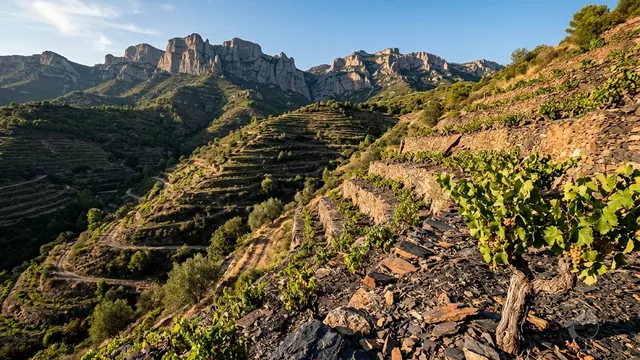

Two appellations, two ways to build a red wine
This article compares two red wines from opposite ends of the Rhône valley: Côte-Rôtie in the north and Châteauneuf-du-Pape in the south. In each case the appellation's cahier des charges, its official specification, sets which grapes may be used.
The comparison runs on three levels, kept apart throughout. First, what the rules say, taken from the specifications. Second, what research says, for example about the compound behind Syrah's peppery aroma. Third, what is commonly said about granite slopes, rounded stones and heat: popular descriptions, which this article treats as accounts rather than measured facts.
Côte-Rôtie: Syrah, with Viognier planted among it
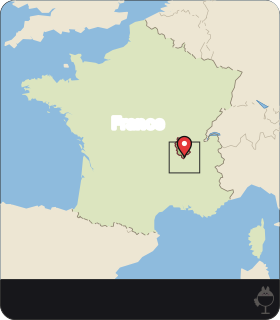
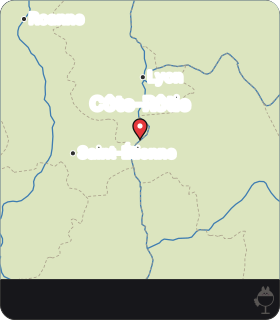
Côte-Rôtie is a red wine only. Syrah is the principal variety and the white grape Viognier is the only accessory variety. Syrah must account for at least 80% of the vines. Viognier may account for at most 20%, and only as vines planted within the Syrah parcels (co-planting); a separate Viognier vineyard does not qualify.
The rule carries on into the cellar. The two varieties are vinified together, blended as grapes rather than as finished wines, and the wine must also be at least 80% Syrah. Viognier cannot be added later as a separate white wine: it goes into the vat with the harvest.
Why keep a white grape in a red wine? Two explanations are often given: Viognier's own aroma, and copigmentation, in which colourless compounds from the white skins are said to stabilise and deepen the red colour. Treat both as hypotheses rather than established effects in Côte-Rôtie, and do not assume any particular Viognier share in a given wine.
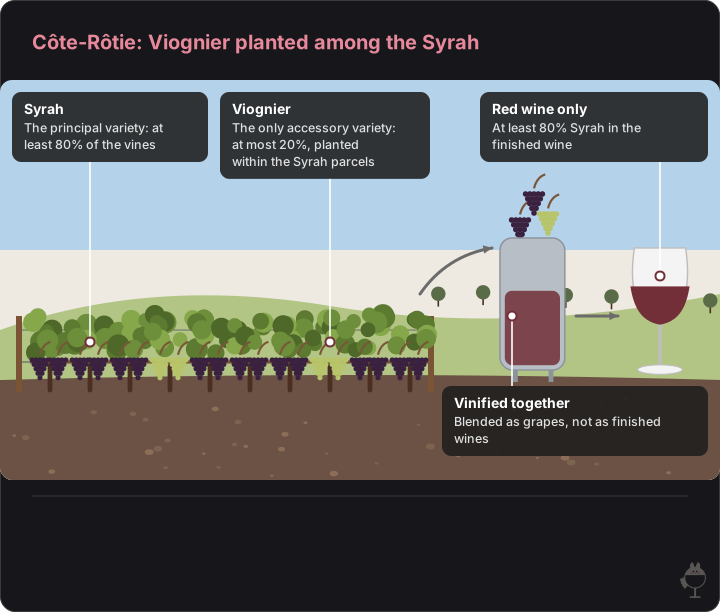
Summarised from the Côte-Rôtie specification. The pale clusters mark Viognier vines growing within the Syrah row, drawn at the 20% maximum the rule allows. The grapes go into the vat together, so Viognier cannot be added later as a separate wine. The ground is drawn level for clarity and does not show the slope or the rock. Shapes and colours are illustrative.
Read the figure as text
- Syrah — The principal variety: at least 80% of the vines
- Viognier — The only accessory variety: at most 20%, planted within the Syrah parcels
- Vinified together — Blended as grapes, not as finished wines
- Red wine only — At least 80% Syrah in the finished wine
Châteauneuf-du-Pape: thirteen varieties, eighteen names
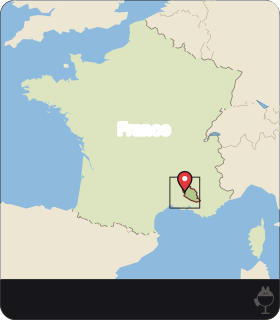
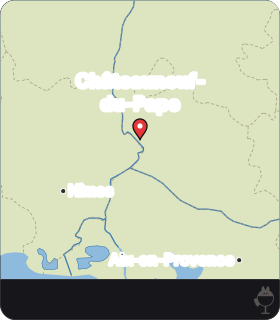
Châteauneuf-du-Pape covers both red and white wines. Its rules list 18 grape names. Three varieties appear in more than one colour form, Grenache and Piquepoul in three each and Clairette in two, so counting each variety once gives the 13 varieties usually quoted for the appellation. Côte-Rôtie's rules, by contrast, name two varieties.
GSM is the informal shorthand for a blend led by Grenache, Syrah and Mourvèdre, all three of which are on the list. Because the rules allow many combinations, the words Châteauneuf-du-Pape on a label do not tell you the proportions in that bottle; only the producer's own information can.
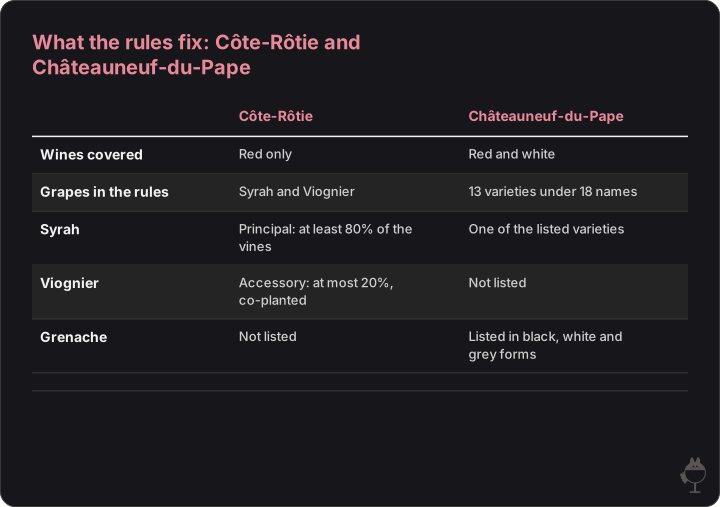
Summarised from each appellation's specification. The rules say which grapes may be used; they do not reveal the blend in a particular bottle.
Read the figure as text
| Côte-Rôtie | Châteauneuf-du-Pape | |
|---|---|---|
| Wines covered | Red only | Red and white |
| Grapes in the rules | Syrah and Viognier | 13 varieties under 18 names |
| Syrah | Principal: at least 80% of the vines | One of the listed varieties |
| Viognier | Accessory: at most 20%, co-planted | Not listed |
| Grenache | Not listed | Listed in black, white and grey forms |
Granite slopes and rounded stones
The northern Rhône vineyards, Côte-Rôtie among them, are steep terraced slopes on granite and related crystalline rocks such as schist and gneiss. Around Châteauneuf-du-Pape, many vineyards are covered with large rounded stones, the galets roulés.
The galets roulés are often credited with storing heat by day and releasing it at night, helping Grenache to ripen. That is physically plausible, but judging the size of the effect in these vineyards requires measurements.
Elevation and aspect, the direction a slope faces, belong in any terroir comparison.

 AI
·
Old bush vine on rounded stones
Image: Maison Apéro (generated image) · Maison Apéro original
The mistral
The mistral is a regional wind of the Rhône valley and Provence. It is turbulent and generally dry. It can blow at any time of year but is most frequent in winter and spring; its mean speed can reach 50 km/h, with gusts of 80 to 100 km/h and sometimes more.
Because it is dry, the mistral helps leaves and bunches dry quickly after rain, which lowers the risk of fungal disease. This article gives no measurements of that effect and does not rank the Rhône against other regions for disease pressure or for how easily vines can be grown organically.
 AI
·
Terraces and rounded stones
Image: Maison Apéro (generated image) · Maison Apéro original
Pepper in Syrah: rotundone
The black-pepper note often described in Syrah has a chemical name. A 2014 review of grape and wine aroma in the American Journal of Enology and Viticulture identifies rotundone, a sesquiterpene, as the potent compound responsible for black-pepper aroma in wine. The same review discusses how conditions in the vineyard influence aroma compounds.
It is sometimes claimed that granite or acidic soil makes Syrah produce more rotundone. That link is not established. A peppery Côte-Rôtie points to rotundone, not to a particular rock.
Tasting the two side by side
A useful exercise is to taste a Côte-Rôtie and a red Châteauneuf-du-Pape side by side and keep three columns of notes. In the first, record only what you observe: intensity of colour; aroma groups such as red fruit, black fruit, pepper, herbs or flowers; then acidity, tannin, alcohol and body.
In the second, write what the rules let you infer: a Côte-Rôtie is at least 80% Syrah and may contain some Viognier, while a red Châteauneuf-du-Pape is made from varieties on a much longer list. In the third, list what neither the glass nor the rules can tell you: the exact blend, the weather of the vintage and the winemaking. Pepper in either wine is a clue to rotundone; it is not proof of a soil type.
Practice question, model answer and mark scheme
Practice question (Maison's own exercise, not an official exam question)
Compare how the rules of Côte-Rôtie and Châteauneuf-du-Pape shape the grape composition of their red wines, and identify which common claims about the two areas are not established.
Model answer
Côte-Rôtie is a red-only appellation. Syrah is the principal variety and must be at least 80% of the vines; Viognier, the only accessory variety, may be at most 20% and only co-planted within the Syrah. The two are vinified together, and the wine must be at least 80% Syrah. Châteauneuf-du-Pape makes red and white wines and lists 18 grape names, usually counted as 13 varieties, including Grenache, Syrah and Mourvèdre; the appellation name alone does not reveal the proportions in a bottle. Rotundone, a sesquiterpene, is the compound responsible for black-pepper aroma, but soil type is not an established cause. Claims that are not established include copigmentation by Viognier as a proven effect in Côte-Rôtie, a measured ripening effect from the heat stored by the galets roulés, and soil type as the cause of the pepper aroma.
Mark scheme (10 marks)
- Côte-Rôtie rules: red only; Syrah at least 80%; Viognier at most 20%, co-planted and vinified together (4 marks)
- Châteauneuf-du-Pape rules: red and white; 13 varieties or 18 names; proportions not revealed by the name (3 marks)
- Rotundone identified, without a soil-type cause (1 mark)
- At least two claims correctly identified as not established (2 marks)
What the rules fix
- Côte-Rôtie: red only, Syrah with up to 20% Viognier, co-planted and vinified together
- Châteauneuf-du-Pape: red and white, 13 varieties under 18 names
Commonly described
- Granite slopes in the north, rounded stones in the south
- Heat stored by the stones
What the glass can suggest
- Black pepper points to rotundone, not to a soil type
- The exact blend and the vintage come from the producer's information
Frequently asked questions
Why does Côte-Rôtie allow a white grape in a red wine?
Its rules allow Viognier as the only accessory variety: at most 20% of the vines, planted among the Syrah and vinified with it, and the wine must be at least 80% Syrah. Viognier's aroma and a colour effect (copigmentation) are often given as reasons; neither is an established effect.
How many grape varieties are allowed in Châteauneuf-du-Pape?
The rules list 18 grape names. Grenache and Piquepoul each appear in three colour forms and Clairette in two; counting each variety once gives the 13 varieties usually quoted. The appellation covers both red and white wines.
What causes the black-pepper aroma in Syrah?
A 2014 review in the American Journal of Enology and Viticulture identifies rotundone, a sesquiterpene, as the compound responsible for black-pepper aroma in wine. Granite or acidic soil is not an established cause, so a peppery note is no proof of a particular soil.
How strong is the mistral?
The mistral is a turbulent, generally dry regional wind that can blow at a mean speed of 50 km/h, with gusts of 80 to 100 km/h and sometimes more. It can occur in any season but is most frequent in winter and spring.
Sources
- INAO — Specification (cahier des charges) of the Côte-Rôtie appellation
- chateauneuf.com — Specification (cahier des charges) of the Châteauneuf-du-Pape appellation
- INAO — Châteauneuf-du-Pape red (product sheet)
- Météo-France — The mistral, a regional wind
- Robinson A.L. et al. (2014) Origins of Grape and Wine Aroma. Part 1. Chemical Components and Viticultural Impacts. American Journal of Enology and Viticulture 65(1)