
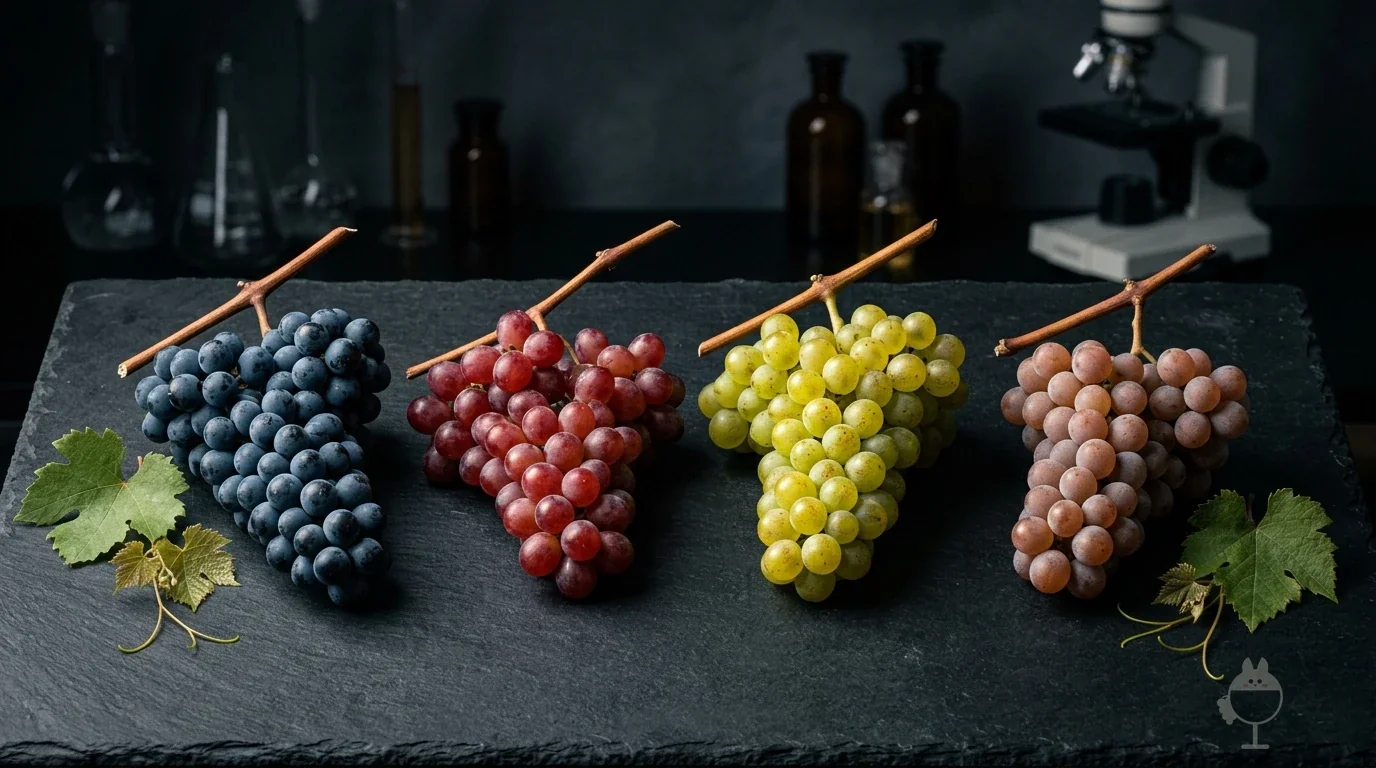
Berry anatomy: why cross-sectional geometry sets varietal style
Every varietal profile begins inside the physical geometry of a wine grape berry divided into four functional compartments: pedicel/stem, skin (exocarp and hypodermis), pulp (mesocarp) and seeds (Adams, 2006). Most table and bulk varieties boast plump, watery berries, whereas elite red Vitis vinifera cultivars typically develop smaller berries whose high skin-to-pulp ratio enriches both extractable pigment and structural phenolics.
Compartmentalisation dictates extraction timing in fermentation vats. Sugars, tartaric and malic acids and free aromatic precursors reside predominantly in pulp vacuoles, alongside mild non-flavonoid hydroxycinnamates that trigger browning in white juice if exposed to oxygen. Flavonoids — including red anthocyanins, yellow UV-absorbing flavonols and supple EGC-containing tannins — sit confined in outer hypodermal cell layers of the skin.
Seeds and lignified stems store distinct pools. Two to four pear-shaped seeds per berry hold dense flavan-3-ol oligomers whose outer coats must hydrate and soften in hydroalcoholic wine before dissolving. Meanwhile vascular stems carry high potassium and herbaceous methoxypyrazines unless fully lignified before harvest (Harbertson et al., 2002; Downey et al., 2006).
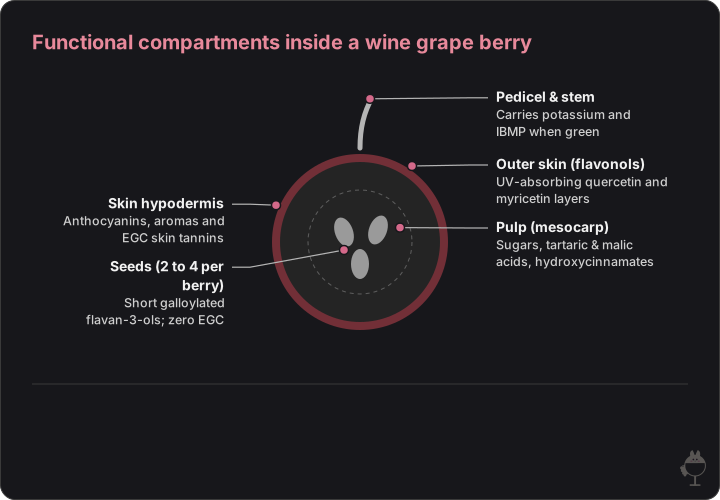
Schematic cross-section mapping sugars, organic acids, flavonoids and structural tannins across berry tissues.
Read the figure as text
- Pedicel & stem — Carries potassium and IBMP when green
- Outer skin (flavonols) — UV-absorbing quercetin and myricetin layers
- Skin hypodermis — Anthocyanins, aromas and EGC skin tannins
- Pulp (mesocarp) — Sugars, tartaric & malic acids, hydroxycinnamates
- Seeds (2 to 4 per berry) — Short galloylated flavan-3-ols; zero EGC
Phenolic chemistry: anthocyanins, flavonols and skin-versus-seed tannins
In grape skins, colour and antioxidant behaviour stem from two main flavonoid classes profiled by Mattivi et al. (2006) across 91 Vitis vinifera cultivars. In white varieties the enzyme flavonoid 3′,5′-hydroxylase is unexpressed, so delphinidin-like tri-hydroxylated flavonols are missing and quercetin (averaging 81.35%) plus kaempferol (16.91%) dominate UV skin protection. Red varieties express that pathway broadly, led by quercetin (43.99%) and myricetin (36.81%) alongside laricitrin, isorhamnetin and syringetin.
Anthocyanin substitution governs hue, stability and ageing trajectory. Tri-hydroxylated, B-ring-methylated malvidin-3-glucoside imparts deep purple-ruby hues and resists oxidation cleanly — characteristic of Cabernet Sauvignon, Syrah and Barbera. Conversely, Pinot Noir lacks acylated anthocyanins (Mattivi et al., 2006), and Nebbiolo relies primarily on di-hydroxylated peonidin-3-glucoside (37%) ahead of malvidin-3-glucoside (28%), yielding translucent brick-edged hues even in concentrated years (Guaita & Bosso, 2019).
Condensed tannins diverge even more sharply between tissue types. Harbertson et al. (2002) measured skin-to-seed tannin ratios near 1:1 per berry in Cabernet Sauvignon and Pinot Noir at harvest, whereas Syrah berries carried nearly 3 times as much seed tannin as skin tannin because seed count per berry drives total seed mass. Critically, skin tannins contain (−)-epigallocatechin (EGC) with long polymeric chains, while seeds lack EGC completely (e.g. mean degree of polymerisation near 4 in fresh Nebbiolo seeds) and deliver firmer galloylated astringency (Guaita & Bosso, 2019).

 AI
·
Berry cross-section morphology
Image: Maison Apéro (generated image) · Maison Apéro original
Varietal aroma chemistry and organic-acid architecture
Aromatic signatures map to four chemically distinct precursor pathways. First, floral terpene alcohols (linalool, geraniol, nerol) mark Muscat, Gewurztraminer, Torrontés and Alsatian aromatics, while C13-norisoprenoid TDN explains petrol evolution in bottle-aged Riesling. Second, non-volatile cysteinylated and glutathionylated precursors cleave during yeast fermentation to liberate volatile thiols such as 3-mercaptohexan-1-ol (3SH) and 4-mercapto-4-methylpentan-2-one (4MSP), driving boxwood, grapefruit and passionfruit lift in Sauvignon Blanc and Petit Manseng (Tominaga et al., 1998).
Third, vegetative bell-pepper methoxypyrazines — notably 3-isobutyl-2-methoxypyrazine (IBMP) — occur in Cabernet Sauvignon, Cabernet Franc, Carmenère and Sauvignon Blanc, declining steeply with cluster sunlight exposure and veraison ripening (Ryona et al., 2008). Fourth, the sesquiterpene rotundone located in berry skins delivers black pepper spice at an astonishing 16 ng/L threshold in red wine (8 ng/L in water), though roughly 20% of consumers carry selective anosmia even up to 4,000 ng/L while 80% detect it clearly (Wood et al., 2008).
Non-volatile acid composition balances aroma against site climate. Because malic acid degrades via berry respiration faster at warmer vineyard temperatures while tartaric acid stays comparatively stable post-veraison, high-malate cultivars grown in warm sites lose brisk lift rapidly unless harvested early or sited at altitude (Sweetman et al., 2009).
Compendium of twelve major black wine grape varieties
Structured black-skinned cultivars span thick-skinned structural powerhouses to translucent aromatic terroir transmitters:
• Cabernet Sauvignon: late-ripening, thick-skinned, high 1:1 skin-to-seed tannin, deep malvidin colour, IBMP in shade; classic across Bordeaux Left Bank, Napa Valley, Coonawarra and Maipo.
• Merlot: earlier-budding and ripening than Cabernet Sauvignon, larger berry with softer mid-palate flesh, deep ruby plum character; anchor of Pomerol, Saint-Émilion and cool coastal blends.
• Cabernet Franc: thinner-skinned cousin ripening ahead of Cabernet Sauvignon, floral graphite and elevated IBMP sensitivity in cool seasons; star in Chinon, Bourgueil and Saint-Émilion.
• Pinot Noir: early-budding and early-ripening in cool regions, very thin skin lacking acylated anthocyanins, supple 1:1 skin/seed tannin, red berry and silky acidity; benchmark in Burgundy, Champagne, Central Otago and Oregon.
• Syrah (Shiraz): moderate-thick dark skins rich in malvidin, high seed-to-skin ratio nearly 3:1, rotundone black-pepper skin compound in cool Northern Rhône (Côte-Rôtie, Hermitage) versus plush blackberry ripeness in Barossa.
• Garnacha (Grenache): vigorous bush-adapted late ripener thriving in dry wind (Priorat, Châteauneuf-du-Pape, Barossa), thinner skins with lower malvidin density yielding translucent ruby colour, high potential alcohol and spicy red-berry warmth.
• Nebbiolo: ultra-early budding and late October ripening, pale peonidin-dominant colour (37%) paired with exceptionally high EGC-rich skin tannins and short-chain seed tannins (mDP near 4); sole grape of Barolo and Barbaresco.
• Sangiovese: slow-ripening Tuscan workhorse with medium-pale translucent colour, sharp natural acidity and firm savoury tannin bridging Chianti Classico to Brunello di Montalcino.
• Tempranillo: early-to-mid ripening thick-skinned Iberian mainstay blending red fruit, moderate acid and rapid oak affinity across Rioja and Ribera del Duero.
• Malbec: deep anthocyanin pigment saturation, plush plum and velvet-grain tannin thriving on high-altitude UV illumination in Mendoza beside historic Cahors.
• Zinfandel (Primitivo): uneven-ripening thin-to-medium skin prone to high sugar and shrivelled berries in Lodi, Dry Creek and Puglia, adapting across bold reds, dry rosé and off-dry bottlings.
• Cariñena (Carignan): late-ripening, high-acid, deeply pigmented dark grape whose old low-yielding Mediterranean bush vines lend tension and spine in Priorat and Languedoc blends.
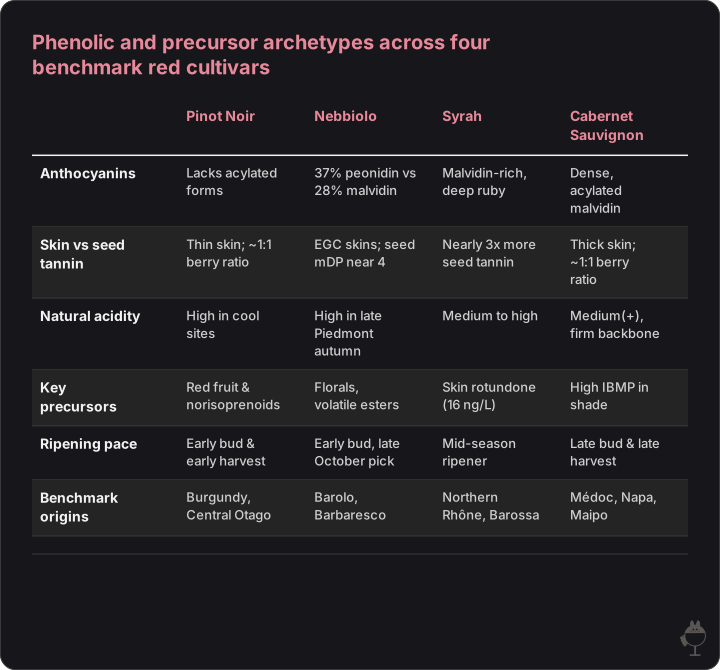
Verified contrasts in anthocyanin stability, skin-to-seed tannin proportions and varietal aroma compounds.
Read the figure as text
| Pinot Noir | Nebbiolo | Syrah | Cabernet Sauvignon | |
|---|---|---|---|---|
| Anthocyanins | Lacks acylated forms | 37% peonidin vs 28% malvidin | Malvidin-rich, deep ruby | Dense, acylated malvidin |
| Skin vs seed tannin | Thin skin; ~1:1 berry ratio | EGC skins; seed mDP near 4 | Nearly 3x more seed tannin | Thick skin; ~1:1 berry ratio |
| Natural acidity | High in cool sites | High in late Piedmont autumn | Medium to high | Medium(+), firm backbone |
| Key precursors | Red fruit & norisoprenoids | Florals, volatile esters | Skin rotundone (16 ng/L) | High IBMP in shade |
| Ripening pace | Early bud & early harvest | Early bud, late October pick | Mid-season ripener | Late bud & late harvest |
| Benchmark origins | Burgundy, Central Otago | Barolo, Barbaresco | Northern Rhône, Barossa | Médoc, Napa, Maipo |
Compendium of eleven major white wine grape varieties
Major white Vitis vinifera cultivars vary equally sharply across skin thickness, natural acidity and winemaking affinity:
• Chardonnay: early-budding, broadly adaptable neutral canvas whose ripe malic/tartaric profile supports crisp Chablis steeliness, Champagne autolysis or Burgundian malolactic conversion (MLC) and French oak lees stirring.
• Sauvignon Blanc: vigorous, mid-ripening aromatic cultivar pairing tart malic vibrancy with both methoxypyrazines and volatile thiols (3SH/4MSP); benchmarked in Sancerre, Pouilly-Fumé and Marlborough.
• Riesling: cold-hardy, late-ripening aromatic stalwart preserving piercing tartaric/malic acidity from dry Mosel slate and Alsace Grand Cru to Eden Valley and Clare Valley, developing TDN petrol complexity with bottle age.
• Chenin Blanc: versatile Loire acid anchor spanning crisp sparkling Crémant, dry Savennières, off-dry Vouvray and Botrytis-concentrated Quarts de Chaume thanks to uneven ripening and durable natural acidity.
• Sémillon: thin-skinned variety highly susceptible to Botrytis cinerea noble rot in Sauternes yet prized for crisp, low-alcohol longevity and lanolin wax development in Australia’s Hunter Valley.
• Pinot Gris / Pinot Grigio: pink-grey-skinned mutation of Pinot Noir containing light skin phenolics that yield crisp alpine styles (Alto Adige) when picked early or rich oily textured wines when ripened fully (Alsace).
• Gewurztraminer: pink-skinned early ripener marked by intense monoterpene geraniol (rose petal, lychee), elevated pH and low natural acid; flagship of Alsace and Alto Adige.
• Viognier: thin-skinned warm-climate aromatic grape producing viscous apricot-blossom texture with narrow acid margins across Condrieu and coastal New World sites.
• Albariño / Alvarinho: thick-skinned Galician and Vinho Verde cultivar resisting Atlantic humidity while delivering stone-fruit terpenes, phenolic skin grip and brisk freshness.
• Grüner Veltliner: Austria’s flagship white blending brisk acid and white-pepper spice (also traces of rotundone) from crisp Steinfeder to age-worthy Wachau Smaragd.
• Koshu: thick pale-pink-grey-skinned indigenous cultivar of Japan’s Kofu Basin, yielding delicate, low-pH, subtly phenolic dry whites engineered for light skin contact and lees complexity.
Global planted footprint and climate positioning (OIV Focus 2017)
Commercial distribution across world vineyards reflects climate versatility as much as prestige. According to the OIV Focus 2017 global census of grapevine surface areas, the leading wine varieties by planted area stand as Cabernet Sauvignon at 341 thousand hectares (341,000 ha), Merlot at 266 thousand ha (266,000 ha), Tempranillo at 231 thousand ha (231,000 ha), Spanish white Airén at 218 thousand ha (218,000 ha) and Chardonnay at 210 thousand ha (210,000 ha).
Behind those five stand Syrah at 190 thousand ha (190,000 ha), Garnacha at 163 thousand ha (163,000 ha), Sauvignon Blanc at 123 thousand ha (123,000 ha) and Pinot Noir at 112 thousand ha (112,000 ha). Notice how structural, drought-resilient or broad-climate international varieties expand globally, whereas climate-fussy late or hyper-early grapes such as Nebbiolo or Pinot Noir occupy tighter thermal corridors.
Yet global hectares never equate to regional dominance: regional benchmarks thrive precisely where local heat-summation windows, diurnal range and soil water regimes match a cultivar’s phenology — aligning budbreak after spring frost and veraison sugar accumulation before malic acid collapses.
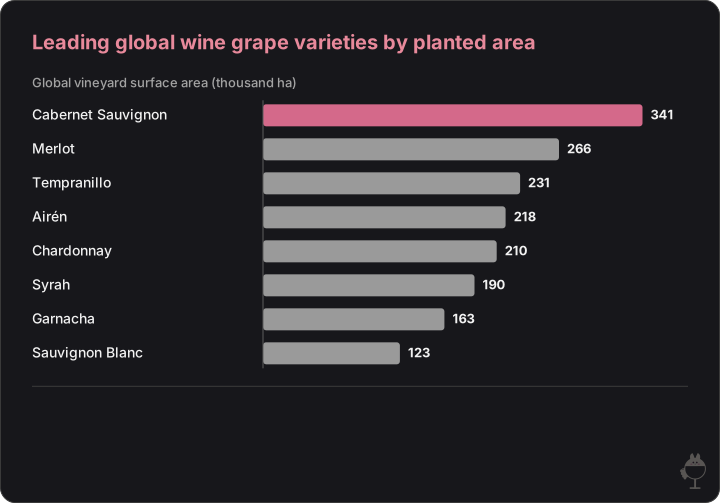
Top eight wine grape cultivars in the OIV Focus 2017 census, measured in thousands of hectares.
Read the figure as text
Global vineyard surface area (thousand ha)
- Cabernet Sauvignon: 341 thousand ha
- Merlot: 266 thousand ha
- Tempranillo: 231 thousand ha
- Airén: 218 thousand ha
- Chardonnay: 210 thousand ha
- Syrah: 190 thousand ha
- Garnacha: 163 thousand ha
- Sauvignon Blanc: 123 thousand ha
Applying varietal phenolic and aroma science in the glass
Translating berry chemistry into analytical blind tasting anchors sensory clues in physical mechanisms rather than memorised checklists. Assessing intensity of colour and rim hue separates thin-skinned, non-acylated Pinot Noir and peonidin-rich Nebbiolo from thick-skinned malvidin powerhouses such as Cabernet Sauvignon, Malbec or Syrah.
Mouthfeel tells a tissue-specific story: fine, broad velvet tannins suggest ripe skin extraction high in long EGC polymers, whereas sharp, drying astringency accompanied by dark bitterness points toward higher extraction of shorter, galloylated seed tannins — whether from cultivar seed count as in Syrah or heavy warm ethanol maceration.
Integrating primary precursor notes — rotundone spice, thiol passionfruit, IBMP bell pepper or terpene rose — with acid profile and oak texture turns varietal identification from guesswork into grounded agricultural reasoning.
Berry tissue
- Exocarp / skin: anthocyanins, UV flavonols, aromatic precursors and EGC tannins
- Mesocarp / pulp: fermentable sugars, tartaric & malic acids, hydroxycinnamates
- Seeds & stems: galloylated short-chain flavan-3-ols (no EGC), potassium and IBMP
Vineyard & vat levers
- Cool vs warm diurnal range shifts malic respiration and IBMP/rotundone
- Water deficit lowers berry volume, enlarging skin-to-pulp ratio
- Fermentation length and ethanol govern skin-versus-seed tannin share
Diagnostic clues
- Hue & intensity separate peonidin/non-acylated reds from malvidin cultivars
- Tannin texture contrasts EGC-rich skin grip against galloylated seed bite
- Volatile thiols, monoterpenes and rotundone pinpoint aromatic pathways
Frequently asked questions
Why do grape skin tannins and seed tannins feel different on the palate?
Skin condensed tannins possess longer polymer chains and include tri-hydroxylated (−)-epigallocatechin (EGC) subunits, extracting easily in early fermentation with a supple, broad grip. Seed tannins completely lack EGC, exhibit lower polymerisation and carry astringent galloylated esters requiring higher ethanol for extraction.
Which anthocyanin features distinguish Pinot Noir and Nebbiolo from Syrah or Cabernet Sauvignon?
Metabolite profiling shows Pinot Noir lacks acylated anthocyanins, leaving less pigment stability. Nebbiolo holds low total anthocyanins dominated by di-hydroxylated peonidin-3-glucoside (37%) over malvidin-3-glucoside (28%), giving pale garnet hues despite high tannin. Syrah and Cabernet Sauvignon abound in stable tri-hydroxylated malvidin derivatives.
What makes rotundone in Shiraz unique among varietal aroma compounds?
Identified in grape skins in 2008, the sesquiterpene rotundone conveys black pepper character at ultra-low thresholds of 16 ng/L in red wine (8 ng/L in water). Crucially, roughly 80% of sensory panelists perceive it sharply while 20% remain anosmic even at 4,000 ng/L.
Which wine grape varieties occupy the largest vineyard area globally according to the OIV?
OIV Focus 2017 places Cabernet Sauvignon first among wine varieties at 341,000 hectares, followed by Merlot (266,000 ha), Tempranillo (231,000 ha), white Airén (218,000 ha), Chardonnay (210,000 ha), Syrah (190,000 ha), Garnacha (163,000 ha), Sauvignon Blanc (123,000 ha) and Pinot Noir (112,000 ha).
See also: What does canopy management change in the grapes? (Canopy Management: How Leaves and Light Shape Grape Polyphenols)
See also: Why should the stems be woody (lignified)? (Whole Bunch or Destemmed: What the Stems Change in a Red Wine)
Sources
- OIV (International Organisation of Vine and Wine) — Distribution of the world’s grapevine varieties (Focus OIV 2017)
- Adams, D. O. (2006). Phenolics and Ripening in Grape Berries. American Journal of Enology and Viticulture 57(3): 249–256
- Harbertson, J. F., Kennedy, J. A. & Adams, D. O. (2002). Tannin in Skins and Seeds of Cabernet Sauvignon, Syrah, and Pinot noir Berries during Ripening. American Journal of Enology and Viticulture 53(1): 54–59
- Mattivi, F., Guzzon, R., Vrhovsek, U., Stefanini, M. & Velasco, R. (2006). Metabolite Profiling of Grape: Flavonols and Anthocyanins. Journal of Agricultural and Food Chemistry 54(20): 7692–7702 (PubMed)
- Guaita, M. & Bosso, A. (2019). Polyphenolic Characterization of Grape Skins and Seeds of Four Italian Red Cultivars at Harvest and after Fermentative Maceration. Foods 8(9): 395 (PMC6770923)
- Downey, M. O., Dokoozlian, N. K. & Krstic, M. P. (2006). Cultural Practice and Environmental Impacts on the Flavonoid Composition of Grapes and Wine. American Journal of Enology and Viticulture 57(3): 257–268
- Wood, C. et al. (2008). From wine to pepper: rotundone, an obscure sesquiterpene, is a potent spicy aroma compound. Journal of Agricultural and Food Chemistry 56(10): 3738–3744 (PubMed)
- Tominaga, T., Murat, M.-L. & Dubourdieu, D. (1998). Development of a Method for Analyzing the Volatile Thiols Involved in the Characteristic Aroma of Wines Made from Vitis vinifera L. Cv. Sauvignon Blanc. Journal of Agricultural and Food Chemistry 46(3): 1044–1048
- Ryona, I. et al. (2008). Effects of cluster light exposure on 3-isobutyl-2-methoxypyrazine accumulation and degradation patterns in red wine grapes (Vitis vinifera L. cv. Cabernet Franc). Journal of Agricultural and Food Chemistry 56(22): 10838–10846 (PubMed)
- Sweetman, C., Deluc, L. G., Cramer, G. R., Ford, C. M. & Soole, K. L. (2009). Regulation of malate metabolism in grape berry and other developing fruits. Phytochemistry 70(11–12): 1329–1344


