

Depopulation and surviving bush vines before 1989
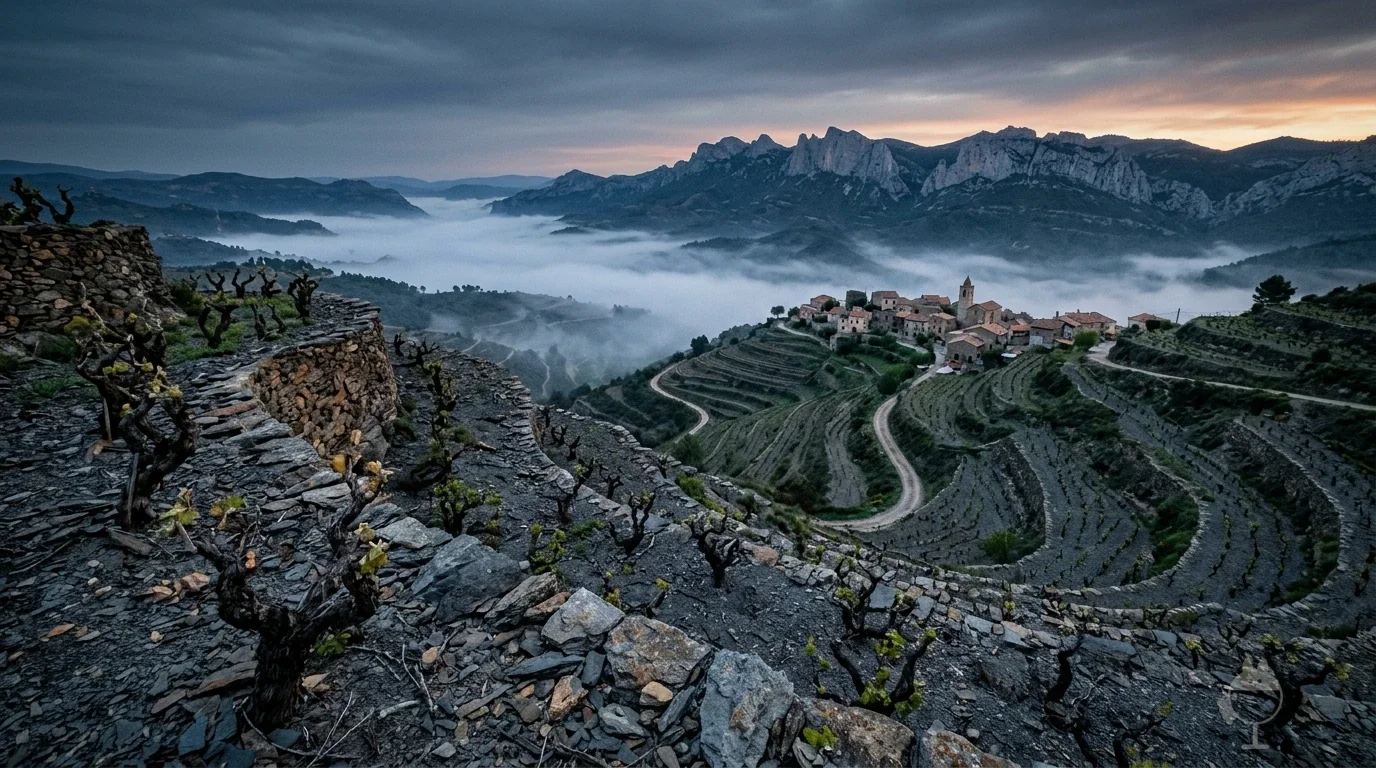
Although Carthusian monks at Scala Dei established monastic viticulture in Priorat during the twelfth century and Spain granted Denominación de Origen status in 1954, most of the twentieth century pushed the district toward abandonment. Rural migration stripped hillside villages of young labour, and terraced costers rising from 100 to 750 metres — most steeper than 15% and some reaching 60% — proved impossible to mechanise economically.
Before 1989, local cooperatives collected low-yielding fruit from ancient bush vines and sold dark, high-alcohol bulk wine used mainly to strengthen lighter reds elsewhere. Those surviving vineyards of old Garnacha and Cariñena held low intrinsic vigour on shallow llicorella slate, yet almost no estate bottled them with geographic pride.
René Barbier, born into a wine-merchant family in Tarragona with experience in Bordeaux and Rioja, recognised the potential of those steep slopes in the late 1970s and bought old plots around Gratallops in 1979 before convincing allies to join him.
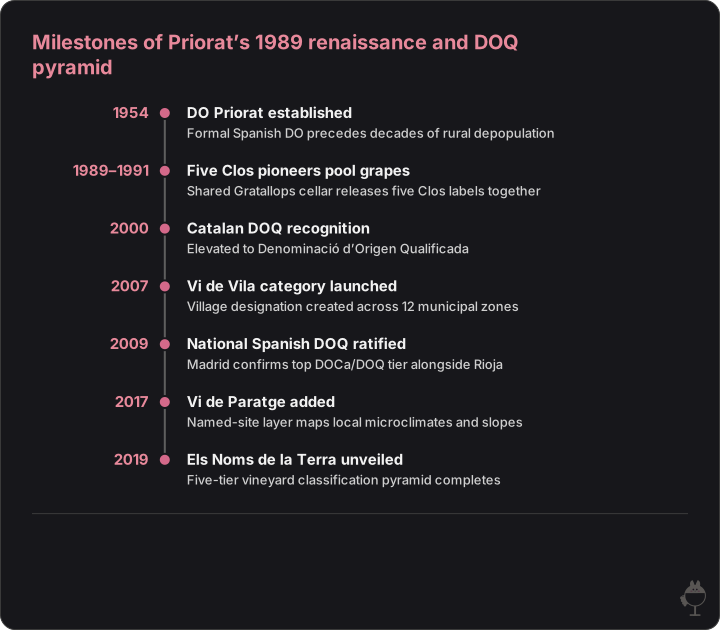
From the 1954 DO creation through the 1989–1991 joint Gratallops Clos vintages to the 2019 Els Noms de la Terra classification.
Read the figure as text
- 1954 — DO Priorat established. Formal Spanish DO precedes decades of rural depopulation
- 1989–1991 — Five Clos pioneers pool grapes. Shared Gratallops cellar releases five Clos labels together
- 2000 — Catalan DOQ recognition. Elevated to Denominació d’Origen Qualificada
- 2007 — Vi de Vila category launched. Village designation created across 12 municipal zones
- 2009 — National Spanish DOQ ratified. Madrid confirms top DOCa/DOQ tier alongside Rioja
- 2017 — Vi de Paratge added. Named-site layer maps local microclimates and slopes
- 2019 — Els Noms de la Terra unveiled. Five-tier vineyard classification pyramid completes
Gratallops 1989–1991: five names sharing one cellar
In 1989, five independent figures united around a bold cooperative experiment in Gratallops. Alongside René Barbier (Clos Mogador) stood young Riojan winemaker Álvaro Palacios (Clos Dofí, later renamed Finca Dofí), Swiss-born merchant Daphne Glorian (Clos Erasmus), Tarragona biology professor and oenology instructor Josep Lluís Pérez (Clos Martinet) and journalist-winemaker Carles Pastrana (Clos de l’Obac).
None possessed enough capital to build five separate wineries at once. Across the 1989, 1990 and 1991 vintages, they harvested separate vineyards, pooled grapes into a single shared cellar in Gratallops and released the resulting blend under five distinct “Clos” labels — a nod to Burgundy’s walled vineyard heritage.
When the 1989 wines reached international critics and collectors at unprecedented prices for Catalan wine, each partner gained the financial footing to establish an autonomous estate after 1991, launching wines such as Palacios’s L’Ermita and transforming Gratallops into Spain’s premier laboratory of steep-slope winemaking.
Garnacha, Cariñena and berry physiology on llicorella
From the start, the Gratallops pioneers rebuilt quality around surviving head-pruned Garnacha and Cariñena while also planting Syrah, Cabernet Sauvignon and Merlot to explore colour, structure and mid-palate depth. Today DOQ rules keep Garnacha and Cariñena as the recommended red backbone while allowing selected complementary varieties.
Llicorella soils — broken Palaeozoic slates low in organic matter and shallow in water-holding capacity — exert powerful physiological leverage over berry composition. Field research on vine water deficits shows that moderate deficit restrains berry size, enlarges the skin-to-pulp ratio and concentrates anthocyanins and tannins inside skins partly independently of berry weight loss (Roby et al., 2004).
Legal production limits codified those natural restrictions: red grapes are capped at 6,000 kilograms per hectare with a maximum pressing ratio of 65 litres per 100 kilograms of grapes — equal to at most 39 hectolitres per hectare — and red wines must reach at least 13.5% alcohol by volume.
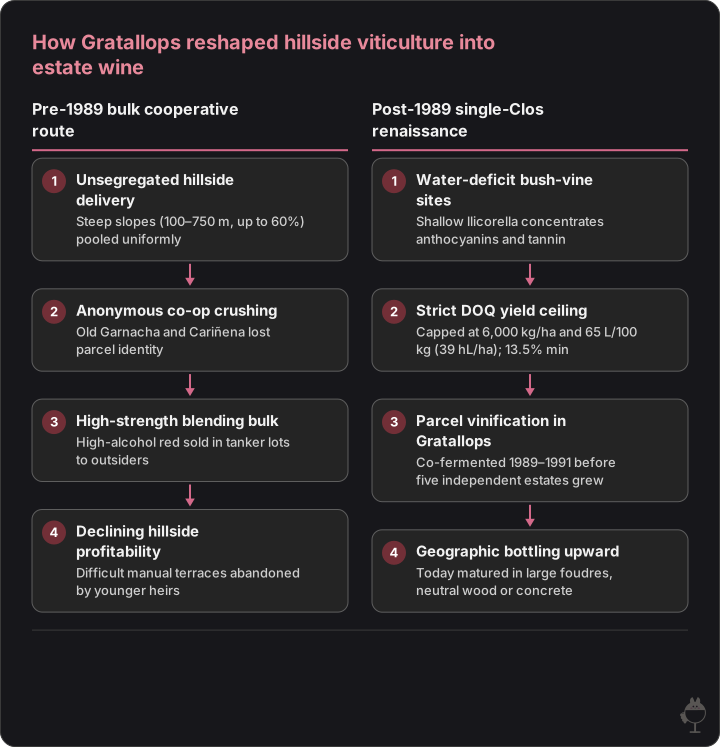
Contrast between pre-1989 bulk cooperatives and the low-yield single-Clos workflow on 100–750 m llicorella slopes.
Read the figure as text
Pre-1989 bulk cooperative route
- Unsegregated hillside delivery — Steep slopes (100–750 m, up to 60%) pooled uniformly
- Anonymous co-op crushing — Old Garnacha and Cariñena lost parcel identity
- High-strength blending bulk — High-alcohol red sold in tanker lots to outsiders
- Declining hillside profitability — Difficult manual terraces abandoned by younger heirs
Post-1989 single-Clos renaissance
- Water-deficit bush-vine sites — Shallow llicorella concentrates anthocyanins and tannin
- Strict DOQ yield ceiling — Capped at 6,000 kg/ha and 65 L/100 kg (39 hL/ha); 13.5% min
- Parcel vinification in Gratallops — Co-fermented 1989–1991 before five independent estates grew
- Geographic bottling upward — Today matured in large foudres, neutral wood or concrete
Cellar evolution: from new barriques to foudres and concrete
In the 1990s, the Priorat renaissance spoke the international cellar language of its era: warm fermentations, frequent punching down to build dense colour and extract, and lengthy maturation in new 225-litre French oak barrels. Extracting thoroughly on steep, water-stressed fruit created powerful, darkly pigmented reds whose reputation soared worldwide, including 100-point critical recognition for Clos Erasmus.
Yet intensive extraction carries structural risks when fruit sugar runs high. Research on phenolic extraction highlights how elevated ethanol and aggressive cap management accelerate late dissolution of harsh seed tannins (Sacchi et al., 2005), while new small oak multiplies oxygen transfer and lactone uptake (Garde-Cerdán & Ancín-Azpilicueta, 2006).
Over the last twenty years, Gratallops pioneers and their successors recalibrated sharply: picking slightly earlier for fresher malic/tartaric balance, infusing whole stems selectively, trimming extractive pump-overs and shifting maturation toward larger 500-to-3,000-litre foudres, neutral oak, ceramic vessels and concrete tanks so llicorella finesse leads.
From 2000 DOQ elevation to Els Noms de la Terra
Economic revival rapidly brought institutional recognition. First elevated from DO to Catalonia’s Denominació d’Origen Qualificada (DOQ) in 2000 and confirmed at Spanish national DOCa level in 2009, Priorat joined Rioja as one of only two top-tier appellations in Spain.
Crucially, rather than copying Rioja’s Crianza/Reserva barrel-ageing hierarchy, Priorat became Spain’s pioneer of Burgundy-style geographic classification. Beginning with the 2007 vintage, the council introduced Vi de Vila (Village Wine) across 12 delimited village zones including Gratallops, Porrera, Torroja del Priorat and Bellmunt del Priorat.
In 2017 the appellation added Vi de Paratge (named sub-site wines), culminating in 2019 in the complete five-tier pyramid called Els Noms de la Terra: regional DOQ Priorat, Vi de Vila across 12 municipalities, Vi de Paratge, single-plot Vinya Classificada and flagship Gran Vinya Classificada.
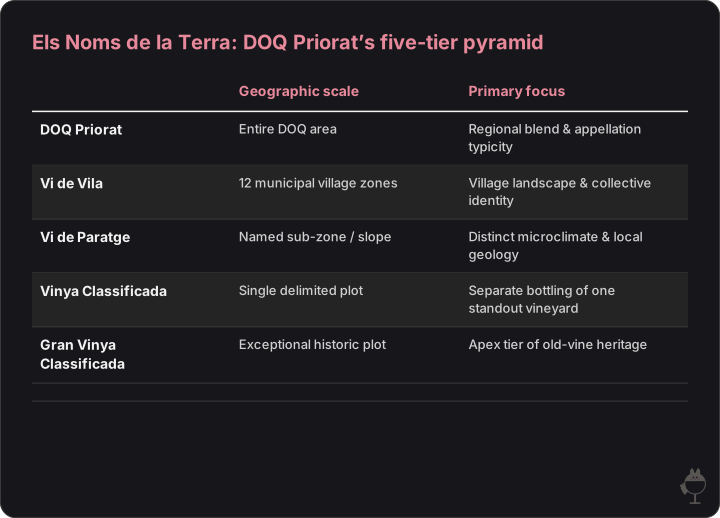
Five origin levels introduced by 2019 in DOQ Priorat, moving from the regional appellation down to single historic vineyards.
Read the figure as text
| Geographic scale | Primary focus | |
|---|---|---|
| DOQ Priorat | Entire DOQ area | Regional blend & appellation typicity |
| Vi de Vila | 12 municipal village zones | Village landscape & collective identity |
| Vi de Paratge | Named sub-zone / slope | Distinct microclimate & local geology |
| Vinya Classificada | Single delimited plot | Separate bottling of one standout vineyard |
| Gran Vinya Classificada | Exceptional historic plot | Apex tier of old-vine heritage |
Why the Priorat Boys reshaped Spanish fine wine
Measured alongside Piedmont’s Barolo Boys, the 1989 Gratallops cohort demonstrated how small-scale collaboration, site mapping and fearless quality ambition can rescue an economically marginal hillside zone without industrial scale.
Unlike large flat valley estates dependent on irrigation and mechanical harvesters, Priorat proved that manual work on 15% to 60% slate slopes — paired with disciplined yields under 39 hectolitres per hectare and transparent parcel labelling — could command global prestige solely on origin.
For advanced tasters, Priorat now offers a clear timeline in the glass: contrast densely oaked mid-1990s blends with contemporary Vi de Vila and Vi de Paratge bottlings of old-vine Garnacha and Cariñena where purity of fruit and slate-driven tension shine through.
Pre-1989 landscape
- Abandoned llicorella slopes (100–750 m) and rural exodus
- Cooperative harvests sold mainly as high-alcohol bulk wine
- Old Garnacha and Cariñena bush vines surviving unbottled
1989–1991 Clos catalyst
- Five pioneers share one Gratallops cellar for 1989–1991
- 6,000 kg/ha (39 hL/ha) cap and water-deficit concentration
- Global acclaim launches five autonomous single-Clos estates
Modern DOQ legacy
- Gentle extraction in large foudres, neutral oak or concrete
- Catalan DOQ (2000) and Spanish national DOQ ratification (2009)
- 5-tier Els Noms de la Terra classification (12 Vi de Vila, Paratge)
Frequently asked questions
Who were the five 1989 Gratallops pioneers in Priorat?
René Barbier of Clos Mogador, Álvaro Palacios of Clos Dofí (later Finca Dofí), Daphne Glorian of Clos Erasmus, Josep Lluís Pérez of Clos Martinet and Carles Pastrana of Clos de l’Obac pooled fruit and cellar space in Gratallops across the 1989, 1990 and 1991 vintages.
Why did they bottle their joint 1989 wine under five separate Clos labels?
Combining grapes from newly acquired old bush-vine parcels allowed the five friends to share one modest winery in Gratallops and split production costs while testing global market reception under five estate names before separating after the 1991 vintage.
How did Priorat’s modern cellar style change after the 1990s?
Early flagship bottlings combined low-yielding Garnacha and Cariñena with Cabernet Sauvignon and Syrah and generous new French oak barrels. Over the past two decades, growers picked slightly earlier, relied more on native varieties and shifted toward larger foudres, neutral oak and concrete.
What is Els Noms de la Terra in DOQ Priorat?
Formalised in 2019 atop earlier Vi de Vila (2007) and Vi de Paratge (2017) rules, Els Noms de la Terra arranges Priorat into five geographic tiers from regional DOQ wines through 12 village zones to single Gran Vinya Classificada parcels.
See also: What is llicorella? (Priorat: why the hillside matters to flavour, structure and price)
See also: What do the DOQ Priorat rules say about yield and alcohol? (Priorat: why the hillside matters to flavour, structure and price)
Sources
- Consell Regulador de la DOQ Priorat — Pliego de condiciones DOP Priorat (texto consolidado, julio 2013)
- Ministerio de Agricultura, Pesca y Alimentación — Pliego de condiciones de la DOP Priorat (versión noviembre 2021)
- Consell Regulador de la DOQ Priorat — Varietals
- Consell Regulador de la DOQ Priorat — Els Noms de la Terra (The names of the land)
- Consell Regulador de la DOQ Priorat — DOQ Priorat History
- Wikipedia — Priorat (wine) (1989 Gratallops Clos pioneers and DOQ recognition)
- Roby, G., Harbertson, J. F., Adams, D. A. & Matthews, M. A. (2004). Berry size and vine water deficits as factors in winegrape composition: anthocyanins and tannins. Australian Journal of Grape and Wine Research 10(2), 100–107
- Sacchi, K. L., Bisson, L. F. & Adams, D. O. (2005). A review of the effect of winemaking techniques on phenolic extraction in red wines. American Journal of Enology and Viticulture 56(3): 197–206
- Garde-Cerdán, T. & Ancín-Azpilicueta, C. (2006). Review of quality factors on wine ageing in oak barrels. Trends in Food Science & Technology 17(8): 438–447


