

Stagnation in the Langhe after 1966 and 1980
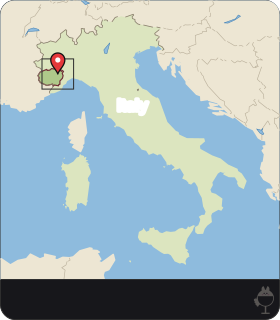
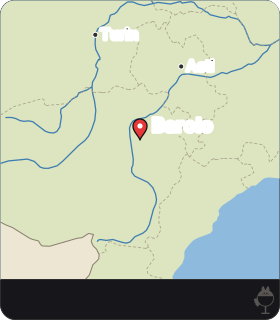
When Barolo gained Italian DOC status in 1966 and stepped up to DOCG status in 1980, its prestige on paper contrasted sharply with commercial fragility on the hillside. Across the eleven communes of the Barolo zone — bounded to 170–540 metres on clay-calcareous slopes — small farmers still sold much of their Nebbiolo to merchant houses that blended fruit across disparate exposures and vintages.
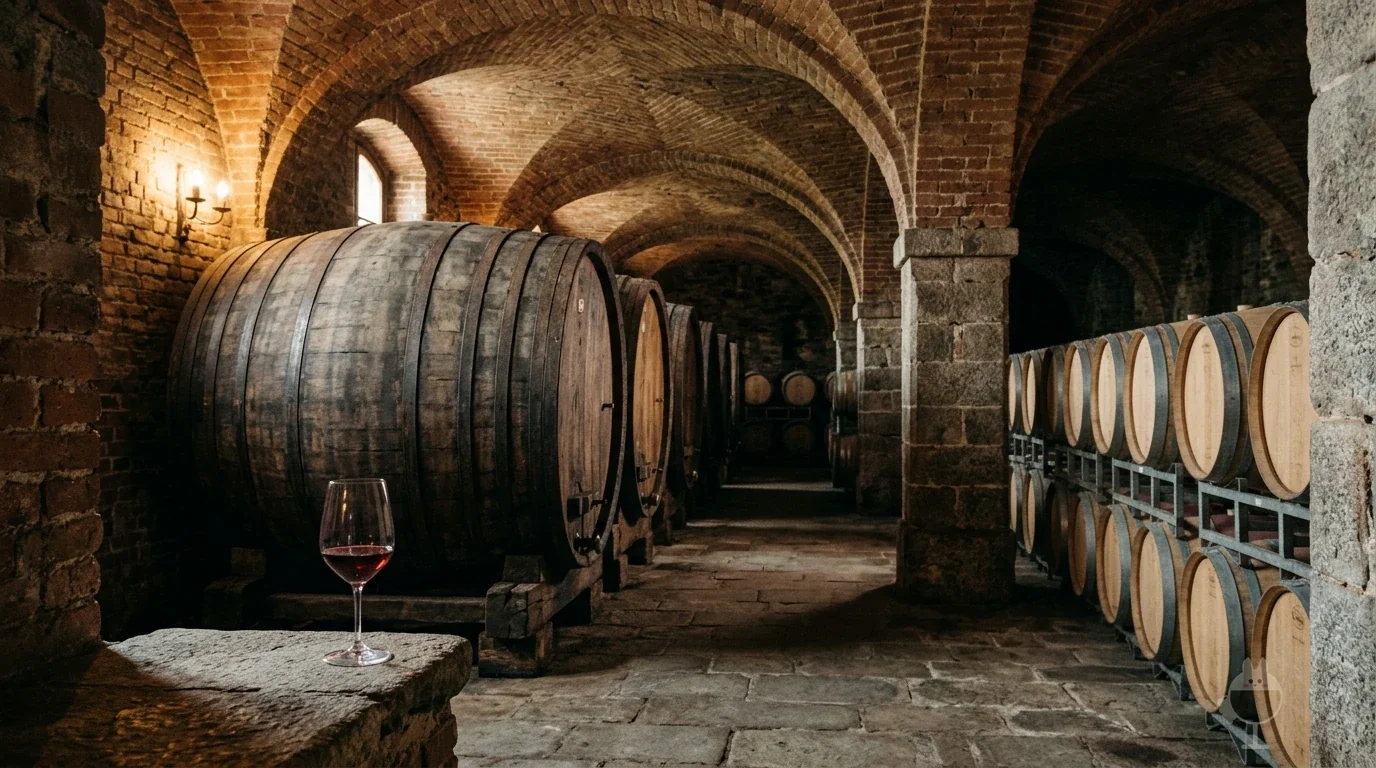
Conventional cellar work compounded the difficulty of the market. Uncontrolled fermentations in weathered wooden vats were frequently followed by three to six weeks of submerged-cap maceration and long years in giant, sometimes poorly sanitised Slavonian oak botti. Young wines often appeared pale, volatile and aggressively astringent, demanding a decade or more of bottle age at a moment when international buyers increasingly favoured supple, clean red wines.
Before the overt rebellion of the 1980s, thoughtful reformers had already mapped a way forward. Starting in the 1970s, producers led by Renato Ratti, Paolo Cordero di Montezemolo and the Ceretto family argued that single-vineyard parcels deserved individual bottling and that gentler, shorter fermentations could highlight floral aromatics without stripping away Nebbiolo’s structural backbone.
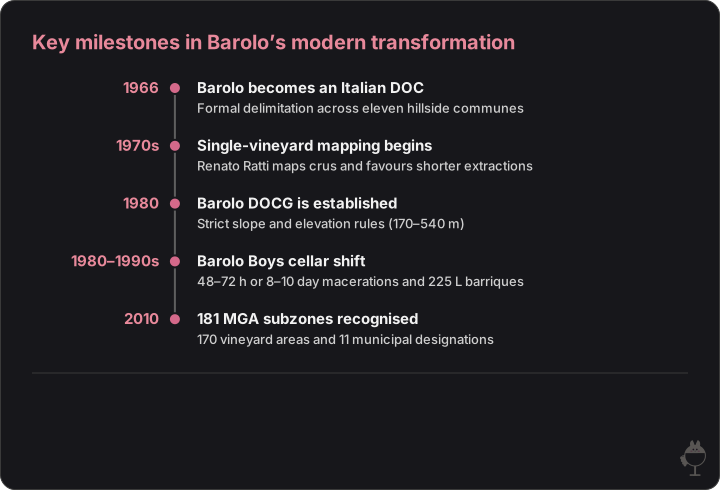
Regulatory benchmarks and cellar shifts from the 1966 DOC creation to the 2010 delimitation of 181 MGAs.
Read the figure as text
- 1966 — Barolo becomes an Italian DOC. Formal delimitation across eleven hillside communes
- 1970s — Single-vineyard mapping begins. Renato Ratti maps crus and favours shorter extractions
- 1980 — Barolo DOCG is established. Strict slope and elevation rules (170–540 m)
- 1980–1990s — Barolo Boys cellar shift. 48–72 h or 8–10 day macerations and 225 L barriques
- 2010 — 181 MGA subzones recognised. 170 vineyard areas and 11 municipal designations
Elio Altare, Burgundy lessons and a generational rupture
The decisive break arrived through growers born just after the war, anchored by Elio Altare in La Morra and peers such as Giorgio Rivetti, Chiara Boschis, Roberto Voerzio and Domenico Clerico. Studying how Burgundy’s domaines converted small single-vineyard holdings of Pinot Noir into high-value bottlings convinced Altare that cellar cleanliness, rigorous yield reduction and 225-litre French oak barriques could unlock Barolo’s international standing.
Following his pivotal 1976 Burgundy trip, Altare famously took a chainsaw to his family’s aged botti in the early 1980s, turning disciplined green-harvesting and strict manual cluster selection into everyday Langhe practice. Pruning buds aggressively and dropping unripe clusters in summer lowered crop loads so late-ripening Nebbiolo reached physiological phenolic ripeness even in cool October autumns.
Together this loose fellowship earned the nickname “Barolo Boys” during the 1980s and 1990s as they toured foreign export markets side by side. By cutting maceration times down from multi-week marathons to 48–72 hours or at most 8–10 days, their wines showed brighter ruby saturation, plush fruit and spicy French oak warmth right from release.
The phenolic chemistry that divided Piedmont
Understanding why two cellar regimes produce dramatically different textures from the exact same hillside requires looking inside Nebbiolo’s berry chemistry. In a comparative polyphenolic study of northern Italian varieties, Guaita and Bosso (2019) demonstrated that Nebbiolo grapes stand apart: their skins are relatively poor in anthocyanins yet packed with condensed tannins, while their seeds contain far higher concentrations of flavan-3-ols and proanthocyanidins than cultivars like Barbera.
Nebbiolo’s anthocyanin fingerprint explains its famously deceptive visual appearance. Roughly 37% of its skin pigments are di-hydroxylated peonidin-3-glucoside alongside 15% cyanidin-3-glucoside, while tri-hydroxylated malvidin-3-glucoside accounts for only 28% (Guaita & Bosso, 2019). Because di-hydroxylated pigments lack the purple intensity of malvidin and oxidise readily into brick-orange polymeric hues, even intense Nebbiolo shows medium to pale intensity of colour.
Tannins behave very differently between berry tissues. Skins contain longer proanthocyanidin chains rich in tri-hydroxylated (−)-epigallocatechin (EGC) subunits, which are extracted early in aqueous must and give supple grip. Seeds completely lack EGC, exhibit a low mean degree of polymerisation (mDP) near 4 units in fresh Nebbiolo seeds, and carry bitter galloylated monomers that require rising ethanol levels and extended time to leach into the wine (Guaita & Bosso, 2019; Sacchi et al., 2005).
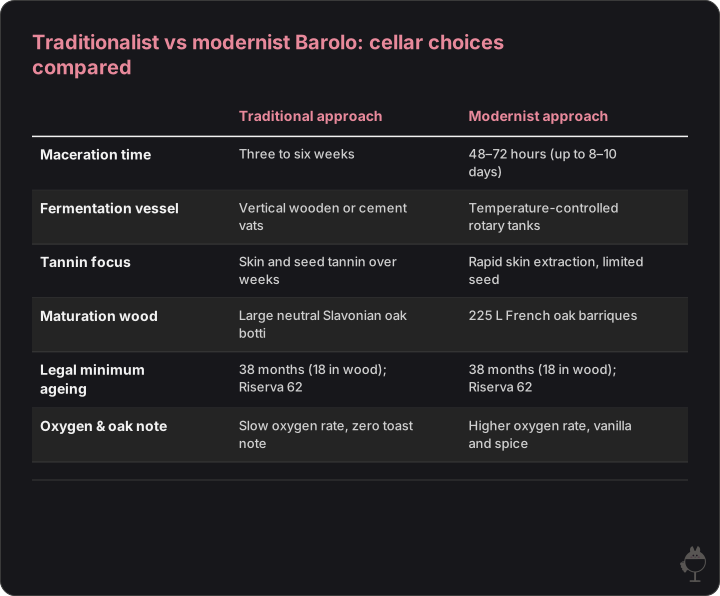
Structural comparison under the same Barolo DOCG legal ageing minimums (38 months total, 18 months in wood; 62 months for Riserva).
Read the figure as text
| Traditional approach | Modernist approach | |
|---|---|---|
| Maceration time | Three to six weeks | 48–72 hours (up to 8–10 days) |
| Fermentation vessel | Vertical wooden or cement vats | Temperature-controlled rotary tanks |
| Tannin focus | Skin and seed tannin over weeks | Rapid skin extraction, limited seed |
| Maturation wood | Large neutral Slavonian oak botti | 225 L French oak barriques |
| Legal minimum ageing | 38 months (18 in wood); Riserva 62 | 38 months (18 in wood); Riserva 62 |
| Oxygen & oak note | Slow oxygen rate, zero toast note | Higher oxygen rate, vanilla and spice |
Rotary fermenters versus large casks in legal ageing
Modernist technology specifically altered the race between early skin extraction and delayed seed dissolution. By gently tumbling fermenting must inside horizontal temperature-controlled rotary fermenters, producers saturated the juice with anthocyanins, aromatic precursors and EGC-bearing skin tannins within 48–72 hours or up to 8–10 days, draining free-run wine off the seeds before rising alcohol extracted harsh seed phenolics.
Oak choices then widened the stylistic gap within the legal Barolo DOCG boundaries, which mandate at least 38 months of total ageing from 1 November of the harvest year including at least 18 months in wood — rising to 62 months total (still 18 months in wood) for Riserva.
Maturing wine in small 225-litre French oak barriques accelerates oxygen permeation and oak compound extraction compared with giant neutral botti grandi because of the dramatically larger wood-to-wine surface ratio (Garde-Cerdán & Ancín-Azpilicueta, 2006). Small new barriques rapidly softened tannins through oxygen-assisted polymerisation while imparting vanilla lactones and toasted spice; traditionalists countered in neutral casks over multi-week macerations, leaving wine unchanged by oak aroma while allowing slow tannin evolution over decades.
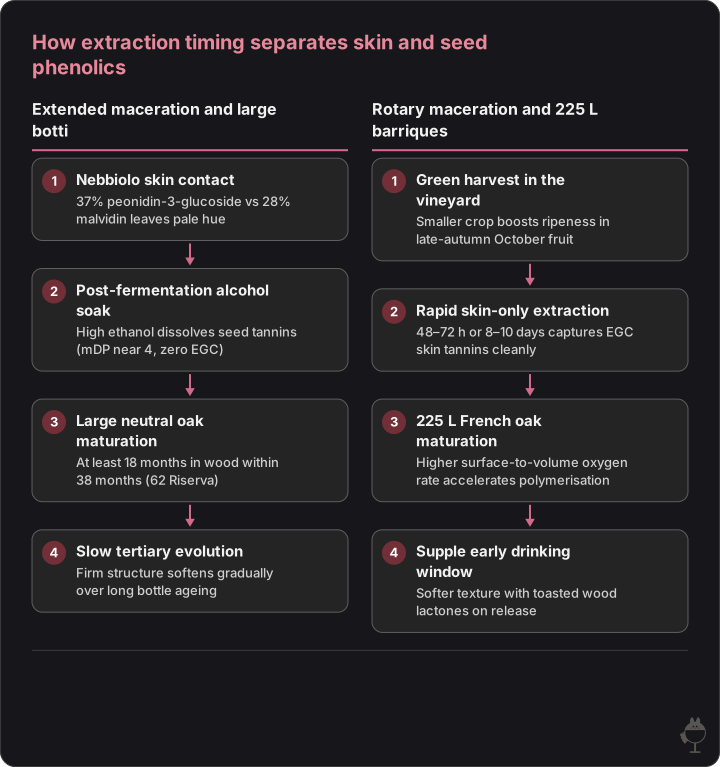
Two cellar routes acting on Nebbiolo’s peonidin-3-glucoside (37%) and seed tannins (mDP near 4) before legal wood maturation.
Read the figure as text
Extended maceration and large botti
- Nebbiolo skin contact — 37% peonidin-3-glucoside vs 28% malvidin leaves pale hue
- Post-fermentation alcohol soak — High ethanol dissolves seed tannins (mDP near 4, zero EGC)
- Large neutral oak maturation — At least 18 months in wood within 38 months (62 Riserva)
- Slow tertiary evolution — Firm structure softens gradually over long bottle ageing
Rotary maceration and 225 L barriques
- Green harvest in the vineyard — Smaller crop boosts ripeness in late-autumn October fruit
- Rapid skin-only extraction — 48–72 h or 8–10 days captures EGC skin tannins cleanly
- 225 L French oak maturation — Higher surface-to-volume oxygen rate accelerates polymerisation
- Supple early drinking window — Softer texture with toasted wood lactones on release
The Barolo wars and international critical acclaim
Between the 1985 and 1997 vintages, stylistic polarisation across the Langhe escalated into the “Barolo wars”. International critics applauded the deep colour, lush oak polish and immediate drinkability of modernist bottlings, sending estate prices soaring and drawing global capital into previously impoverished hillside villages.
Traditionalists such as Bartolo Mascarello and Giuseppe Rinaldi pushed back forcefully, arguing that heavy new French barriques masked Nebbiolo’s volatile florals — dried rose, violet, tar and sour cherry — under uniform vanillin and chocolate. They insisted that multi-week macerations and large Slavonian or chestnut casks preserved authentic commune differences across the Tortonian marls of La Morra and Barolo versus the older Serravallian sandstones and marls of Serralunga d’Alba.
With hindsight, both sides exposed real flaws in the opposing extreme. Abrupt rotary macerations coupled with 100% new toasted barriques risked homogenising terroir under oak spice, whereas dirty, over-cropped traditional botti wine suffered from volatile acidity, Brettanomyces and unyielding dryness.
The modern synthesis and 181 legal MGAs
Once heated polemics cooled in the early 2000s, virtually the entire Langhe region retained the best lessons from the Barolo Boys while retreating from stylistic excesses. Green-harvesting, clonal selection, clean temperature-controlled fermentation and meticulous cask hygiene became universal standards shared equally by neo-traditionalists and former modernists.
Instead of extreme 48-hour rotary extractions or 100% new barriques, many cellars settled on balanced 12-to-25-day macerations and neutral French tonneaux (500 litres) or medium-sized Austrian and Slavonian botti alongside 18 months or more of calm cellar elevation before release.
That shared respect for site expression culminated legally in 2010, when the appellation officially delimited 181 Menzioni Geografiche Aggiuntive (MGAs) across Barolo — 170 specific hillside vineyard zones and 11 municipal designations — enshrining on every label the single-vineyard mapping culture first championed by Langhe reformers decades earlier.
Pre-revolution
- High yields and mixed-vineyard fruit bought by merchants
- Three to six week uncooled macerations in variable vats
- Long storage in aged large neutral botti grandi
Barolo Boys shift
- Rigorous green-harvesting and single-parcel selection
- Temperature-controlled rotary extraction (days, not weeks)
- Maturation in 225 L French barriques accelerating polymerisation
Current Langhe consensus
- Clean fermentations preserving di-hydroxylated pigment and skin EGC
- Measured oak vessels (large casks or neutral tonneaux)
- Official traceability across 181 delimited MGAs
Frequently asked questions
What winemaking changes defined the Barolo Boys movement?
Led by growers such as Elio Altare alongside peers who studied Burgundy and earlier pioneers like Renato Ratti, the movement lowered vineyard yields, embraced strict cellar hygiene, cut fermentation and maceration from several weeks to 48–72 hours or 8–10 days, and matured wine in 225-litre French barriques.
Why does Nebbiolo taste fiercely tannic despite its pale colour?
Chemical profiling shows Nebbiolo skins hold modest total anthocyanins dominated by di-hydroxylated peonidin-3-glucoside (around 37%) rather than malvidin-3-glucoside (28%), giving paler garnet hues. Simultaneously, its skins and especially its seeds contain abundant condensed tannins with short, galloylated seed chains around four monomer units long.
How did rotary fermenters change Nebbiolo extraction?
Rotating horizontal stainless-steel drums gently bathed skins in fermenting juice and maintained even temperatures, extracting pigment and softer skin proanthocyanidins in days instead of weeks. Shortened contact reduced prolonged hydroalcoholic extraction of bitter, galloylated seed tannins, yielding rounder, earlier-drinking red wines.
How do traditionalist and modernist Barolo practices coexist today?
Following the intense debates between 1980 and 1990s vintages, most Langhe estates converged on a synthesis: meticulous vineyard green-harvesting and hygienic temperature-controlled fermentations paired with medium macerations and measured maturation in large neutral casks or lightly toasted barrels across 181 delimited MGAs.
See also: What do the Barolo DOCG rules require? (Barolo's Nebbiolo and Tuscany's Sangiovese: Hills, Rocks and Rules)
See also: How much oxygen does a new oak barrel let into wine? (Oak Barrels: French vs American Oak, Split vs Sawn, and What Toasting Does)
Sources
- Consorzio di Tutela Barolo Barbaresco Alba Langhe e Dogliani — Production regulations for “Barolo” DOCG (English text)
- Consorzio di Tutela Barolo Barbaresco Alba Langhe e Dogliani — Barolo DOCG
- Consorzio di Tutela Barolo Barbaresco Alba Langhe e Dogliani — Nebbiolo
- Wikipedia — Barolo (history, modernist revolution and MGA subzones)
- Guaita, M. & Bosso, A. (2019). Polyphenolic Characterization of Grape Skins and Seeds of Four Italian Red Cultivars at Harvest and after Fermentative Maceration. Foods 8(9): 395 (PMC6770923)
- Mattivi, F., Guzzon, R., Vrhovsek, U., Stefanini, M. & Velasco, R. (2006). Metabolite Profiling of Grape: Flavonols and Anthocyanins. Journal of Agricultural and Food Chemistry 54(20): 7692–7702 (PubMed)
- Sacchi, K. L., Bisson, L. F. & Adams, D. O. (2005). A review of the effect of winemaking techniques on phenolic extraction in red wines. American Journal of Enology and Viticulture 56(3): 197–206
- Garde-Cerdán, T. & Ancín-Azpilicueta, C. (2006). Review of quality factors on wine ageing in oak barrels. Trends in Food Science & Technology 17(8): 438–447


