
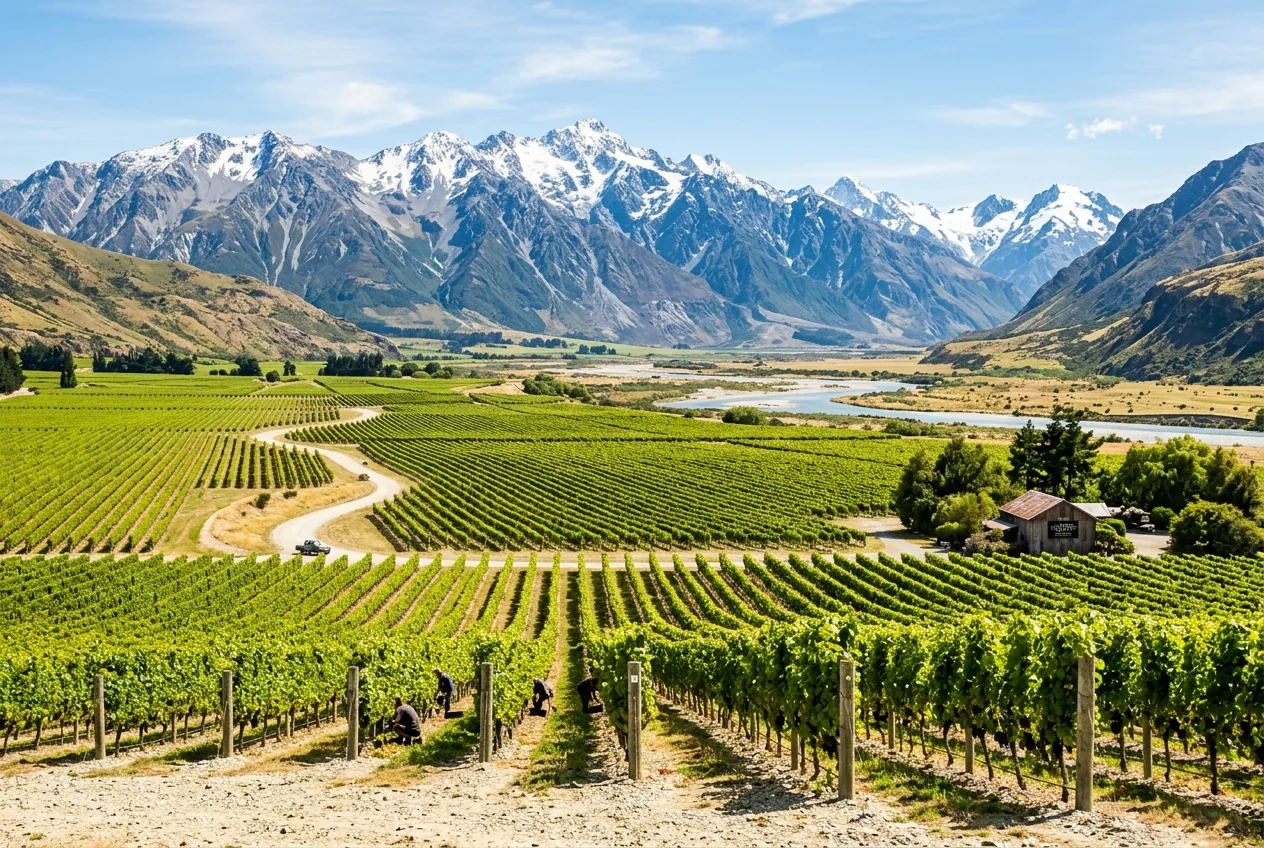
Two regions, one island
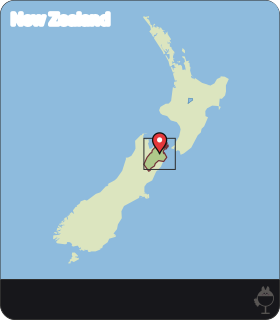
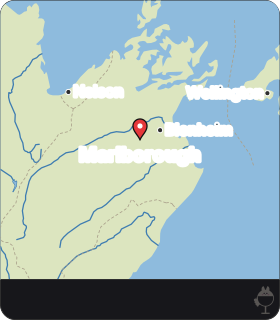
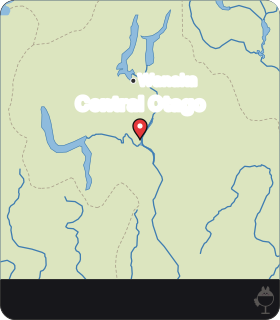
Marlborough, in the north-east of the South Island, has three sub-regions: the Wairau Valley, the Southern Valleys and the Awatere Valley. The name is a geographical indication registered in 2018 that covers all three, so a label that says only Marlborough does not tell you which valley the fruit came from.
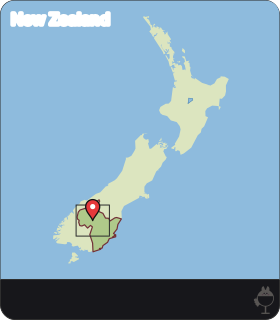
Central Otago lies far inland in the south of the island, on the 45th parallel south. New Zealand Winegrowers calls it the world's most southerly wine region, but vineyards in Chubut, in Argentine Patagonia, are also planted at about 45° south and make the same claim, so it is one of the most southerly. Central Otago has six sub-regions: Alexandra, Bannockburn, Bendigo, the Cromwell Basin (including Lowburn and Pisa), Gibbston and Wānaka.
The article follows one chain for each region: climate, then rock, then the chemistry of the flagship grape, then the cost of growing it.
Climate: sunny and dry versus continental
Dryness is the main feature of Marlborough's climate (NIWA): most of the region lies in the rain shadow east of the Main Divide, and summer droughts are frequent. It is also sunny: in the Wairau Valley NIWA records more than 2,400 hours of bright sunshine a year, the highest in the region. The Awatere Valley, south of the Wairau, is cooler, drier and windier, often with some elevation.
Central Otago is the country's only wine region with a continental climate: it is dry, with extreme variation between summer and winter temperatures and a marked diurnal range. It lies inland, far from the sea. Each sub-region has its own climate, aspect and altitude: Gibbston, for example, is the highest and coolest, with north-facing slopes, which are the sunward slopes in the southern hemisphere.
The table sets the two regions side by side.
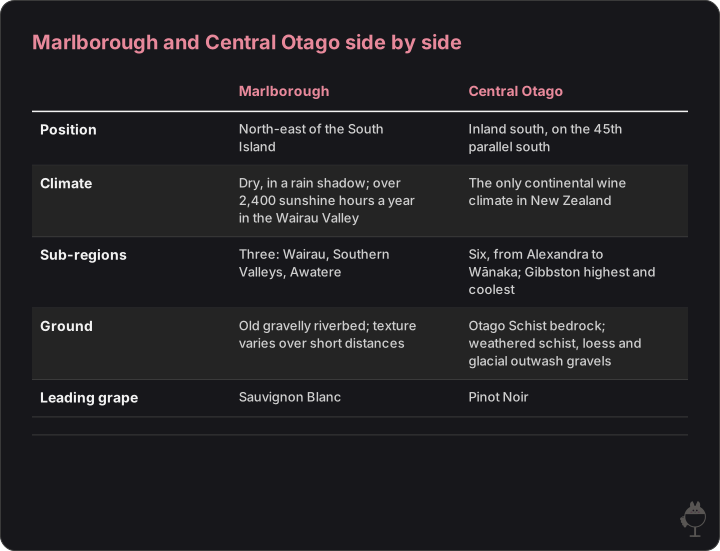
Position, climate, sub-regions, ground and leading grape of the two regions.
Read the figure as text
| Marlborough | Central Otago | |
|---|---|---|
| Position | North-east of the South Island | Inland south, on the 45th parallel south |
| Climate | Dry, in a rain shadow; over 2,400 sunshine hours a year in the Wairau Valley | The only continental wine climate in New Zealand |
| Sub-regions | Three: Wairau, Southern Valleys, Awatere | Six, from Alexandra to Wānaka; Gibbston highest and coolest |
| Ground | Old gravelly riverbed; texture varies over short distances | Otago Schist bedrock; weathered schist, loess and glacial outwash gravels |
| Leading grape | Sauvignon Blanc | Pinot Noir |
Rock and soil: river gravel and schist
On the Wairau Plains the soil texture changes markedly over short distances, reflecting the braided past of the Wairau River. In one vineyard study, where gravels came to the surface the soil at 30 cm was 1 to 2 °C warmer than on deep silt, vine phenology was more advanced and the fruit was riper on the same date; yield did not differ. The Wairau Valley has old, gravelly riverbed soils and the Southern Valleys heavier soils with more clay.
Much of Central Otago sits on the Otago Schist, a metamorphic rock formed from greywacke and argillite in an accretionary wedge in the Late Jurassic to Early Cretaceous. Central Otago's soils include schist weathered into fine earth, windblown loess from past ice ages and glacial outwash gravels, with alluvial sand, gravel and silt on terraces and valley floors.
There is no evidence that mica or minerals in the rock can be tasted in the wine.
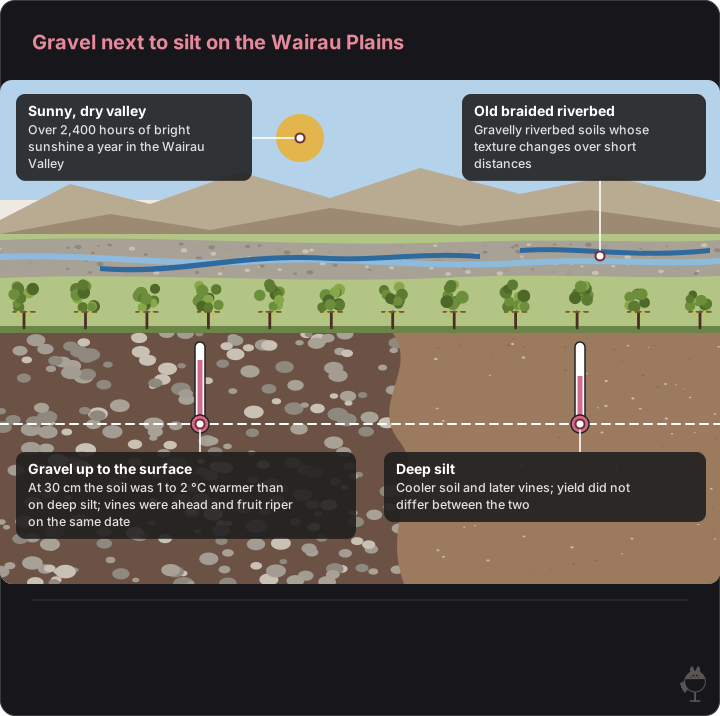
A Wairau vineyard in cutaway. Where old riverbed gravels reach the surface, the soil is warmer than over deep silt a short distance away; both thermometers sit at the same depth. Shapes and colours are illustrative.
Read the figure as text
- Sunny, dry valley — Over 2,400 hours of bright sunshine a year in the Wairau Valley
- Old braided riverbed — Gravelly riverbed soils whose texture changes over short distances
- Gravel up to the surface — At 30 cm the soil was 1 to 2 °C warmer than on deep silt; vines were ahead and fruit riper on the same date
- Deep silt — Cooler soil and later vines; yield did not differ between the two
Sauvignon Blanc: where the passion fruit comes from
The passion fruit and grapefruit notes of many Sauvignon Blancs are linked to varietal thiols, mainly 3-mercaptohexan-1-ol (3MH) and its acetate 3MHA. The grape holds no free 3MH; it holds odourless precursors such as the cysteine and glutathione conjugates Cys-3MH and G3MH. During fermentation yeast takes up the precursors, cleaves the carbon-sulfur bond and releases 3MH, then converts part of the 3MH into 3MHA. The conjugates are not the whole story: in one study less than 1% of Cys-3MH became 3MH, and it accounted for only a small share of the 3MH in the wine.
Harvest handling matters. In a study of five Marlborough sites, wines from machine-harvested juice had more varietal thiols than wines from hand-picked grapes at three of the five, and more oxidised juices gave wines with less 3MH and 3MHA. A later New Zealand trial held machine-harvested Sauvignon Blanc at 6, 15 or 24 °C for 2 hours before pressing, to mimic transport: precursor levels differed between 6 and 15 °C, but the finished wines showed no significant difference in 3MH and 3MHA.
So the aroma depends on the vineyard and on every step to the fermenter, and more precursor in the juice does not always mean more thiol in the glass. The figure shows the sequence.
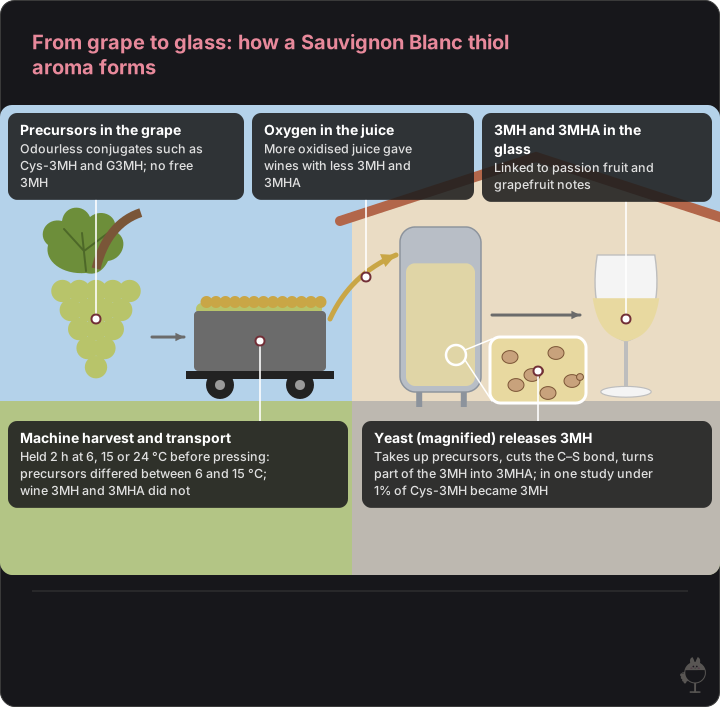
The grape holds bound, odourless 3MH precursors; yeast releases 3MH during fermentation and turns part of it into 3MHA. Picking, transport and juice oxidation change the amounts, but more precursor does not always mean more thiol in the wine. Shapes and colours are illustrative.
Read the figure as text
- Precursors in the grape — Odourless conjugates such as Cys-3MH and G3MH; no free 3MH
- Oxygen in the juice — More oxidised juice gave wines with less 3MH and 3MHA
- 3MH and 3MHA in the glass — Linked to passion fruit and grapefruit notes
- Machine harvest and transport — Held 2 h at 6, 15 or 24 °C before pressing: precursors differed between 6 and 15 °C; wine 3MH and 3MHA did not
- Yeast (magnified) releases 3MH — Takes up precursors, cuts the C–S bond, turns part of the 3MH into 3MHA; in one study under 1% of Cys-3MH became 3MH
Pinot Noir and the cost of frost in Central Otago
Pinot Noir is Central Otago's flagship variety and covers most of its vineyard area. Frost is a recurring hazard. In November 2012 spring frosts damaged new growth on vines in Central Otago (Otago Daily Times); growers ran overhead sprinklers and wind machines around dawn, and vineyard managers expected some crop loss. It also makes no claim that ultraviolet light, the ozone layer or schist minerals produce a particular flavour.

 AI
·
Stony terraces, dark grapes
Image: Maison Apéro (generated image) · Maison Apéro original
Exercise: connecting climate, rock and aroma
Question: Using one example from each region, explain how climate and ground can lead to different wine styles.
Model answer: In Marlborough, a dry, sunny valley with gravelly riverbed soils grows Sauvignon Blanc whose passion fruit aroma is linked to thiols released from grape precursors during fermentation and changes with handling at harvest and pressing. In Central Otago, a continental climate with large swings and a frost hazard, on schist-derived soils, grows Pinot Noir whose cost and risk are shaped by that climate. In both regions the claim must stay with what is demonstrated: the link between a specific rock and a flavour is not established.
Mark scheme (6 marks): 2 marks for the Marlborough climate and soil facts; 2 marks for the thiol precursor and yeast release explanation; 1 mark for the Central Otago continental climate and frost; 1 mark for avoiding an unsupported rock-to-flavour claim.
Environment
- Marlborough: dry, sunny, gravelly riverbed soils. Central Otago: continental climate, schist rock
Vine and fruit
- Sauvignon Blanc builds thiol precursors that handling can change. Pinot Noir faces frost risk and large temperature swings
In the glass
- Passion fruit and grapefruit thiol aromas. Pinot Noir from a region of strong contrasts
Frequently asked questions
What gives Marlborough Sauvignon Blanc its passion fruit aroma?
It is linked mainly to varietal thiols: 3-mercaptohexan-1-ol (3MH) and its acetate 3MHA. The grape holds odourless precursors bound to cysteine or glutathione; during fermentation yeast releases 3MH from them and turns part of it into 3MHA. Handling after picking, such as machine harvesting and juice oxidation, changes how much thiol reaches the wine.
Why is Central Otago called a continental wine region?
It is the country's only wine region with a continental climate: inland and dry, with extreme variation between summer and winter temperatures and a marked diurnal range. Spring frost is a recurring hazard.
Is Central Otago the world's southernmost wine region?
It lies on the 45th parallel south, and New Zealand Winegrowers calls it the world's most southerly wine region. Vineyards in Chubut, Argentine Patagonia, also lie at about 45° south and make the same claim, so Central Otago is one of the most southerly wine regions.
Sources
- New Zealand Winegrowers — Marlborough region
- New Zealand Winegrowers — Central Otago region
- New Zealand Winegrowers — Central Otago regional profile (PDF)
- IPONZ Geographical Indications Register — Marlborough (GI 1004)
- NIWA — The Climate and Weather of Marlborough, 2nd edition
- Trought et al. (2008), OENO One — Soil texture within a vineyard, vine vigour, earliness and juice composition
- Central Otago Winegrowers — Subregions
- Geoscience Society of New Zealand — Otago Schist field trip guide (2016, Wānaka)
- Vanzo et al. (2017), Scientific Reports — UHPLC-MS/MS determination of varietal thiol precursors in Sauvignon Blanc grapes
- Parish-Virtue et al. (2021), AJGWR — Effect of holding temperature on the thiol potential of machine-harvested Sauvignon Blanc grapes
- Allen et al. (2011), J. Agric. Food Chem. — Influence of grape-harvesting steps on varietal thiol aromas in Sauvignon blanc wines
- Otago Daily Times (8 November 2012) — Scramble to prevent vineyards freezing
- Central Otago Winegrowers — Central Otago (place and soils)
- Subileau et al. (2008), J. Agric. Food Chem. — Cys-3MH and (E)-hexen-2-al are not the major precursors of 3MH in Sauvignon Blanc wines
- Wine Enthusiast — In southernmost South America, cool-climate white wines reach new heights (Chubut vineyards near 45° S)


