

Where Elgin is and how it is classified
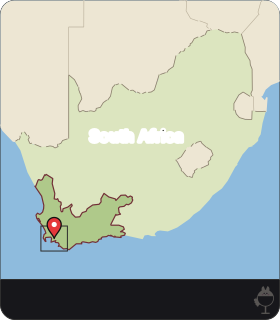
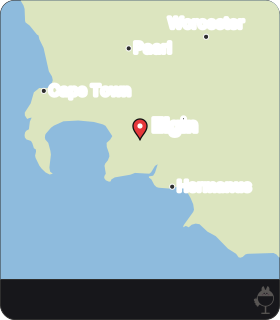
In South Africa’s Wine of Origin scheme, Elgin is a district of the Cape South Coast region, within the Western Cape geographical unit. That is how it appears in the list of production areas that SAWIS published in October 2023.
The valley lies about 70 km east of Cape Town in a landscape enclosed by mountains. Wines of Elgin, the producers’ association, presents Elgin as the coolest wine region in South Africa. That is the association’s own description, not a measured ranking.
From apple orchards to vineyards
Elgin grew fruit long before it made wine. The story dates to 1896, when the Clüver family began growing apples on the De Rust farm; the area was historically apple-growing, with viticulture a fairly recent addition.
In the mid-1980s, researchers at Nietvoorbij, the state-owned research institute for the wine industry, identified Elgin as a potential cool-climate area where grapes would ripen slowly and could show fruit character similar to Burgundy’s. In 1986 Dr Paul Clüver planted Elgin’s first vines, and in 1990 Elgin was declared a Wine of Origin ward. In the current SAWIS list (October 2023) it appears as a district of the Cape South Coast region.
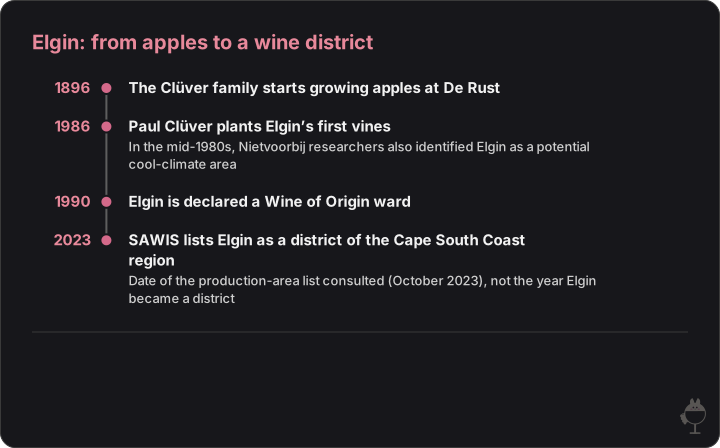
Apple farming in Elgin is older than its vineyards. Dates from Wines of Elgin and the SAWIS production-area list.
Read the figure as text
- 1896 — The Clüver family starts growing apples at De Rust
- 1986 — Paul Clüver plants Elgin’s first vines. In the mid-1980s, Nietvoorbij researchers also identified Elgin as a potential cool-climate area
- 1990 — Elgin is declared a Wine of Origin ward
- 2023 — SAWIS lists Elgin as a district of the Cape South Coast region. Date of the production-area list consulted (October 2023), not the year Elgin became a district
Wind, cloud and a long ripening season
Wind, and the cloud it brings, shape Elgin’s climate. In summer, south-easterly sea breezes blow in off the cold Atlantic; the south-easter known as the “black south-easter” brings cloud cover in the run-up to and during harvest. The valley is shielded from extreme temperatures by its coastal climate and south-east winds, with a wide diurnal range.
Mist and low cloud filter the sunlight, which lowers the temperature of the canopy and prolongs ripening. According to Wines of Elgin, ripening moves later in the year, closer to autumn, and sugar builds more slowly, so the berries can gather more aroma and flavour while keeping higher acidity.

 AI
·
Refractometer in the vineyard
Image: Maison Apéro (generated image) · Maison Apéro original
Topography and elevation
Elgin is a valley enclosed by mountains, and its vineyard slopes rise from about 250 to 500 m above sea level, a height linked to the area’s reputation for coolness (Wines of Elgin).
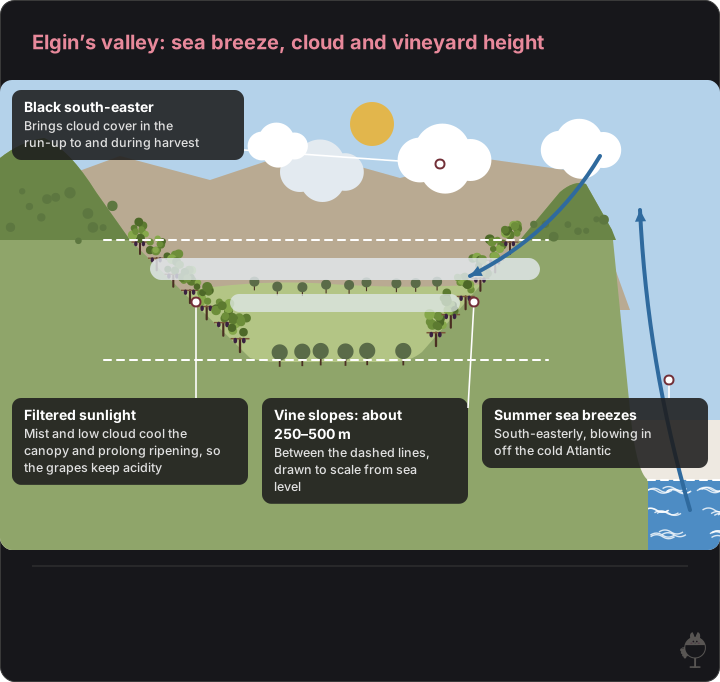
Summer south-easterly sea breezes blow in off the cold Atlantic, and the black south-easter brings cloud before and during harvest. Only the 250–500 m vineyard band is drawn to scale against sea level; mountain heights, distances, the direction of view, shapes and colours are illustrative.
Read the figure as text
- Black south-easter — Brings cloud cover in the run-up to and during harvest
- Filtered sunlight — Mist and low cloud cool the canopy and prolong ripening, so the grapes keep acidity
- Vine slopes: about 250–500 m — Between the dashed lines, drawn to scale from sea level
- Summer sea breezes — South-easterly, blowing in off the cold Atlantic
Soils: Bokkeveld shale and Table Mountain sandstone
Elgin’s soils are a varied mix in which well-draining soils from Bokkeveld shale and Table Mountain sandstone are the most dominant. Both rocks belong to the Cape Supergroup.
The Table Mountain Group dates to the Middle Ordovician to Lower Devonian and the Bokkeveld Group to the Lower to Middle Devonian. The Table Mountain Group is dominated by clean quartzite, and the Bokkeveld Group, which lies conformably on top of it, by mudstone. The Bokkeveld shale is therefore a Devonian rock.
These ages describe the rock groups as a whole.
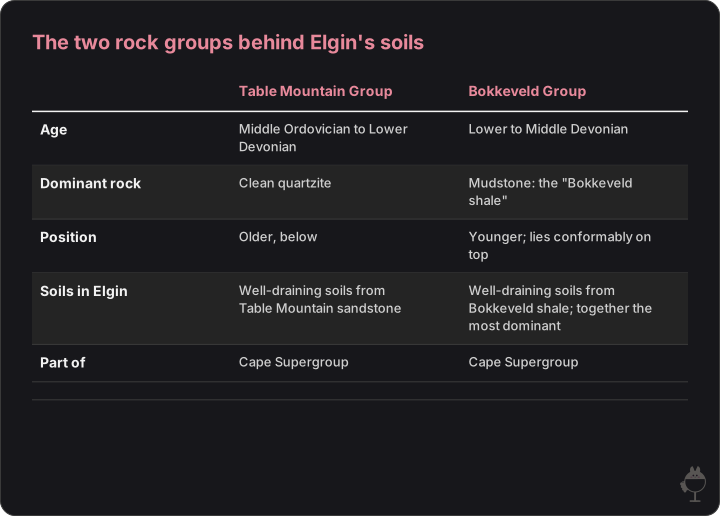
Both groups belong to the Cape Supergroup. The ages and dominant rocks describe each group as a whole; which group lies under a particular vineyard is a matter for a geological map.
Read the figure as text
| Table Mountain Group | Bokkeveld Group | |
|---|---|---|
| Age | Middle Ordovician to Lower Devonian | Lower to Middle Devonian |
| Dominant rock | Clean quartzite | Mudstone: the "Bokkeveld shale" |
| Position | Older, below | Younger; lies conformably on top |
| Soils in Elgin | Well-draining soils from Table Mountain sandstone | Well-draining soils from Bokkeveld shale; together the most dominant |
| Part of | Cape Supergroup | Cape Supergroup |
Grapes, and what to look for in the glass
Sauvignon Blanc, Chardonnay and Pinot Noir are the varieties most at home in Elgin’s cool climate, and Riesling, Merlot and Syrah are grown as well (Wines of Elgin).
The climate described above points to two things a taster can check: the level of acidity and the intensity of aroma and flavour. Treat them as questions to test in each wine, not as a promise made by the place name. Vintage, site and winemaking all change the result.
Exercise 1: wind, cloud and acidity
[Question]
Explain how wind and cloud in Elgin affect the ripening of Chardonnay and Pinot Noir, and what this means for acidity and aroma.
[Model answer]
In summer, south-easterly sea breezes off the cold Atlantic cool the vineyards, and the black south-easter brings cloud before and during harvest. Mist and low cloud filter the sunlight, lowering canopy temperature and prolonging ripening. Ripening shifts later, towards autumn, and sugar builds slowly, so the grapes can gain aroma and flavour while keeping higher acidity.
[Mark scheme (6 marks)]
• Names the summer sea breezes and the cloud brought by the south-easter (2 marks)
• Links filtered sunlight to a cooler canopy and longer ripening (2 marks)
• Explains slower sugar build-up with retained acidity and more aroma and flavour (2 marks)
Exercise 2: the two rock groups
[Question]
Name the two rock groups behind Elgin’s dominant vineyard soils, put them in order of age, and contrast their main rock types.
[Model answer]
Soils from Table Mountain sandstone and Bokkeveld shale are the most dominant. The Table Mountain Group is older (Middle Ordovician to Lower Devonian) and is dominated by clean quartzite; the Bokkeveld Group lies on top of it, is younger (Lower to Middle Devonian) and is dominated by mudstone. Both give well-draining soils.
[Mark scheme (6 marks)]
• Names both groups (2 marks)
• Gives the correct order and periods (2 marks)
• Contrasts quartzite with mudstone and notes the good drainage (2 marks)
Site
- Slopes of about 250–500 m in a valley enclosed by mountains
- Summer sea breezes and cloud before harvest
- Well-draining shale and sandstone soils
Vine
- Filtered sunlight lowers canopy temperature
- Ripening is prolonged towards autumn
- Sugar builds slowly
Glass
- Higher acidity is kept
- More aroma and flavour
- To be checked by tasting each wine
Frequently asked questions
Where is Elgin, and what is its official status?
Elgin is a Wine of Origin district in the Cape South Coast region of the Western Cape, about 70 km east of Cape Town. It was declared a ward in 1990 and appears as a district in the SAWIS list of October 2023.
Why is Elgin’s climate cool?
Height (slopes of about 250 to 500 m), summer south-easterly sea breezes off the cold Atlantic, and the cloud the black south-easter brings before and during harvest keep Elgin cool (Wines of Elgin). The cloud filters sunlight, lowers canopy temperature and prolongs ripening.
Which grapes is Elgin known for?
Sauvignon Blanc, Chardonnay and Pinot Noir are the varieties most at home in Elgin’s cool climate; Riesling, Merlot and Syrah are also grown (Wines of Elgin).
Sources
- SAWIS — Production areas defined in terms of the Wine of Origin scheme (October 2023)
- Wines of Elgin — Terroir Talk: the Elgin Valley
- Wines of Elgin — Story of one of the Cape’s newer appellations
- University of Johannesburg — The Cape Supergroup (Middle Ordovician–Lower Carboniferous) of South Africa: A review
- Scientific Reports (2021) — An early Devonian flora from the Baviaanskloof Formation (Table Mountain Group) of South Africa


