

How the Andes create a rain shadow
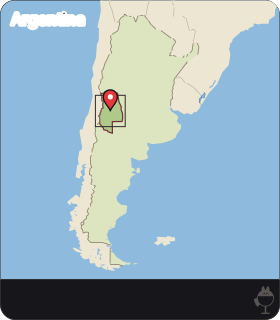
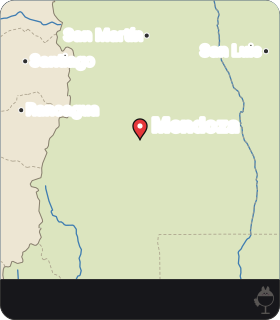
A rain shadow is the area on the lee side of a mountain range where precipitation is noticeably lower than on the windward side. At the latitude of Mendoza, frontal systems from the Pacific arrive within the westerly winds, mostly in winter. The westerly flow is forced up the Chilean slopes of the Andes, and precipitation increases as the air rises.
Where the air crosses the range and descends the eastern slopes, precipitation falls off. The result is a rain shadow on the Argentine side. The Pacific lies beyond the mountains, but Mendoza lies in this rain shadow.
The range itself is the product of plate motion. Along the Peru–Chile Trench the oceanic Nazca Plate is pushed beneath the South American Plate, whose continental part has been lifted to form the Andes. The block diagram below follows that west–east line, from the Pacific to the vineyards at the foot of the Andes.
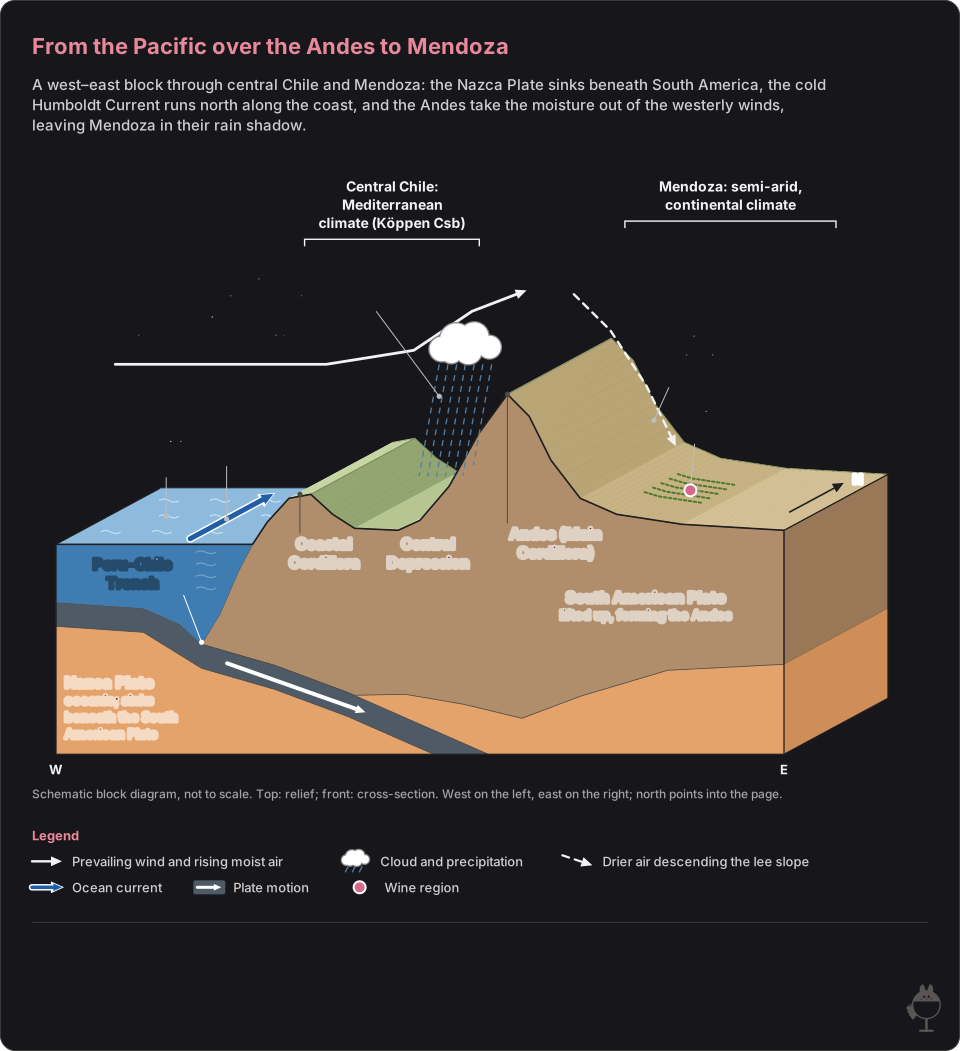
Schematic block diagram, not to scale: the top shows the relief and the front face a cross-section, coloured by soil and rock type.
Read the figure as text
- Along the Peru–Chile Trench the oceanic Nazca Plate is pushed into and beneath the continental part of the South American Plate, which is lifted up to form the Andes.
- From west to east, the Chilean Andes are divided into the Coastal Cordillera, the Central Depression and the Main Cordillera.
- The Humboldt Current, also called the Peru Current, carries cold sub-Antarctic water north along the coasts of Chile and Peru.
- Westerly winds with Pacific fronts are forced up the Chilean slopes of the Andes, where precipitation increases; where the air descends the leeward slopes, precipitation falls off, and a rain shadow lies on the Argentine side at the latitude of Mendoza.
- Central Chile, from the coast to the lower slopes of the Andes, is dominated by a Mediterranean climate (Köppen Csb).
- Mendoza lies at the foot of the Andes, which act as a barrier to the humid Pacific winds; the climate is continental and semi-arid, and the Andes provide the main source of irrigation.
Two climates on either side of one range
The contrast shows clearly in climate classifications. Central Chile, from the coast to the lower slopes of the Andes, is dominated by a Mediterranean climate (Köppen Csb; climatic regionalisation of continental Chile by Sarricolea and colleagues, 2017). Mendoza, on the other side of the range, has a continental, semi-arid climate; the Andes act as a barrier to the humid winds of the Pacific.
Annual rainfall totals depend on the station and on the period averaged. Argentina's national weather service (SMN) publishes climate normals for 1991–2020 from 105 stations, including Mendoza Aero; that is the place to read station values.
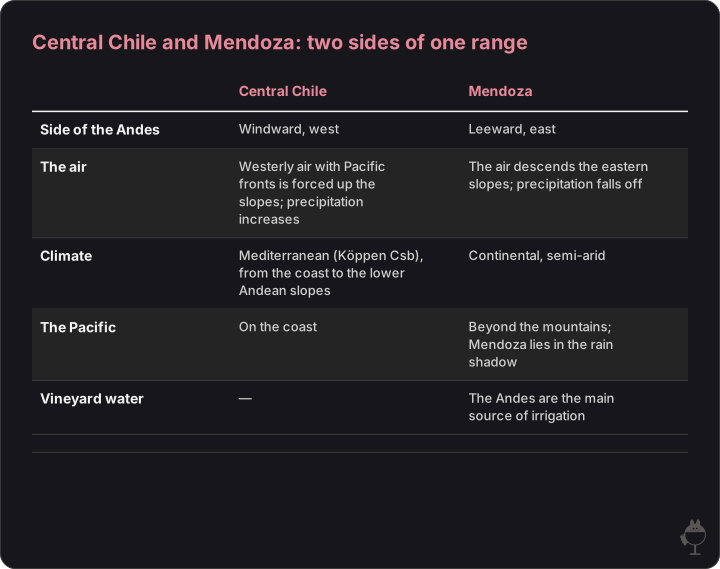
What the sources state for each side of the Andes at the latitude of Mendoza: which way the air moves, how precipitation changes and how each climate is classified.
Read the figure as text
| Central Chile | Mendoza | |
|---|---|---|
| Side of the Andes | Windward, west | Leeward, east |
| The air | Westerly air with Pacific fronts is forced up the slopes; precipitation increases | The air descends the eastern slopes; precipitation falls off |
| Climate | Mediterranean (Köppen Csb), from the coast to the lower Andean slopes | Continental, semi-arid |
| The Pacific | On the coast | Beyond the mountains; Mendoza lies in the rain shadow |
| Vineyard water | — | The Andes are the main source of irrigation |
Altitude and ultraviolet light
Altitude changes the light that reaches a vineyard. With less atmosphere above to absorb it, ultraviolet (UV) radiation increases with height, by about 10% for every 1,000 m of altitude (WHO).
Whether this matters for grapes has been tested in the field. Berli and colleagues (2011) studied Malbec in a vineyard at 1,450 m, comparing vines with and without solar UV-B, and with and without an application of abscisic acid (ABA), a plant hormone.
Both solar UV-B and ABA increased the phenols in the berry skins, and their effects added up. The profiles of anthocyanins and of non-anthocyanin phenols changed, and the proportion of phenols with high antioxidant capacity rose. Solar UV-B raised the total of non-anthocyanin phenols, which stayed high until harvest.
The study answers a specific question, how Malbec berries in one high vineyard respond to UV-B, and it supports a mechanism. It does not show that every wine from a high site is deeper in colour.
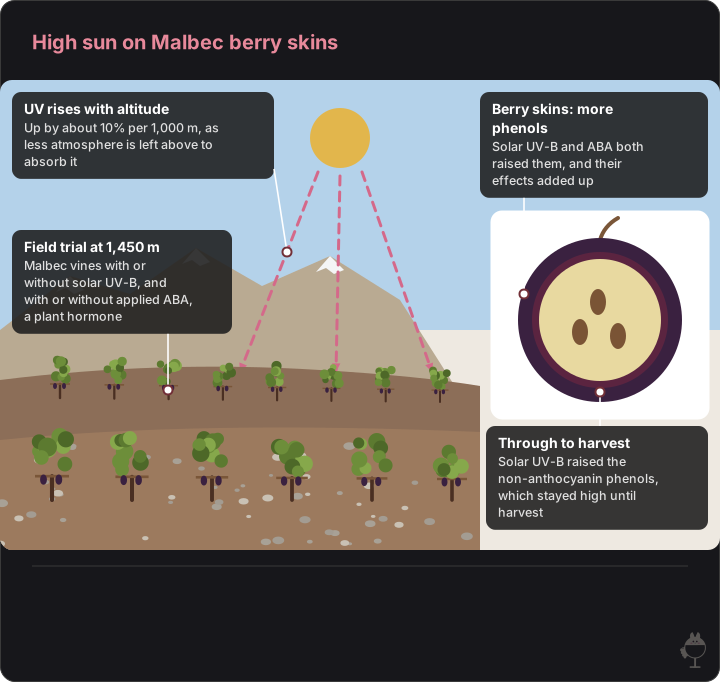
Ultraviolet light rises with altitude everywhere; the other callouts are results of one field study in a Malbec vineyard, which measured berries, not finished wine. The dashed rays, the vines and the berry proportions are not to scale. Shapes and colours are illustrative.
Read the figure as text
- UV rises with altitude — Up by about 10% per 1,000 m, as less atmosphere is left above to absorb it
- Field trial at 1,450 m — Malbec vines with or without solar UV-B, and with or without applied ABA, a plant hormone
- Berry skins: more phenols — Solar UV-B and ABA both raised them, and their effects added up
- Through to harvest — Solar UV-B raised the non-anthocyanin phenols, which stayed high until harvest
Water from the Andes
In a semi-arid climate, rain alone does not decide how much water a vineyard receives. The Andes are the main source of irrigation for Mendoza: the range that dries the westerly winds also supplies the water that reaches the vines.
Where irrigation supplies most of the water, how much a vine receives, and when, depends more on irrigation decisions than on the weather.

 AI
·
Irrigation channel and soil pit
Image: Maison Apéro (generated image) · Maison Apéro original
Landform and elevation
Terroir is more than climate. On landform, Mendoza's vineyards lie at the foot of the Andes, east of the range. On elevation, the field study above was carried out at 1,450 m.
In the glass: what can and cannot be inferred
When tasting a Mendoza Malbec, it is tempting to read the place straight from the colour. The evidence in this article supports a narrower link: at a high site, solar UV-B can raise the phenols in Malbec berry skins. Between the berry and the glass lies the whole of winemaking, so the intensity of colour in one wine cannot be credited to altitude alone.
A better exercise is comparative. Taste wines from sites at different altitudes side by side, note colour intensity, aroma, acidity and tannin in the same order each time, and treat any difference as a hypothesis to check against how each wine was made.
Practice question 1: the rain shadow
[Question]
Explain why Mendoza lies in a rain shadow, and contrast its climate with that of central Chile.
[Model answer]
At the latitude of Mendoza, westerly winds bring fronts from the Pacific. The air is forced up the Chilean slopes of the Andes, where precipitation increases; after crossing the range it descends the eastern slopes, where precipitation falls off. This leaves a rain shadow on the Argentine side. Central Chile, on the windward side, has a Mediterranean climate (Köppen Csb) from the coast to the lower Andean slopes, whereas Mendoza has a continental, semi-arid climate, and its vineyards rely on the Andes as their main source of irrigation water.
[Mark scheme (10 marks)]
- Rising air and increased precipitation on the windward Chilean slopes (3 marks)
- Descending air and reduced precipitation on the lee side, named as a rain shadow (3 marks)
- The contrast between a Mediterranean (Csb) and a continental, semi-arid climate (2 marks)
- Irrigation from the Andes as the consequence for vineyards (2 marks)
Practice question 2: altitude and evidence
[Question]
A back label says that “high-altitude sunlight gives this Malbec its deep colour”. Using the WHO figure for UV and the 2011 field study, assess the claim.
[Model answer]
UV radiation increases with altitude, by about 10% for every 1,000 m (WHO), because less atmosphere is left to absorb it. In a Malbec vineyard at 1,450 m, Berli and colleagues found that solar UV-B increased berry-skin phenols, additively with applied ABA, changed the anthocyanin and non-anthocyanin profiles, and kept non-anthocyanin phenols high until harvest. This supports a mechanism linking altitude, UV-B and skin phenols. But the study measured berries in one vineyard, not finished wine, and colour in the glass also passes through winemaking. The claim is plausible as part of the story, not proven by altitude alone.
[Mark scheme (10 marks)]
- The size and cause of the UV increase with altitude (2 marks)
- The design and main results of the field study (4 marks)
- The limits of the evidence: berries, one site, and the role of winemaking (4 marks)
Physical setting
- Westerly winds with Pacific fronts rise over the Chilean slopes and drop precipitation
- Drier air descends the eastern slopes: Mendoza lies in the rain shadow
Conditions for the vines
- Continental, semi-arid climate; the Andes are the main source of irrigation
- More UV with height: about 10% per 1,000 m
What has been measured
- At 1,450 m, solar UV-B raised phenols in Malbec berry skins
- Colour in the glass also depends on winemaking
Frequently asked questions
Why is Mendoza drier than central Chile?
Because the two lie on opposite sides of the Andes. Westerly winds bring Pacific fronts, mostly in winter, and the air rises over the Chilean slopes, where precipitation increases. Central Chile has a Mediterranean climate (Köppen Csb); Mendoza, on the lee side, has a continental, semi-arid climate.
Why do Mendoza's vineyards depend on irrigation?
Because the Andes act as a barrier to the humid Pacific winds, Mendoza has a continental, semi-arid climate. The Andes are also the main source of irrigation water.
Does altitude change Malbec grapes?
UV levels rise by about 10% for every 1,000 m of altitude (WHO). In a field study on Malbec in a vineyard at 1,450 m, solar UV-B increased berry-skin phenols, and its effect added to that of the plant hormone ABA (Berli and colleagues, 2011). The study measured berries, not finished wine.
See also: What is a rain shadow? (Mountain Ranges and Their Shadows: Rain Shadows Compared from the Cascades to the Alps)
Sources
- NOAA National Weather Service glossary: rain shadow
- Frontiers in Earth Science (2021): Orographic effects on frontal precipitation systems in the subtropical and extratropical Andes
- Viale et al. (2019), Contrasting climates at both sides of the Andes in Argentina and Chile, Frontiers in Environmental Science
- Sarricolea, Herrera-Ossandon and Meseguer-Ruiz (2017), Climatic regionalisation of continental Chile, Journal of Maps
- U.S. Geological Survey, This Dynamic Earth: Understanding plate motions
- Wines of Argentina: Mendoza
- Servicio Meteorológico Nacional (Argentina): Estadísticas climatológicas normales, período 1991–2020
- World Health Organization: Radiation: Ultraviolet (UV) radiation — questions and answers
- Berli et al. (2011), Solar UV-B and ABA are involved in phenol metabolism of Vitis vinifera L. increasing biosynthesis of berry skin polyphenols, Journal of Agricultural and Food Chemistry 59 (9): 4874–4884 (PubMed abstract)
- Santibáñez et al. (2019), Crustal faults in the Chilean Andes: geological constraints and seismic potential, Andean Geology 46 (1)
- Global Environment Facility: Connecting the Current – ecosystem-based management of the Humboldt Current large marine ecosystem
- NOAA JetStream: Ocean circulations
- Encyclopaedia Britannica: Lima (the offshore Peru, also called Humboldt, Current)
- Wines of Argentina: Cuyo


