Three site properties, three different routes
Altitude, slope and aspect are properties of a vineyard’s ground, and they act through different physical routes. Altitude changes the air: how warm it is and how much ultraviolet light reaches the vines. Slope governs how water and cold air move downhill, and how hard the ground is to work. Aspect, which eXtension, the Cooperative Extension information service, defines as the compass direction a slope faces, governs how much sun the ground receives.
This article takes them in that order and ends with how far the rules can be trusted. Each is a tendency that points in a direction. None of them fixes the taste of a wine, and the sources cited here measure temperatures, light and costs, not flavour.
Altitude and temperature: about 0.65 °C per 100 m
In the ICAO standard atmosphere, temperature falls by 6.5 °C per kilometre, about 0.65 °C per 100 m, from sea level up to 11 km. NASA’s Glenn Research Center writes the same layer as a line: T = 15.04 − 0.00649 h, with T in °C and h in metres.
That figure is an average, a convention agreed for aircraft, not a law of any one vineyard. The US National Weather Service defines the lapse rate as the rate at which temperature falls with height. A parcel of dry air that rises cools faster, by 9.8 °C per km, and the real air over a valley changes with weather, season and time of day.
As a rough rule, then, a site 300 m higher is on average about 2 °C cooler (0.65 × 3, our own arithmetic). Treat that as an order of magnitude and check it against local temperature records.
Altitude and light: ultraviolet and the day–night swing
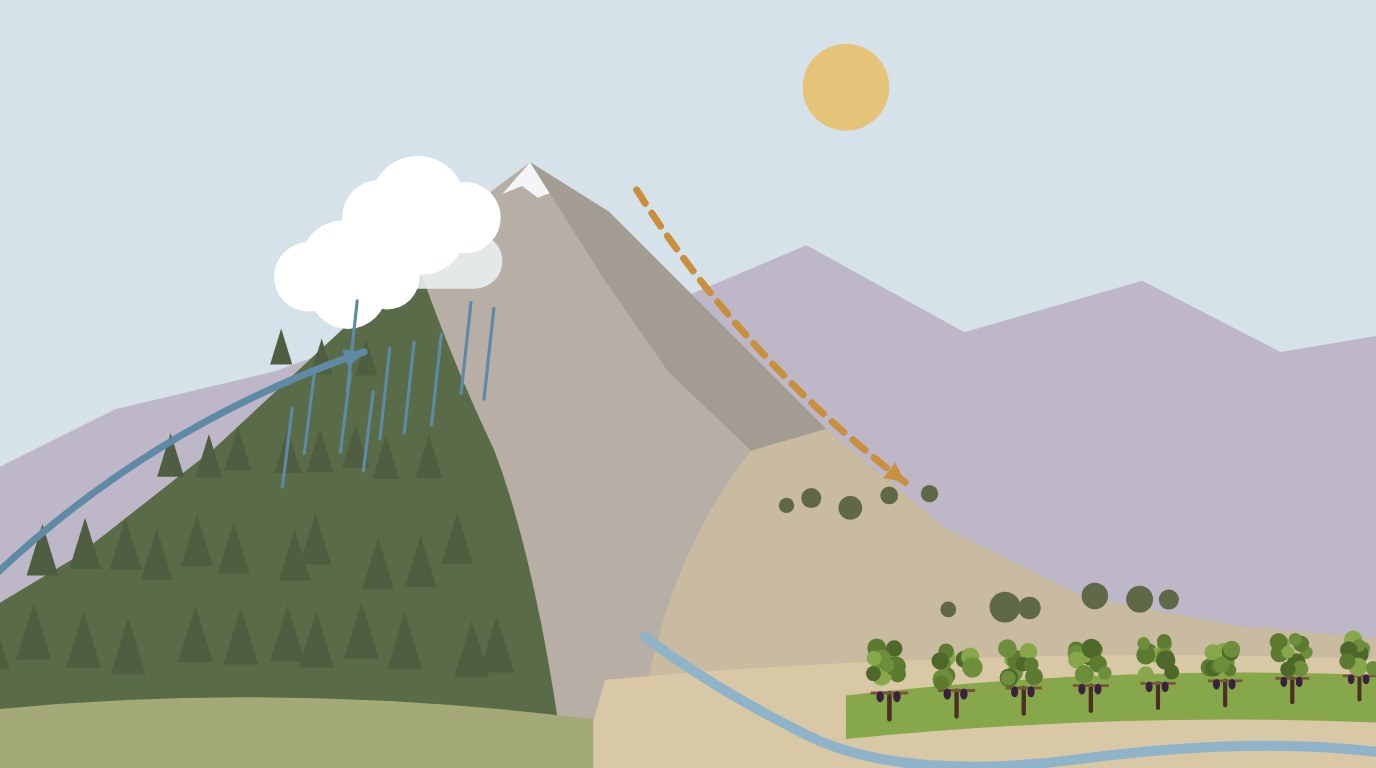
Higher up, less atmosphere lies above the vines to absorb ultraviolet (UV) radiation. The World Health Organization gives an increase of about 10% for every 1,000 m of altitude.
Berli and colleagues (2011) studied Malbec in a vineyard at 1,450 m and found that solar UV-B raised the phenols in the berry skins. The study measured berries, not wine, so it supports a mechanism, not a taste. The article on the Andes rain shadow of Mendoza places this study in its wider setting.
A wider swing between day and night is often expected at height, because thin air tends to let the ground lose heat faster after dark. That is a tendency. No primary measurement by altitude for Mendoza or Salta was found for this article, so it gives no figure.
Slope: how water and cold air move downhill
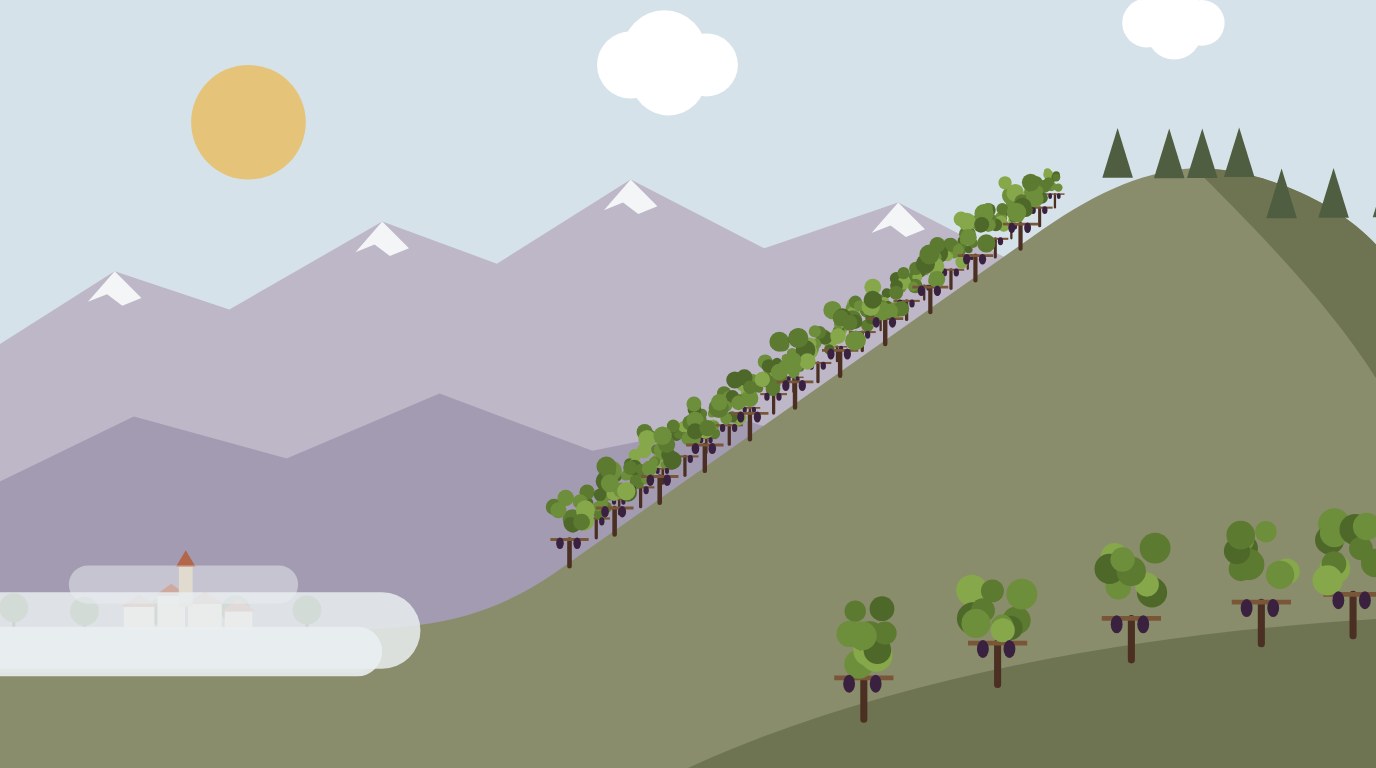
On a clear, calm night the ground loses heat by radiation and the air next to it cools. Cold air is denser, so it flows downhill and collects at the bottom of slopes and in hollows, according to Penn State Extension. Frost formed this way is called radiation frost, and the lowest ground is hit hardest. Mid-slope can stay warmer, a band sometimes called the thermal belt, provided the cold air can keep moving. A line of trees, a bank or a wall across the slope can dam it, so that it pools uphill of the barrier. A slope also lets surplus rain water drain away.
eXtension adds that a slight to moderate slope speeds cold-air drainage, and that the steeper the slope, the faster the air moves, if nothing blocks it.
Where a vine stands on the slope can therefore matter as much as the slope itself. In a study of the Monasterio vineyard in Gualtallary, Mendoza (1,430–1,550 m), the lower sectors were prone to cold-air pooling at night and to frost.
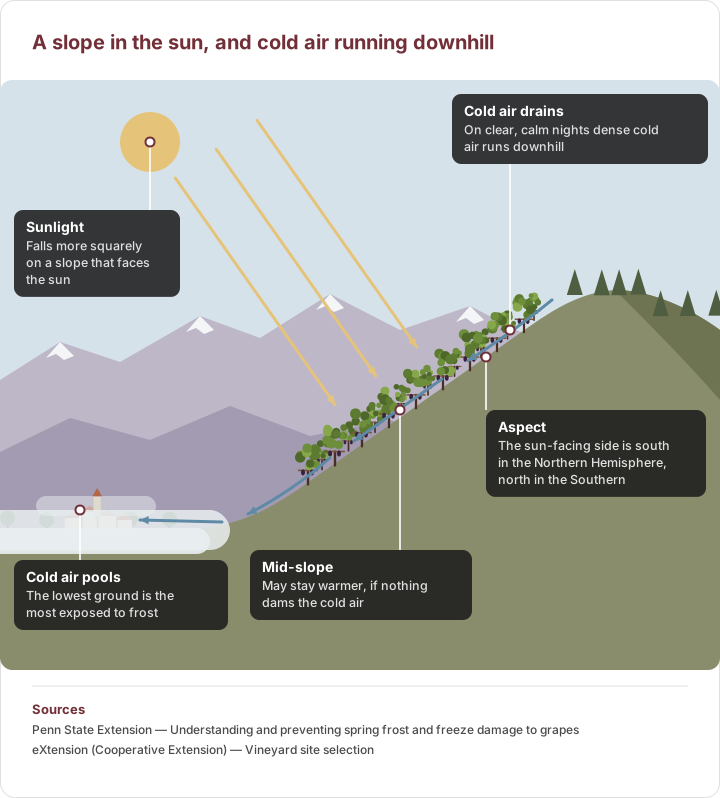
Diagram drawn from sourced data
A schematic hillside seen from the side. The sun-facing side is lit more squarely. On a clear, calm night cold air runs downhill and pools at the bottom, while mid-slope can stay warmer. Shapes are illustrative, not to scale.
- Sunlight — Falls more squarely on a slope that faces the sun
- Cold air drains — On clear, calm nights dense cold air runs downhill
- Aspect — The sun-facing side is south in the Northern Hemisphere, north in the Southern
- Cold air pools — The lowest ground is the most exposed to frost
- Mid-slope — May stay warmer, if nothing dams the cold air
Steep ground: what it gains and what it costs
Steep ground can help with drainage and sun, but it is expensive to farm. In German usage a steep site, a Steillage, has a gradient of more than 30%. Weinland Mosel, the region’s marketing body, counts about 3,000 ha of steep vineyards out of 8,440 ha at the end of 2024; other sources quote different shares, so this is one cited figure. The Bremmer Calmont is the best-known extreme: RLP Tourism gives a gradient of up to 65 degrees, and other sources say 68.
Machines can rarely work on slopes like these, and hand labour dominates. Strub and Loose (2021, OENO One) analysed 2,321 working-time records from five German estates over three years and found that manual steep-slope management cost 2.6 times as much as standard viticulture on flat land. They also describe how hard it is for a steep-slope estate to cover that cost.
Sources state slopes in different units, and the table below keeps each as stated. The Priorat specification gives percent: gradients above 15% in most vineyards and up to 60% in some. A gradient of 60% is a rise of 60 m over 100 m of horizontal run, about 31 degrees; the Mosel threshold of 30% is about 17 degrees (our own arithmetic). The Calmont’s 65 degrees is steeper than either. The article on Priorat’s landscape covers its terraces.
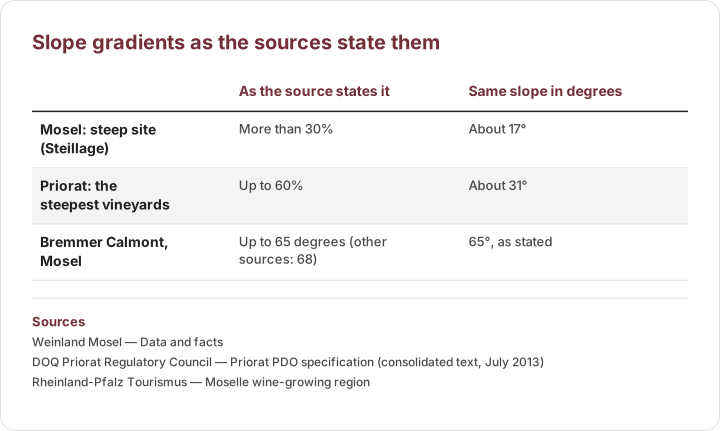
Diagram drawn from sourced data
Each gradient is kept in the unit its source uses. The degree values for percent gradients are Maison’s own arithmetic (the arctangent of the percentage); a gradient of 60% rises 60 m over 100 m of horizontal run.
| As the source states it | Same slope in degrees | |
|---|---|---|
| Mosel: steep site (Steillage) | More than 30% | About 17° |
| Priorat: the steepest vineyards | Up to 60% | About 31° |
| Bremmer Calmont, Mosel | Up to 65 degrees (other sources: 68) | 65°, as stated |
Aspect: which way the slope faces
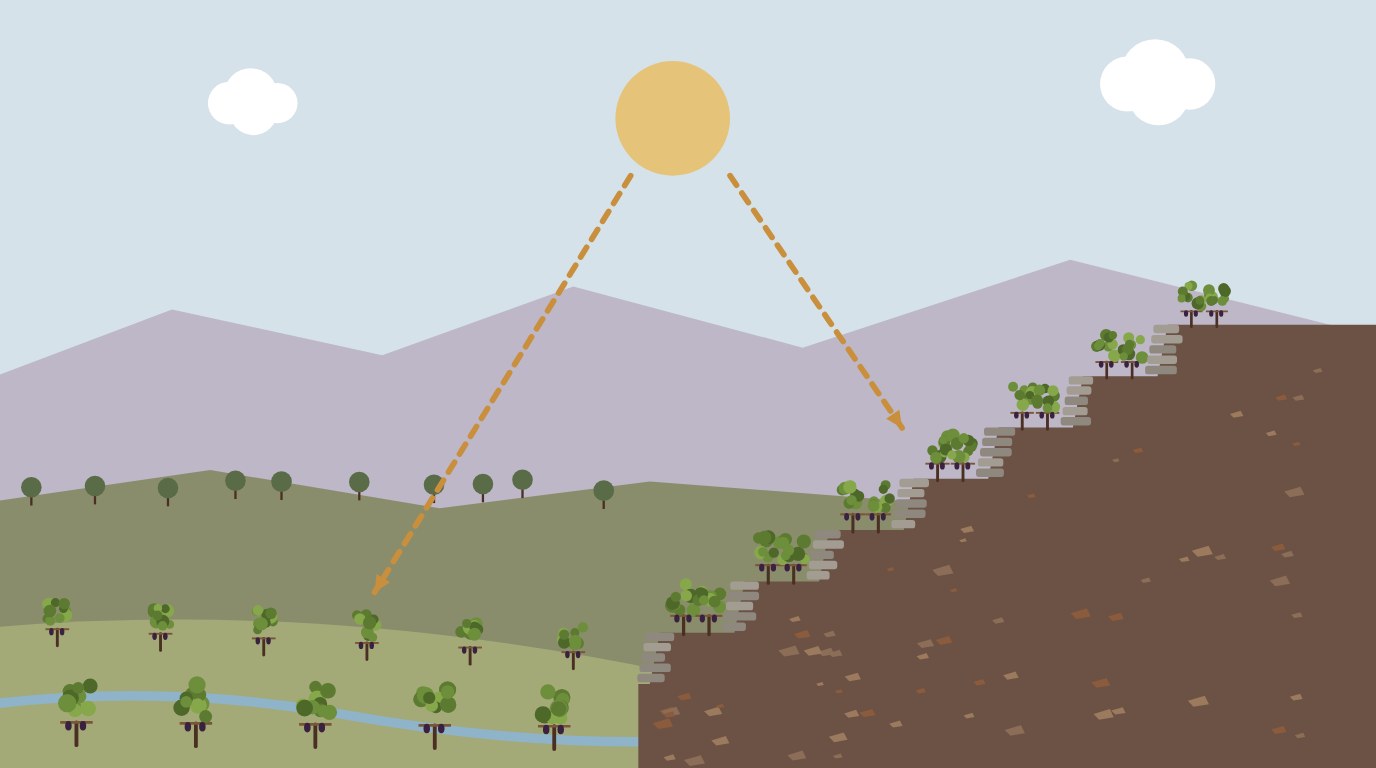
eXtension defines aspect as the compass direction a slope faces. In the Northern Hemisphere south-facing slopes receive the most sun; in the Southern Hemisphere it is the north-facing ones. East-facing slopes catch the morning sun. Where the climate is hot, a cooler aspect can slow ripening usefully, so the sunniest slope is not always the goal.
Burgundy’s Côte d’Or is the textbook case of seeking the sun in a cool climate. The BIVB, the Burgundy wine board, describes the vineyard as a succession of slopes between about 200 and 450 m, mostly exposed to the south-east, towards the rising sun. The slope is convex, steep up to mid-slope and gentler below it.
In the Southern Hemisphere the sun-facing side is north, but a single site can still surprise: at Monasterio, in Mendoza, the east-, north-east- and south-east-facing slopes accumulated more heat than the others. The compass rule is a starting point; local measurement decides.
Where the numbers sit, and how far to trust the rules
Vineyards sit at very different heights. The chart below puts four sourced elevation ranges side by side, each in metres as its source gives it: Priorat about 100–750 m (the DOQ specification), the Côte d’Or about 200–450 m (BIVB), Alto Adige 200–1,000 m (the Südtirol Wein consortium) and the Monasterio vineyard in Gualtallary, Mendoza, 1,430–1,550 m (a university study, one vineyard and not a region). The bars show where vines grow, not how cool or good a site is. A vine at 500 m in Alto Adige and one at 500 m in Priorat sit in different climates, because latitude, distance from the sea and surrounding mountains differ.
The Monasterio study is the strongest argument for caution. It found that slope, aspect and altitude together produce strong microclimate contrasts inside one vineyard: east-, north-east- and south-east-facing slopes accumulated more heat, lower sectors had cold-air pooling and frost at night, and across the site the mean maximum and minimum temperatures of the growing season differed by up to 3.5 °C and 2.5 °C. The site spans only 120 m of height, which at the average lapse rate explains under 1 °C (our own arithmetic), so altitude alone cannot account for the contrasts.
That is the rule of this article. The lapse rate, the thermal belt and the sun-facing slope are tendencies. They tell you what to check, not what you will find.
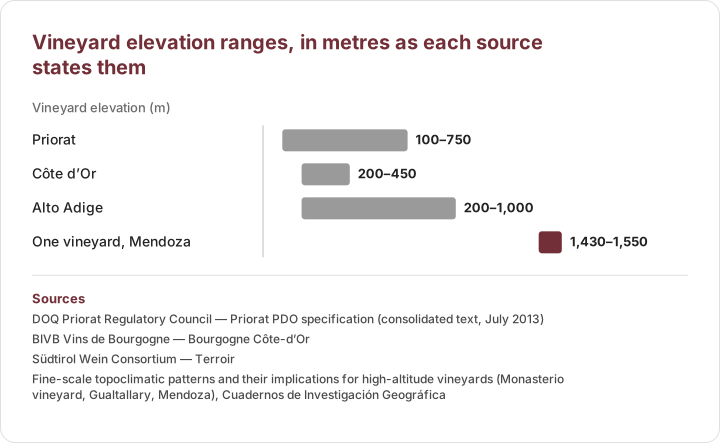
Diagram drawn from sourced data
Sourced elevation ranges, each as its source gives it: the Priorat specification, the Burgundy wine board (Côte d’Or), the Südtirol Wein consortium and a university study of one vineyard in Mendoza (highlighted; one vineyard, not a region). The bars show where vines grow, not how cool or good a site is.
Vineyard elevation (m)
- Priorat: 100–750 m
- Côte d’Or: 200–450 m
- Alto Adige: 200–1,000 m
- One vineyard, Mendoza: 1,430–1,550 m
Sources
- DOQ Priorat Regulatory Council — Priorat PDO specification (consolidated text, July 2013)
- BIVB Vins de Bourgogne — Bourgogne Côte-d’Or
- Südtirol Wein Consortium — Terroir
- Fine-scale topoclimatic patterns and their implications for high-altitude vineyards (Monasterio vineyard, Gualtallary, Mendoza), Cuadernos de Investigación Geográfica
Practice question: two plots on one hillside
[Question]
A grower in the Northern Hemisphere has two candidate plots for a new vineyard, both facing south: one in a hollow at the foot of a slope and one halfway up. Using the sources in this article, say what altitude, slope and aspect each suggest, and why the choice still needs checking on the ground.
[Model answer]
Both plots face south, the sun-facing aspect in the Northern Hemisphere, so the choice turns on slope and height. On clear, calm nights cold air drains downhill and pools at the bottom of the slope, so the hollow is more exposed to radiation frost, while mid-slope can stay warmer if trees or banks do not dam the flow. The higher plot is also cooler on average, by about 0.65 °C per 100 m. These are averages and tendencies: the Monasterio study found contrasts of up to 3.5 °C within one vineyard, so the grower should measure temperatures on both plots, look for barriers and weigh the cost of working the slope before deciding.
[Self-check]
• Notes that the aspect is the same, so slope and height decide
• Explains cold-air drainage, pooling at the bottom, the mid-slope warmer band and the effect of barriers
• Gives the average lapse rate and calls it an average
• Names the limit: local contrasts measured at Monasterio, and the need to check on the site
Altitude
- Thinner air: about 0.65 °C cooler per 100 m on average
- More ultraviolet light: about 10% per 1,000 m
- A wider day–night swing is expected; no figure is cited
Slope
- Cold air drains downhill on clear, calm nights
- It pools at the bottom; mid-slope may be warmer
- Steep ground costs more to work: 2.6 times in one study
Aspect
- Sun-facing side: south in the north, north in the south
- East-facing slopes catch the morning sun
- Hot sites may prefer a cooler aspect
Frequently asked questions
How much cooler is it for every 100 m of altitude?
In the ICAO standard atmosphere, temperature falls by 6.5 °C per kilometre, about 0.65 °C per 100 m. This is an average for the atmosphere; real vineyards differ with weather, time of day and local ground.
Why is the middle of a slope often safer from frost than the bottom?
On clear, calm nights cold, dense air drains downhill and pools at the bottom of slopes and in hollows (Penn State Extension). Mid-slope can stay warmer if nothing blocks the flow; trees or banks can dam the cold air.
Which side of a slope gets the most sun?
In the Northern Hemisphere south-facing slopes receive the most sun; in the Southern Hemisphere, north-facing ones do (eXtension). The slopes of the Côte d’Or are mostly exposed to the south-east, towards the rising sun (BIVB). In hot places a cooler aspect may be preferred.
Sources
- NASA Glenn Research Center — Earth Atmosphere Model (metric)
- Oxford Reference — ICAO standard atmosphere
- NOAA National Weather Service — Glossary: lapse rate
- World Health Organization: Radiation: Ultraviolet (UV) radiation — questions and answers
- Berli et al. (2011), Solar UV-B and ABA are involved in phenol metabolism of Vitis vinifera L. increasing biosynthesis of berry skin polyphenols, Journal of Agricultural and Food Chemistry 59 (9): 4874–4884 (PubMed abstract)
- Fine-scale topoclimatic patterns and their implications for high-altitude vineyards (Monasterio vineyard, Gualtallary, Mendoza), Cuadernos de Investigación Geográfica
- Penn State Extension — Understanding and preventing spring frost and freeze damage to grapes
- eXtension (Cooperative Extension) — Vineyard site selection
- BIVB Vins de Bourgogne — Bourgogne Côte-d’Or
- Rheinland-Pfalz Tourismus — Moselle wine-growing region
- Weinland Mosel — Data and facts
- Strub and Loose (2021), The cost disadvantage of steep slope viticulture and strategies for its preservation, OENO One 55 (1)
- DOQ Priorat Regulatory Council — Priorat PDO specification (consolidated text, July 2013)
- Südtirol Wein Consortium — Terroir