How a mountain lifts the rain and then withholds it
The National Weather Service (NWS) glossary defines orographic lifting as air forced to rise over terrain. As the air rises it cools; if it cools enough, water vapour condenses into cloud, and further cooling produces rain or snow. Precipitation is therefore greater over higher terrain.
On the far side the process runs in reverse. The NWS and the American Meteorological Society (AMS) define a rain shadow as an area of reduced precipitation on the lee side of a mountain barrier, because descending air warms and cloud dissipates. The AMS describes the foehn as a warm, dry wind that descends the lee side of a mountain range, as in the Alps. In the classic explanation, the water vapour that condensed on the windward side released heat, so the air arrives warmer and drier.
The drawing follows the air from the windward slope to a vineyard in the lee. The rest of the article compares six ranges and says, for each, whether the sources give numbers or only a description.
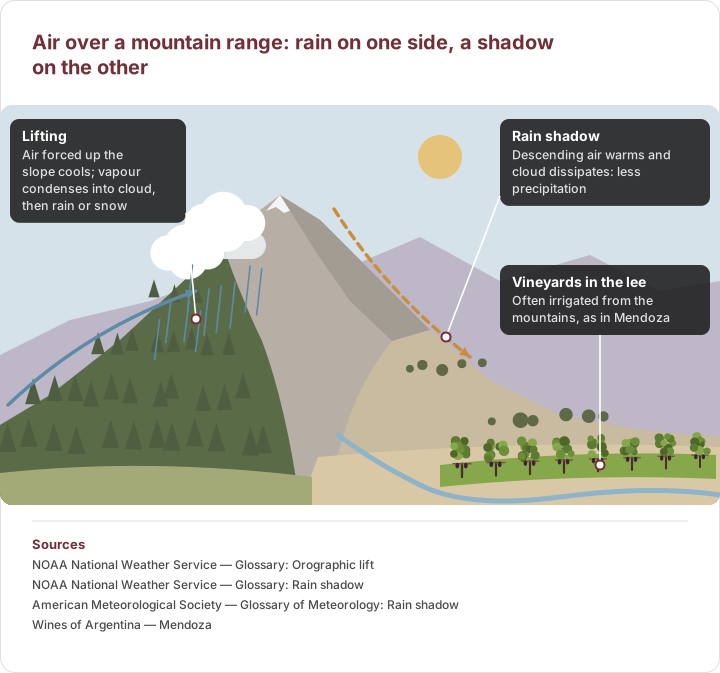
Diagram drawn from sourced data
Moist air rises on the windward slope, cools, forms cloud and sheds rain or snow; on the lee side the descending air warms and the cloud dissipates. Shapes and colours are illustrative, not a drawing of a particular range.
- Lifting — Air forced up the slope cools; vapour condenses into cloud, then rain or snow
- Rain shadow — Descending air warms and cloud dissipates: less precipitation
- Vineyards in the lee — Often irrigated from the mountains, as in Mendoza
The Cascades and the Columbia Valley: the clearest transect
The Western Regional Climate Center (WRCC) describes Washington's climate along a line that crosses the Cascades. Snoqualmie Pass, near the crest, averages about 100 in of precipitation a year. Cle Elum, on the east slope, receives 22.5 in, and Yakima about 8 in. According to the WRCC, precipitation on the east slope falls with distance from the summit.
The Washington State Wine Commission places the Columbia Valley AVA in the rain shadow of the Cascades, with 6–8 in of precipitation a year on average, and states that irrigation is required. The units are inches, as the sources state them.
The chart that follows the next section puts these stations beside the Sierra Nevada figures, all in inches.
The Sierra Nevada: a gradient on the windward side, a shadow beyond the crest
On the western slope of the Sierra Nevada, the WRCC reports heavy precipitation: from about 30 in in the western foothill zone to 70–80 in between 4,500 and 6,500 ft in the northern half of the range. The east side, and the valleys just east of it, are very dry. The rain shadow in the strict sense therefore lies east of the crest, not on the western side where Lodi lies.
Lodi lies on the windward side, on the valley floor. A Federal Register notice on the expansion of the Lodi viticultural area quotes the 1937 USDA soil survey: 18.26 in of rain a year at Lodi and 24.03 in at Valley Springs, in the foothills to the east. This is the windward rule in miniature: rainfall rises as the ground rises. It is not a rain shadow, and this article does not call Lodi one.
The 1937 figures are historical survey values, not current climate normals. Read them as a comparison of two places in the same survey, not as today's rainfall.
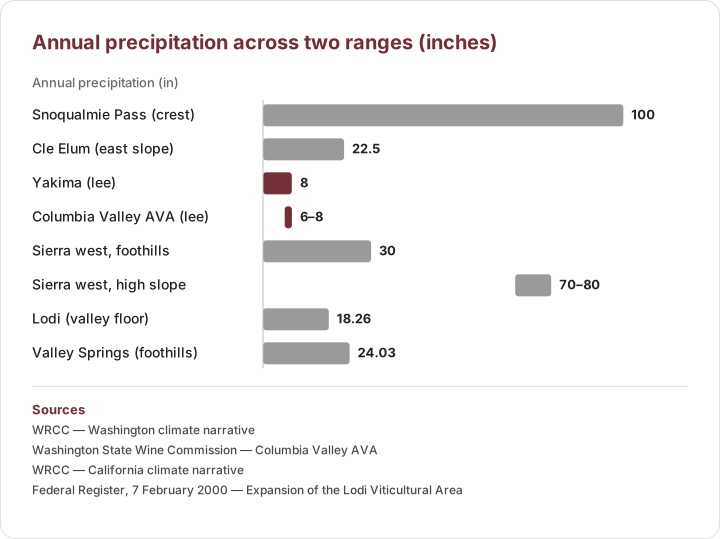
Diagram drawn from sourced data
Values are as each source states them, in inches. They come from different stations and surveys, so compare the pattern, not the decimals. Lodi and Valley Springs are from the 1937 USDA soil survey quoted in the Federal Register.
Annual precipitation (in)
- Snoqualmie Pass (crest): 100 in
- Cle Elum (east slope): 22.5 in
- Yakima (lee): 8 in
- Columbia Valley AVA (lee): 6–8 in
- Sierra west, foothills: 30 in
- Sierra west, high slope: 70–80 in
- Lodi (valley floor): 18.26 in
- Valley Springs (foothills): 24.03 in
The Vosges and the Andes: two shadows with their own articles
In Alsace, the Alsace wine council (CIVA) says the westerlies discharge their rain on the western slopes of the Vosges and then descend, dried, over the vineyards; it gives the vineyard 500 to 600 mm of rain a year. The Météo-France normal for 1991–2020 is 595.0 mm at Colmar-Meyenheim and 634.3 mm at Paris-Montsouris, so Colmar is drier than Paris by about 6 per cent, not by half. The article on the Vosges rain shadow shows in which part of the year that difference arises.
The Andes work on a larger scale. A 2025 study of snow cover in the Chilean Andes describes winter precipitation there as mainly frontal, brought by the westerlies and enhanced by the orography. According to a climatic regionalisation of Chile, central Chile has a Mediterranean climate (Köppen Csb) from the coast to the lower Andean slopes. Mendoza, east of the range, has a continental, semi-arid climate instead. Wines of Argentina names the Andes as a barrier to the humid Pacific winds and as Mendoza's main source of irrigation water. This article quotes no Mendoza rainfall figure, because the station value has not yet been read from the national weather service's normals; the article on the Andean rain shadow explains the setting.
The Alps: shelter in Alto Adige and the Valais
The AMS glossary names the Alps as its example of the foehn. The consortium of Alto Adige wines says the Alps protect the region from cold air masses from the north, while warm Mediterranean air reaches it from the south. Swiss Wine Promotion presents the Valais as sheltered by the Alps and as the driest of the Swiss wine regions.
These statements describe shelter, not measured rainfall or foehn hours. This article gives no rainfall, sunshine or foehn figures for the Valais or Alto Adige, because the national climate normals have not yet been read, and it does not say that the foehn dries the grapes of any particular vineyard.
The other shadow: shelter from cold wind, and what is left out
A mountain can shelter a vineyard from cold as well as from rain. The Priorat specification says the Montsant range shelters the area from cold northern winds; it also describes a dry climate, north-westerly winds that speed up evaporation, and a marked difference between day and night temperatures. The Alto Adige case above is the same idea on a larger scale.
The table below sets the six ranges side by side, using only what the sources state. It also shows what is missing: no rainfall figure is given for the Priorat, the Andes or the Alps, because none has been checked.
The shade that slopes and peaks cast, and the sun hours that result, is a third effect. This article gives no sun-hour figures because no primary source has been checked for them; see the article on altitude, slope and aspect for the general principle.
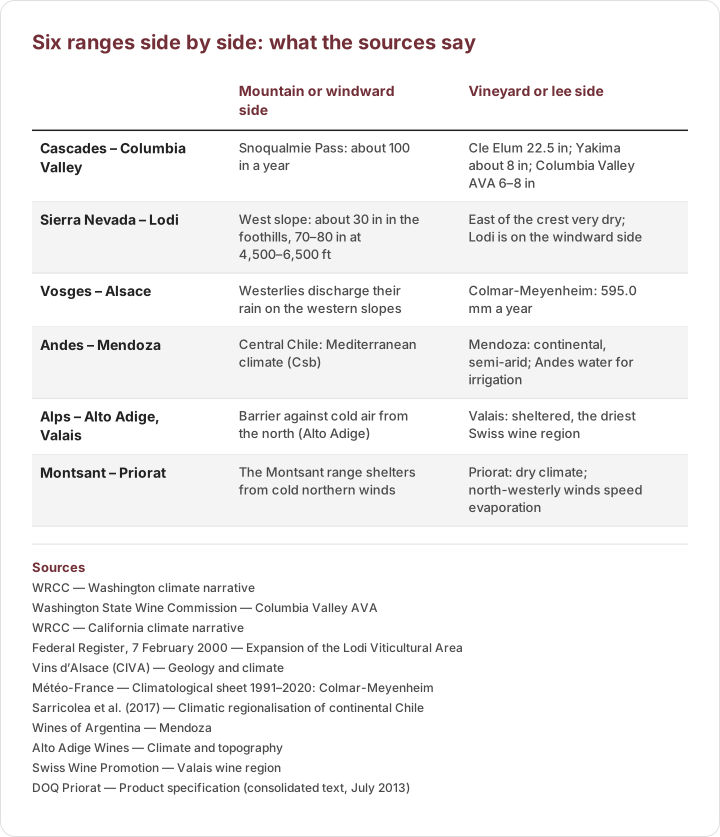
Diagram drawn from sourced data
Only statements and figures from the cited sources. Nothing is filled in where no figure has been checked: there is no rainfall figure here for the Priorat, the Andes or the Alps.
| Mountain or windward side | Vineyard or lee side | |
|---|---|---|
| Cascades – Columbia Valley | Snoqualmie Pass: about 100 in a year | Cle Elum 22.5 in; Yakima about 8 in; Columbia Valley AVA 6–8 in |
| Sierra Nevada – Lodi | West slope: about 30 in in the foothills, 70–80 in at 4,500–6,500 ft | East of the crest very dry; Lodi is on the windward side |
| Vosges – Alsace | Westerlies discharge their rain on the western slopes | Colmar-Meyenheim: 595.0 mm a year |
| Andes – Mendoza | Central Chile: Mediterranean climate (Csb) | Mendoza: continental, semi-arid; Andes water for irrigation |
| Alps – Alto Adige, Valais | Barrier against cold air from the north (Alto Adige) | Valais: sheltered, the driest Swiss wine region |
| Montsant – Priorat | The Montsant range shelters from cold northern winds | Priorat: dry climate; north-westerly winds speed evaporation |
Sources
- WRCC — Washington climate narrative
- Washington State Wine Commission — Columbia Valley AVA
- WRCC — California climate narrative
- Federal Register, 7 February 2000 — Expansion of the Lodi Viticultural Area
- Vins d’Alsace (CIVA) — Geology and climate
- Météo-France — Climatological sheet 1991–2020: Colmar-Meyenheim
- Sarricolea et al. (2017) — Climatic regionalisation of continental Chile
- Wines of Argentina — Mendoza
- Alto Adige Wines — Climate and topography
- Swiss Wine Promotion — Valais wine region
- DOQ Priorat — Product specification (consolidated text, July 2013)
Exercise 1: reading a transect
[Question]
Use the WRCC figures to explain how the Cascades produce a rain shadow over the Columbia Valley, and say why irrigation is needed there.
[Model answer]
Moist air is forced up the western side of the Cascades, cools and releases precipitation: Snoqualmie Pass, near the crest, averages about 100 in a year. After the crest the air descends and warms, cloud dissipates, and precipitation falls with distance from the summit: 22.5 in at Cle Elum and about 8 in at Yakima. The Columbia Valley AVA lies in this shadow with 6–8 in a year on average, so, as the Washington State Wine Commission states, irrigation is required.
[Mark scheme (6 marks)]
• Describes lifting, cooling and precipitation on the windward side, with the Snoqualmie Pass figure (2 marks)
• Describes descent, warming and the fall in precipitation with distance from the crest, with the Cle Elum and Yakima figures (2 marks)
• Links the 6–8 in average to the need for irrigation (2 marks)
Exercise 2: is Lodi in a rain shadow?
[Question]
A brochure says: "Lodi's dry climate comes from the Sierra Nevada rain shadow." Assess the claim using the sources in this article.
[Model answer]
Lodi lies on the windward, western side of the Sierra Nevada, not in its lee. According to the WRCC, the west slope receives heavy precipitation, from about 30 in in the foothill zone to 70–80 in at 4,500–6,500 ft, while the very dry ground lies east of the crest. The 1937 soil survey quoted in the Federal Register gives 18.26 in at Lodi and 24.03 in at Valley Springs in the foothills: rain rises with the ground, as in orographic lifting. The sources do not support the claim; Lodi shows a windward gradient, and the rain shadow lies east of the crest.
[Mark scheme (6 marks)]
• Places Lodi on the windward side and the rain shadow east of the crest (2 marks)
• Uses the west-slope figures from the WRCC (2 marks)
• Uses the Lodi and Valley Springs figures and names the date of the survey (2 marks)
Windward side
- Air is forced up the slope
- It cools and vapour condenses into cloud
- Rain or snow falls on the higher ground
Lee side
- Air descends and warms
- Cloud dissipates
- Precipitation is lower: a rain shadow
Vineyard
- Rain alone does not supply the water
- Mountain water is used for irrigation
- Read the station and period behind any figure
Frequently asked questions
What is a rain shadow?
A rain shadow is an area of reduced precipitation on the lee side of a mountain barrier. Air that rose and cooled on the windward side descends on the lee side, where it warms and cloud dissipates.
How dry is the Columbia Valley in Washington?
The Washington State Wine Commission places the Columbia Valley AVA in the rain shadow of the Cascades, with 6–8 in of precipitation a year on average, and says irrigation is required. The WRCC gives Yakima about 8 in, against about 100 in at Snoqualmie Pass near the crest.
Is Lodi in the rain shadow of the Sierra Nevada?
No. Lodi lies on the windward, western side, where rainfall rises with elevation: 18.26 in at Lodi and 24.03 in at Valley Springs in the 1937 soil survey. The rain shadow lies east of the crest.
Sources
- NOAA National Weather Service — Glossary: Orographic lift
- NOAA National Weather Service — Glossary: Rain shadow
- American Meteorological Society — Glossary of Meteorology: Rain shadow
- American Meteorological Society — Glossary of Meteorology: Foehn
- Snow Cover Trends in the Chilean Andes (Remote Sensing, 2025)
- Sarricolea et al. (2017) — Climatic regionalisation of continental Chile
- Wines of Argentina — Mendoza
- Météo-France — Climatological sheet 1991–2020: Colmar-Meyenheim
- Météo-France — Climatological sheet 1991–2020: Paris-Montsouris
- Vins d’Alsace (CIVA) — Geology and climate
- WRCC — Washington climate narrative
- Washington State Wine Commission — Columbia Valley AVA
- WRCC — California climate narrative
- Federal Register, 7 February 2000 — Expansion of the Lodi Viticultural Area
- Alto Adige Wines — Climate and topography
- Swiss Wine Promotion — Valais wine region
- DOQ Priorat — Product specification (consolidated text, July 2013)