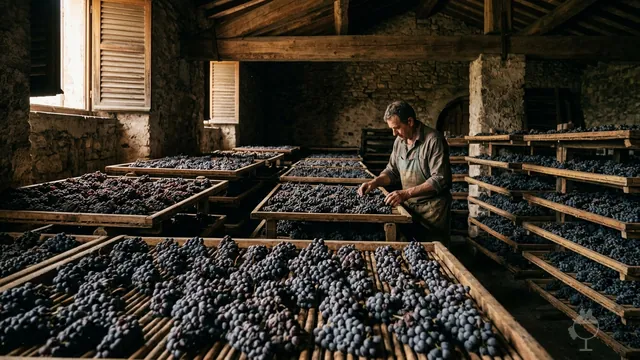

Two places for the second fermentation
Both methods begin with a still base wine and make it sparkle through a second alcoholic fermentation. The yeast turns sugar into alcohol and carbon dioxide, and because the vessel is closed, the gas stays dissolved in the wine. What separates the two methods is the vessel. In the traditional method the second fermentation takes place in the very bottle that will be sold. In the tank method, known as the Martinotti or Charmat method, it takes place in a large sealed pressure tank called an autoclave, and the finished wine is then bottled.
That single choice decides how long the wine stays in contact with its yeast, how much work each bottle needs and which aromas come forward. It is a difference of purpose rather than a ranking: one method leaves the wine on its yeast inside the bottle, the other is designed to keep the grape's own fruit and flowers in front.

 AI
·
Gauges on a steel tank
Image: Maison Apéro (generated image) · Maison Apéro original
How each method works, step by step
In the traditional method, the base wine is bottled with sugar and yeast and sealed. The second fermentation takes place in each bottle, and the spent yeast, the lees, stays inside. The bottles are then riddled so that the lees slide into the neck, and the lees are removed by disgorging. Commission Delegated Regulation (EU) 2019/33 allows the term 'traditional method' only when the wine has stayed on its lees without interruption for at least 9 months in the same undertaking, counted from when the cuvée was made up, and has been separated from them by disgorging. Franciacorta in Lombardy is one wine made this way.
In the tank method, the second fermentation takes place in the autoclave. For Prosecco DOC, it lasts at least 30 days; the temperature is then lowered to end the fermentation, leaving some residual sugar. The wine is then bottled. Because the second fermentation did not take place in the bottle, there are no lees in it to riddle or disgorge.
Asti and Moscato d'Asti are a different case. They too are usually made in pressure tanks, but from a single fermentation of grape must that is stopped while sugar remains, not from a second fermentation of a finished base wine.
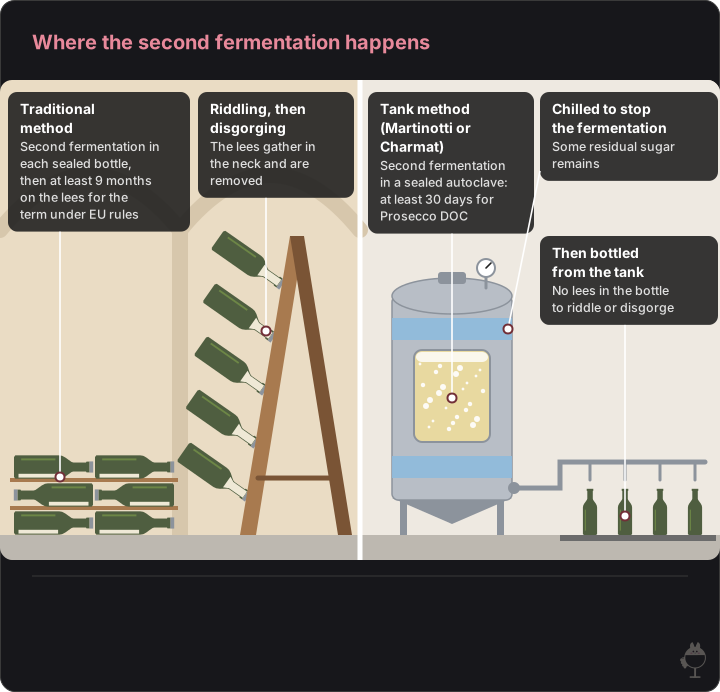
Left, the traditional method: bottles resting on their lees, then neck-down in a riddling rack so the lees can be disgorged. Right, the tank method: one sealed autoclave serves the whole batch before bottling. The minimum times come from EU labelling rules and from the Prosecco DOC consortium. Shapes and colours are illustrative.
Read the figure as text
- Traditional method — Second fermentation in each sealed bottle, then at least 9 months on the lees for the term under EU rules
- Riddling, then disgorging — The lees gather in the neck and are removed
- Tank method (Martinotti or Charmat) — Second fermentation in a sealed autoclave: at least 30 days for Prosecco DOC
- Chilled to stop the fermentation — Some residual sugar remains
- Then bottled from the tank — No lees in the bottle to riddle or disgorge
Martinotti, Charmat and the two names
The tank method was patented in 1895 by Federico Martinotti, who directed the experimental oenology institute in Asti, in Piedmont. The Frenchman Eugène Charmat later patented pressurised tanks for the process in the early twentieth century, and the method is now most widely known by his name. In Italy it is usually called the metodo Martinotti.
Prosecco sparkling wines are made by this Italian method in large autoclaves, as a way to preserve the aromas of the grape.
What time on the lees changes
While a traditional-method wine rests on its lees, the dead yeast cells slowly break down, a process called autolysis. Autolysis releases amino acids, peptides, mannoproteins and other cell components into the wine, and these influence both its aroma and its foam (review by Alexandre and Guilloux-Benatier, 2006). These changes take time, which is why the length of lees contact matters.
The tank method pursues a different goal. It is meant to preserve the aromas of the grape and give a fruity, floral wine that is fresh on the palate. Prosecco DOC is made mainly from the Glera grape, and the method is meant to keep that grape's character in front rather than to add the marks of long lees ageing.
Neither method is a guarantee of quality. The vessel sets the framework, but the base wine and how long the producer chooses to wait shape the result as well.
Pressure, and the bubbles in your glass
EU law sorts these wines by the pressure of dissolved carbon dioxide in the closed container at 20 °C. Regulation (EU) No 1308/2013 requires at least 3 bar for sparkling wine and at least 3.5 bar for quality sparkling wine, with the gas coming only from fermentation; semi-sparkling wine lies between 1 and 2.5 bar. These categories apply whichever method made the bubbles, and Prosecco, for example, is made both as spumante and as frizzante.
The bubbles you see are not a reliable test of the method. Research reviewed by Liger-Belair (2005) shows that in the glass, bubbles form mainly on tiny particles stuck to the glass wall, such as cellulose fibres, and grow as they rise by taking in dissolved carbon dioxide. The glass and how it was cleaned and dried therefore change the stream of bubbles, so read the label rather than judging the method by the bead.
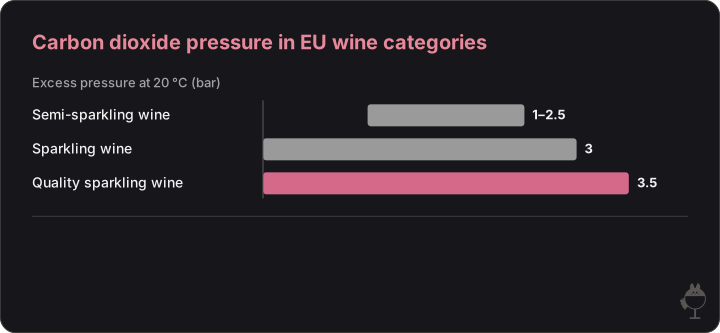
For semi-sparkling wine the bar shows the permitted range; for sparkling and quality sparkling wine it shows the legal minimum, measured in the closed container. Both the traditional and the tank method can make wines in these categories.
Read the figure as text
Excess pressure at 20 °C (bar)
- Semi-sparkling wine: 1–2.5 bar
- Sparkling wine: 3 bar
- Quality sparkling wine: 3.5 bar
Work, time and what the label tells you
The two methods also differ in labour and cellar time. In the traditional method every bottle is fermented, riddled and disgorged on its own, and the wine must stay on its lees for at least 9 months to carry the term. In the tank method a whole tank is fermented together and then bottled, and for Prosecco DOC the second fermentation lasts at least 30 days. The result is a lighter, fresher and younger wine.
On a label, 'traditional method', 'classical method' and their translations, such as 'méthode traditionnelle' or 'metodo classico', point to second fermentation in the bottle under the EU conditions above. When no such term appears, the appellation's own rules and descriptions are the next place to look: Prosecco, for instance, is made in autoclaves.
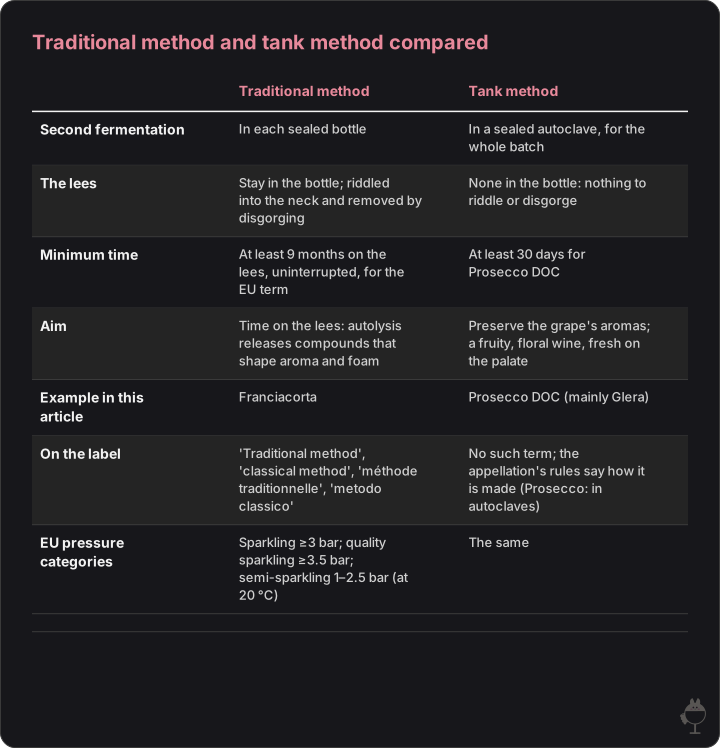
Where the second fermentation happens, what becomes of the lees, the minimum times in the rules cited here, the aim of each method and what the label says. The EU pressure categories apply whichever method made the bubbles.
Read the figure as text
| Traditional method | Tank method | |
|---|---|---|
| Second fermentation | In each sealed bottle | In a sealed autoclave, for the whole batch |
| The lees | Stay in the bottle; riddled into the neck and removed by disgorging | None in the bottle: nothing to riddle or disgorge |
| Minimum time | At least 9 months on the lees, uninterrupted, for the EU term | At least 30 days for Prosecco DOC |
| Aim | Time on the lees: autolysis releases compounds that shape aroma and foam | Preserve the grape's aromas; a fruity, floral wine, fresh on the palate |
| Example in this article | Franciacorta | Prosecco DOC (mainly Glera) |
| On the label | 'Traditional method', 'classical method', 'méthode traditionnelle', 'metodo classico' | No such term; the appellation's rules say how it is made (Prosecco: in autoclaves) |
| EU pressure categories | Sparkling ≥3 bar; quality sparkling ≥3.5 bar; semi-sparkling 1–2.5 bar (at 20 °C) | The same |
Exercise: matching the method to the base wine
This is a Maison practice question for self-study, not an official examination question.
[Question]
A producer has two base wines: one from a grape valued for fresh, fruity and floral aromas, and one neutral, high-acid base intended for long ageing. Which second-fermentation method suits each, and why? Refer to where the second fermentation takes place, the time on the lees and the aromas you would expect.
[Model answer]
The aromatic base suits the tank method. Its second fermentation takes place in a sealed autoclave (for Prosecco DOC, at least 30 days), after which the wine is chilled and bottled; the method aims to keep the grape's fruity and floral aromas in front. The neutral base suits the traditional method. Its second fermentation takes place in each bottle, the wine stays on its lees (at least 9 months for the term 'traditional method' under EU rules), and autolysis gradually adds yeast-derived character and influences the foam before the bottles are riddled and disgorged.
[Mark scheme (10 points)]
1. States where the second fermentation takes place in each method (3 points).
2. Gives the minimum times correctly and says who sets them (3 points).
3. Links lees contact and autolysis to aroma and foam, and the tank method to preserving grape aroma (4 points).
Where the second fermentation happens
- Traditional method: in each bottle
- Tank method: in one sealed autoclave
Time with the yeast
- At least 9 months on the lees for the term 'traditional method'
- At least 30 days of second fermentation for Prosecco DOC
What comes forward
- Yeast-derived character from autolysis, and changes to the foam
- The grape's fruity and floral aromas, kept fresh
Frequently asked questions
What is the difference between the traditional method and the tank method?
The vessel used for the second fermentation. In the traditional method it happens in each bottle, and EU rules require at least 9 months on the lees and disgorging for the term. In the tank method it happens in a sealed pressure tank (autoclave), and the wine is then bottled.
Who invented the tank method?
Federico Martinotti, who directed the experimental oenology institute in Asti, patented it in 1895. The Frenchman Eugène Charmat later patented pressurised tanks for the process in the early twentieth century, which is why the method carries both names.
How long does Prosecco spend in the tank?
For Prosecco DOC, the second fermentation in autoclaves lasts at least 30 days. The temperature is then lowered to stop the fermentation, leaving some residual sugar.
Is Asti made the same way as Prosecco?
Not quite. Asti and Moscato d'Asti are usually made in pressure tanks too, but from a single fermentation of grape must that is stopped while sugar remains, not from a second fermentation of a finished base wine.
Sources
- Consorzio Tutela Prosecco DOC — Winemaking (second fermentation in autoclaves, Martinotti method)
- Consorzio Tutela Prosecco DOC — Production regulation (Glera as the main grape)
- EUR-Lex — Commission Delegated Regulation (EU) 2019/33 (terms for production methods, including 'traditional method')
- EUR-Lex — Regulation (EU) No 1308/2013, Annex VII Part II (categories of grapevine products: sparkling, quality sparkling and semi-sparkling wine)
- Consorzio Franciacorta — Metodo Classico Franciacorta: metodo e fasi
- Club Oenologique — How the Martinotti method took Prosecco Superiore to the next level
- Wikipedia — Asti wine (single fermentation in pressurised tanks)
- Alexandre H., Guilloux-Benatier M. (2006). Yeast autolysis in sparkling wine – a review. Australian Journal of Grape and Wine Research 12(2): 119–127
- Liger-Belair G. (2005). The physics and chemistry behind the bubbling properties of champagne and sparkling wines: a state-of-the-art review. Journal of Agricultural and Food Chemistry 53(8): 2788–2802