

Where Sherry comes from and its main styles
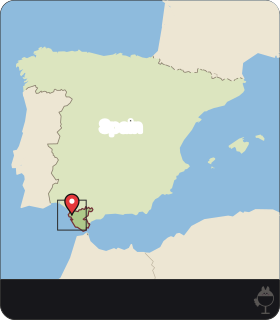
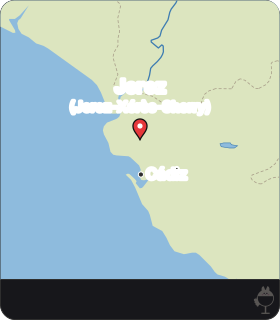
The Jerez-Xérès-Sherry PDO lies in Andalusia, in southern Spain. Until October 2022 the final ageing had to take place in Jerez de la Frontera, El Puerto de Santa María or Sanlúcar de Barrameda; a change to the rules then extended the ageing zone to the whole production zone, which also includes Trebujena, Lebrija, Chipiona, Rota, Chiclana and Puerto Real. Manzanilla, aged in Sanlúcar, has its own designation. Palomino is the main grape.
The rules set the style by alcohol and by how the wine ages. Fino is 15 to 17 per cent vol. and aged exclusively biologically; Oloroso is 17 to 22 per cent vol. and aged exclusively oxidatively. The styles between them, such as Amontillado, combine the two.
Albariza and the Atlantic setting
The vineyards are planted largely on albariza, a calcareous soil of marine origin made mainly of calcium carbonate, clay and silica. It acts like a sponge: it absorbs winter rain, and in the hot summer its surface dries over and keeps the water below for the vine roots.
Flor and biological ageing
Flor is a biofilm of Saccharomyces cerevisiae flor strains that floats on the wine. When nitrogen and fermentable carbon are used up, the yeast switches to ethanol and glycerol as its main carbon sources, oxidising ethanol to acetaldehyde. Over the ageing of a Fino, glycerol and volatile acidity fall while acetaldehyde rises.
The film is generally understood to limit the wine’s direct contact with air, and a study of Fino ageing describes acetaldehyde as mainly responsible for the typical flavour of these wines. The rules class Fino as exclusively biological ageing, in the 15 to 17 per cent vol. range.

 AI
·
White film on golden wine
Image: Maison Apéro (generated image) · Maison Apéro original
Oxidative ageing, Amontillado and Palo Cortado
Oloroso is the reference for oxidative ageing: 17 to 22 per cent vol. and, under the rules, exclusively oxidative. Without a flor film, the wine ages in contact with air. Under the rules, Oloroso sits in a higher alcohol range than Fino, the style aged under flor.
Amontillado follows a biological stage with an oxidative one, so it carries marks of both routes. Palo Cortado is defined as a wine of predominantly oxidative ageing after the initial veil of flor has disappeared.
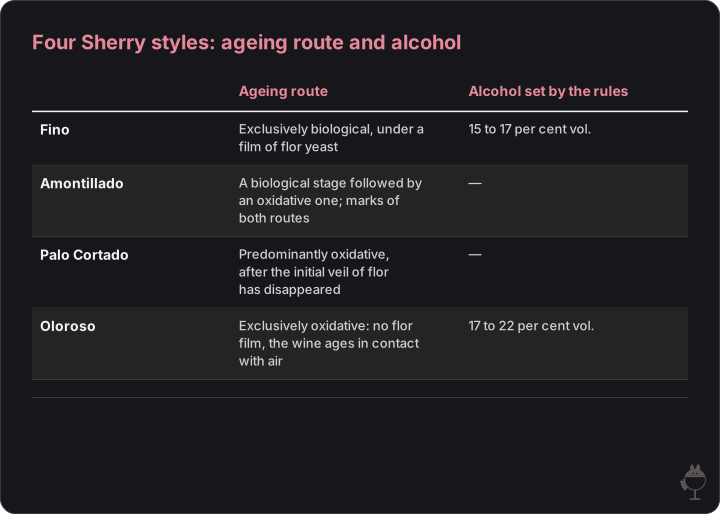
How the rules define each style by its ageing, and the alcohol ranges they set for Fino and Oloroso. The flor film is a biofilm of yeast that floats on the wine and limits its direct contact with air. An empty cell means this article gives no figure.
Read the figure as text
| Ageing route | Alcohol set by the rules | |
|---|---|---|
| Fino | Exclusively biological, under a film of flor yeast | 15 to 17 per cent vol. |
| Amontillado | A biological stage followed by an oxidative one; marks of both routes | — |
| Palo Cortado | Predominantly oxidative, after the initial veil of flor has disappeared | — |
| Oloroso | Exclusively oxidative: no flor film, the wine ages in contact with air | 17 to 22 per cent vol. |
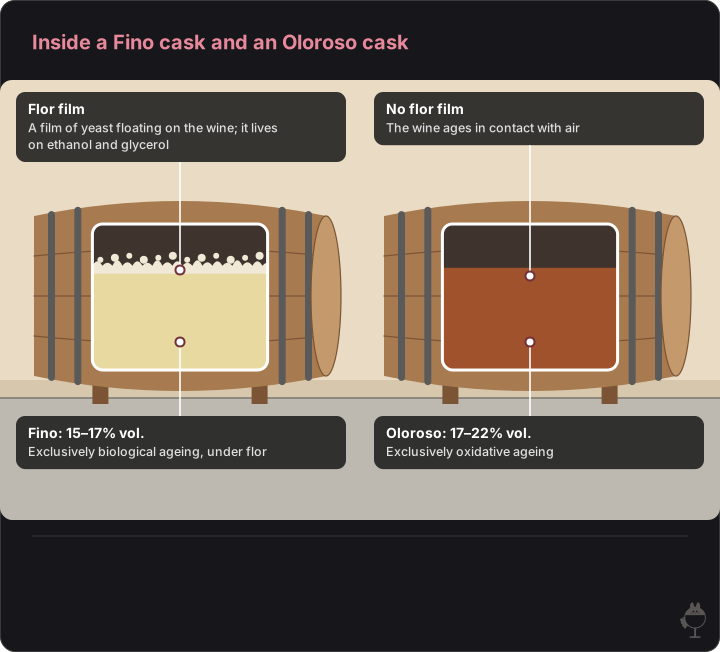
Two casks drawn open. Fino ages under a floating film of flor yeast; Oloroso has no film and ages in contact with air. Alcohol ranges and ageing types follow the rules, the film follows the review of flor yeast. Shapes, colours and fill levels are illustrative; no film thickness is given.
Read the figure as text
- Flor film — A film of yeast floating on the wine; it lives on ethanol and glycerol
- Fino: 15–17% vol. — Exclusively biological ageing, under flor
- No flor film — The wine ages in contact with air
- Oloroso: 17–22% vol. — Exclusively oxidative ageing
The solera system: criaderas, saca and rocío
Criaderas y solera is a dynamic system of periodic extractions (sacas) of part of the wine in each cask of a scale, topped up (rocíos) with wine from a younger scale. A scale is a row of casks at a homogeneous level of ageing. The oldest scale, from which wine is drawn for shipment or blending, is the solera; the intermediate scales are the criaderas. Before entering the system, wine of a single vintage may spend a period of static ageing, unblended with other wines, called sobretablas.
The saca is capped: a registered bodega may never dispatch more than 40 per cent of the stock of each ageing type at the start of the campaign. Because every rocío mixes wines of different ages, the wine drawn from the solera is a blend of ages rather than the wine of a single year.
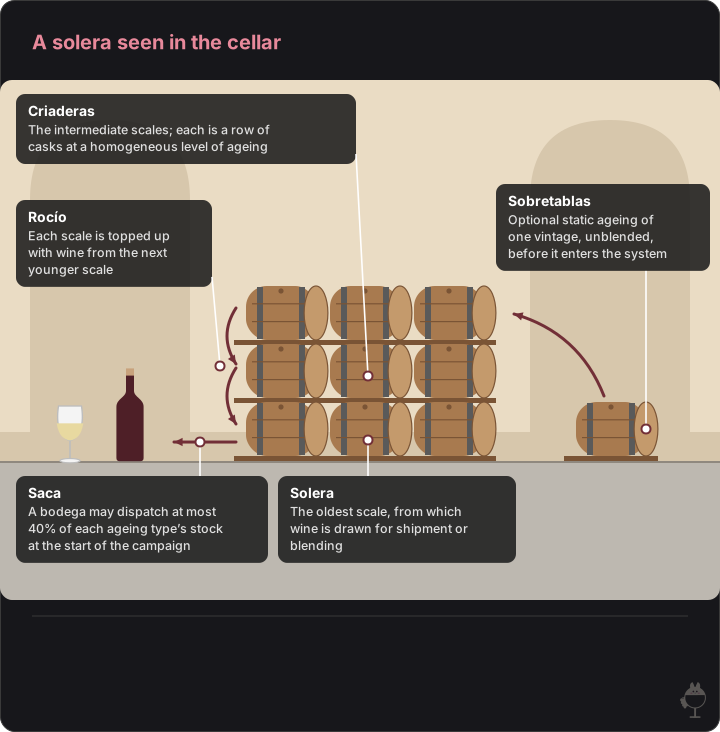
Wine moves from younger to older scales and leaves from the solera. The scales are drawn as stacked rows and their number is illustrative: a scale is defined by its level of ageing, not by where it stands. Shapes and colours are illustrative.
Read the figure as text
- Criaderas — The intermediate scales; each is a row of casks at a homogeneous level of ageing
- Sobretablas — Optional static ageing of one vintage, unblended, before it enters the system
- Rocío — Each scale is topped up with wine from the next younger scale
- Solera — The oldest scale, from which wine is drawn for shipment or blending
- Saca — A bodega may dispatch at most 40% of each ageing type’s stock at the start of the campaign
Reading the glass, and what is left out
In the glass, a Fino is usually described as pale and dry with yeasty and almond notes, while an Oloroso is darker, with nutty notes. Treat these as typical tasting descriptions, not rules of the appellation.
Biological ageing
- Wine brought into the Fino range, 15 to 17% vol.
- Flor film forms on the surface
- Pale, dry wine with almond and yeast notes
Oxidative ageing
- Wine brought into the Oloroso range, 17 to 22% vol.
- No flor film; the wine ages in contact with air
- Darker wine with nutty notes
The solera
- Saca: part of the oldest scale is drawn
- Rocío: refilled from the younger scale
- Each rocío blends wines of different ages
Frequently asked questions
What is flor?
Flor, or velum, is a film of Saccharomyces cerevisiae flor yeast that forms on the surface of the wine. Without fermentable sugars the yeast lives on ethanol and glycerol and produces acetaldehyde. Fino is aged exclusively under flor.
How does a solera work, and how much can be sold each year?
Part of the wine in each cask of a scale is drawn periodically (saca), and the casks are topped up with wine from a younger scale (rocío). A bodega may never dispatch more than 40 per cent of the stock of each ageing type at the start of the campaign.
What separates Fino from Oloroso?
The rules give Fino 15 to 17 per cent vol. and exclusively biological ageing, and Oloroso 17 to 22 per cent vol. and exclusively oxidative ageing. Fino ages under flor; Oloroso ages in contact with air.
Sources
- Sherry Regulatory Council — Jerez-Xérès-Sherry PDO specification (updated 2024)
- Sherry Wines (Regulatory Council) — What is Albariza? The Soil that Defines Sherry
- Legras et al. (2016). Flor Yeast: New Perspectives Beyond Wine Aging. Frontiers in Microbiology 7:503
- Martínez et al. (1998). Metabolism of Saccharomyces cerevisiae Flor Yeasts During Fermentation and Biological Aging of Fino Sherry: By-products and Aroma Compounds. American Journal of Enology and Viticulture 49(3), 240–250
- Sherry Regulatory Council — Most of the specification changes approved by the Council officially enter into force (October 2022)


