Maison Media

Mount Pleasant Hunter Valley Semillon 2023

Updated ·

Mount Pleasant Hunter Valley Semillon 2023 is a white wine from Hunter Valley, Australia, made from Semillon. In Maison Apéro’s structured tasting profile, the quality is “Very good” and the readiness for drinking is “Can drink, with potential”.

Region
Hunter Valley · Australia
Vintage
2023
Grapes
Semillon
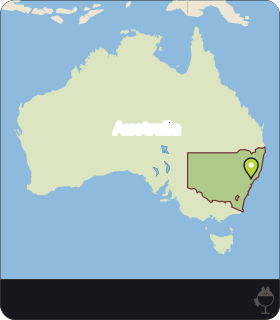
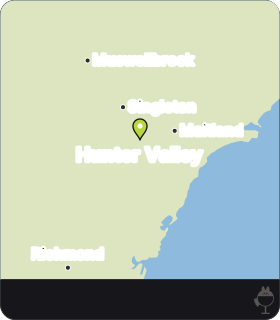
Australia: map with a pin on Hunter ValleyHunter Valley and its surroundings: map with a pin
Hunter Valley · AustraliaMap: Maison Apéro, based on Natural Earth (public domain)

About Mount Pleasant Hunter Valley Semillon 2023

What grapes is Mount Pleasant Hunter Valley Semillon 2023 made from?

Mount Pleasant Hunter Valley Semillon 2023 is made from Semillon.

Where does Mount Pleasant Hunter Valley Semillon 2023 come from?

Mount Pleasant Hunter Valley Semillon 2023 comes from Hunter Valley, Australia. It is made by Mount Pleasant.

How does Mount Pleasant Hunter Valley Semillon 2023 taste?

In Maison Apéro’s structured tasting profile, Mount Pleasant Hunter Valley Semillon 2023 is recorded with these levels — Sweetness: Dry; Acidity: High; Alcohol: Medium; Body: Light; Flavour intensity: Medium; Finish: Medium+. Aromas: Citrus fruit, Green fruit, Mineral.

When should you drink Mount Pleasant Hunter Valley Semillon 2023?

In Maison Apéro’s structured tasting profile, the readiness for drinking of Mount Pleasant Hunter Valley Semillon 2023 is “Can drink, with potential”.

Mount Pleasant is a historic winery in Australia's Hunter Valley, whose foundations were laid by Maurice O'Shea. Using Semillon harvested early during cool nights and employing traditional methods of low-temperature fermentation in stainless steel tanks without oak, it produces an iconic regional white wine characterized by pure fruit and piercing acidity.
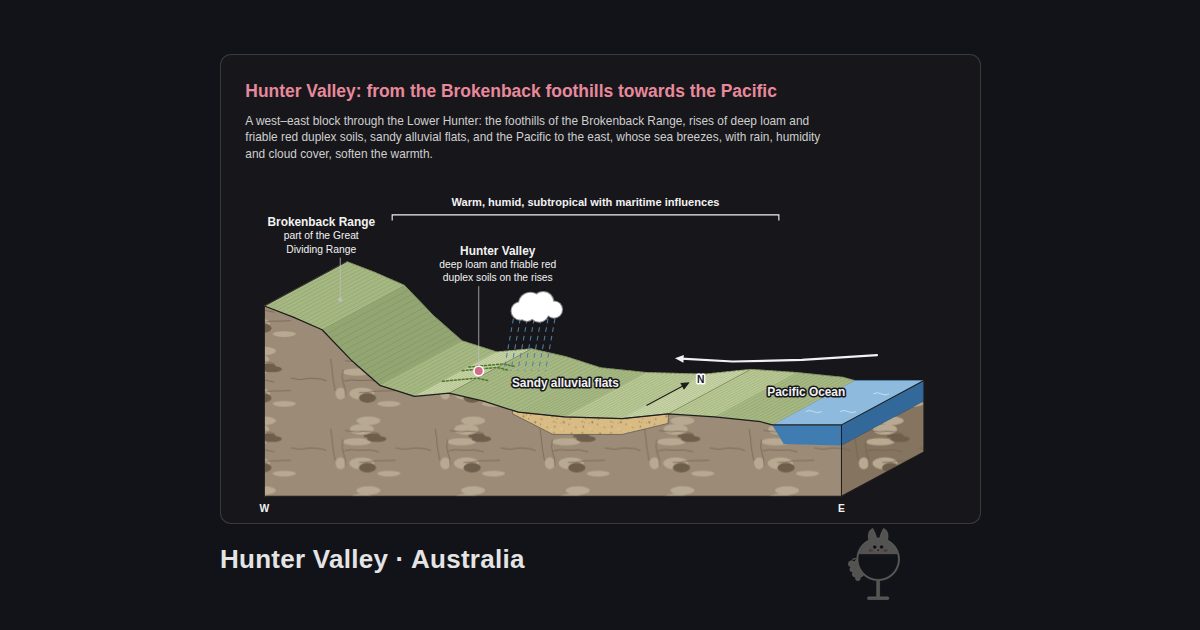
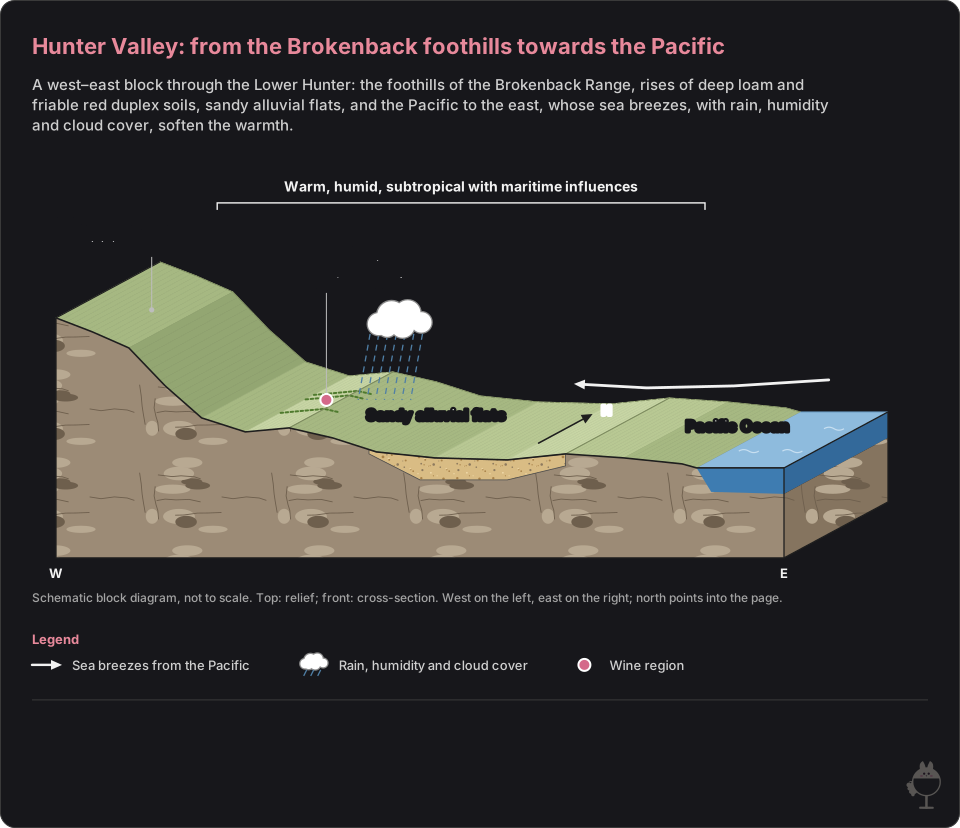
Hunter Valley, Australia. Hunter Valley: from the Brokenback foothills towards the Pacific: Brokenback Range, Hunter Valley, Sandy alluvial flats, Pacific Ocean, Warm, humid, subtropical with maritime influences
Hunter Valley · AustraliaDiagram: Maison Apéro Sources: Wine Australia, Australian Wine Discovered — Hunter Valley region sheet · Wine Australia — Hunter Valley (regions and varieties)

Sensory & terroir profile

6-Axis Radar

Acidity High Tannin Not measured Body Light Alcohol Medium Flavourintensity Medium Finish Medium+

Tannin is not part of the evaluation of a white wine, so this axis is empty.

3-Tier Aromas

● Primary (Varietal, Fruit & Flora):
Citrus fruitGreen fruitMineral

Climate & Landscape

Hunter Valley: from the Brokenback foothills towards the Pacific: Brokenback Range, Hunter Valley, Sandy alluvial flats, Pacific Ocean, Warm, humid, subtropical with maritime influences

Schematic block diagram, not to scale: the top shows the relief and the front face a cross-section, coloured by soil and rock type.

  • The Hunter Valley, north-west of Newcastle, lies in the foothills of the Brokenback Range, part of the Great Dividing Range; its climate is warm and humid, subtropical with maritime influences.
  • Rain, humidity, cloud cover and sea breezes soften the warmth. In the Lower Hunter, soils range from sandy alluvial flats to deep loam and friable red duplex soils.

Terroir at a glance

Climate
Warm, humid, subtropical with maritime influences Wine Australia, Australian Wine Discovered — Hunter Valley region sheet

Tasting review

From the review saved in Maison Apéro for this wine and vintage.

Structured tasting profile

How to read this profile: each attribute is recorded as one level on a fixed scale, for example Acidity: Low · Medium− · Medium · Medium+ · High. Attributes without a saved level are left out; nothing is estimated.

Clarity
Clear
Intensity
Pale
Color
Lemon-green
Aroma intensity
Medium−
Development
Youthful
Sweetness
Dry
Acidity
High
Alcohol
Medium
Body
Light
Flavour intensity
Medium
Finish
Medium+
Quality
Very good
Readiness for drinking
Can drink, with potential
Primary

Citrus fruit, Green fruit, Mineral

Quality markers

✓ Balance, ✓ Length, ✓ Intensity

Up to 8 aromas across all three categories, with a target of 4–5 palate flavours. Only supported descriptors are listed; absences do not count as aromas. Red check counts are not scores.

Expert commentary

Displaying a pale lemon-green hue, fresh aromas of lime and green apple rise delicately. On the palate, remarkably high acidity and a taut, light body stand out, with pure citrus fruit and flinty minerality leading into a persistent finish.

Serving and ageing guide

While in a youthful, invigorating state, it possesses further aging potential and can be enjoyed now or cellared. Vivid lime flavors can be enjoyed at present, but bottle aging will develop it into a long-lived wine acquiring complex tertiary aromas of toast, beeswax, and nuts. The optimal serving temperature is 7–10°C to highlight its piercing acidity and clean aromas, and decanting is not required. Aging of 8 to 12 years or more is anticipated. Suitable food pairings include fresh oysters, white fish carpaccio, and fried seafood with a squeeze of lemon. In terms of quality assessment, piercing high acidity, medium alcohol, and clean fruit remain in superb harmony. While aroma intensity is restrained, the flavor intensity on the palate is more clearly pronounced, forming a slender, long finish. Although aromatic complexity is limited at this stage, the wine demonstrates very high quality through its outstanding balance, length, and concentration.

Appearance

Phrases the assessment is based on

It has a clear, bright, Assessment evidence pale Assessment evidence lemon-green color.

Advanced analysis Grand

Nose

Tasting Review Example Réserve

Advanced analysis Grand

Palate

Tasting Review Example Réserve

Advanced analysis Grand

Quality

Tasting Review Example Réserve

Advanced analysis Grand

Readiness for drinking

Tasting Review Example Réserve

Advanced analysis Grand

Read Réserve and Grand sections by signing in to Maison Apéro with the corresponding plan.

Maison Apéro uses a multi-stage validation process. This tasting review is data-driven reference information created from wine information and analytical signals. Actual aromas, flavours and condition may vary by bottle, storage, service and individual perception, so it is not a definitive assessment.