The background that matters
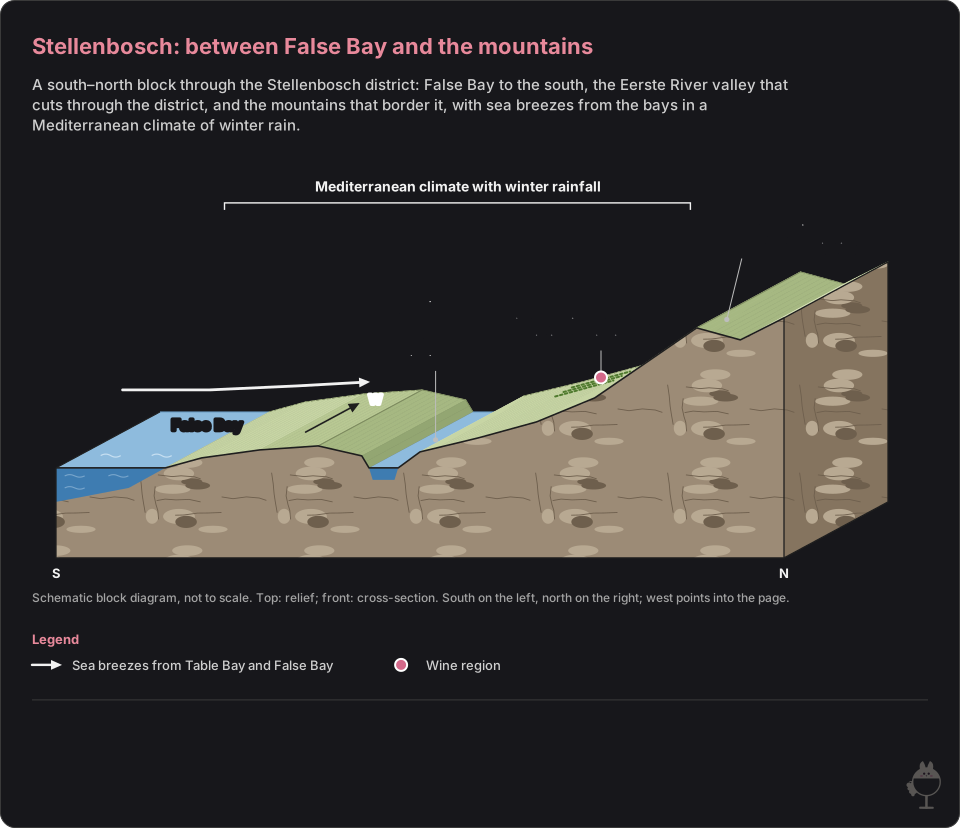
The climate is Mediterranean with winter rainfall, and varies markedly within the area, which is bordered by mountains, lies close to the ocean and is cut by the Eerste River valley. In a modelling study of February 2000, during ripening, one sea breeze developed from Table Bay late in the morning and another from False Bay later in the afternoon.
Read it alongside this wine
This wine is listed under the name Stellenbosch, not under a single vineyard, so read its review as one example from the area rather than a portrait of it. Its published profile records a dry red of deep purple colour with medium(+) acidity and tannin, high alcohol and medium(+) body, and red fruit, black fruit, spice and oak among its aroma groups. It is marked as youthful: drinkable now, with potential to develop.
Try it with the review
Find the high alcohol and the medium(+) tannin in the review, then see how the acidity is described alongside them. Write one sentence on the balance using only those recorded levels, without using ‘Stellenbosch’ or ‘Pinotage’ as the explanation.
These are learning prompts, not guaranteed tasting results. Separate the published facts from your own observations.
Sources
- Carey, Saayman, Archer, Barbeau, Wallace (2008) – Viticultural terroirs in Stellenbosch, South Africa. I. The identification of natural terroir units (J. Int. Sci. Vigne Vin / OENO One)Checked 2026-10-06
- Bonnardot & Cautenet (2009) – Mesoscale atmospheric modeling using a high horizontal grid resolution over a complex coastal terrain and a wine region of South Africa (J. Appl. Meteor. Climatol. 48)Checked 2026-10-06
- S. Afr. J. Enol. Vitic. 35(2), 2014 – Integrative effects of vine water relations and grape ripeness level of Vitis vinifera L. cv. Shiraz/Richter 99. I.Checked 2026-10-06